Download
3D Flyover
Add to list
More
12.7 km
~2 hrs 53 min
210 m
Out and Back
“A gentle island crossing from bustling pier to dazzling Atlantic sands, rich with history, moorland quiet, and sea-light.”
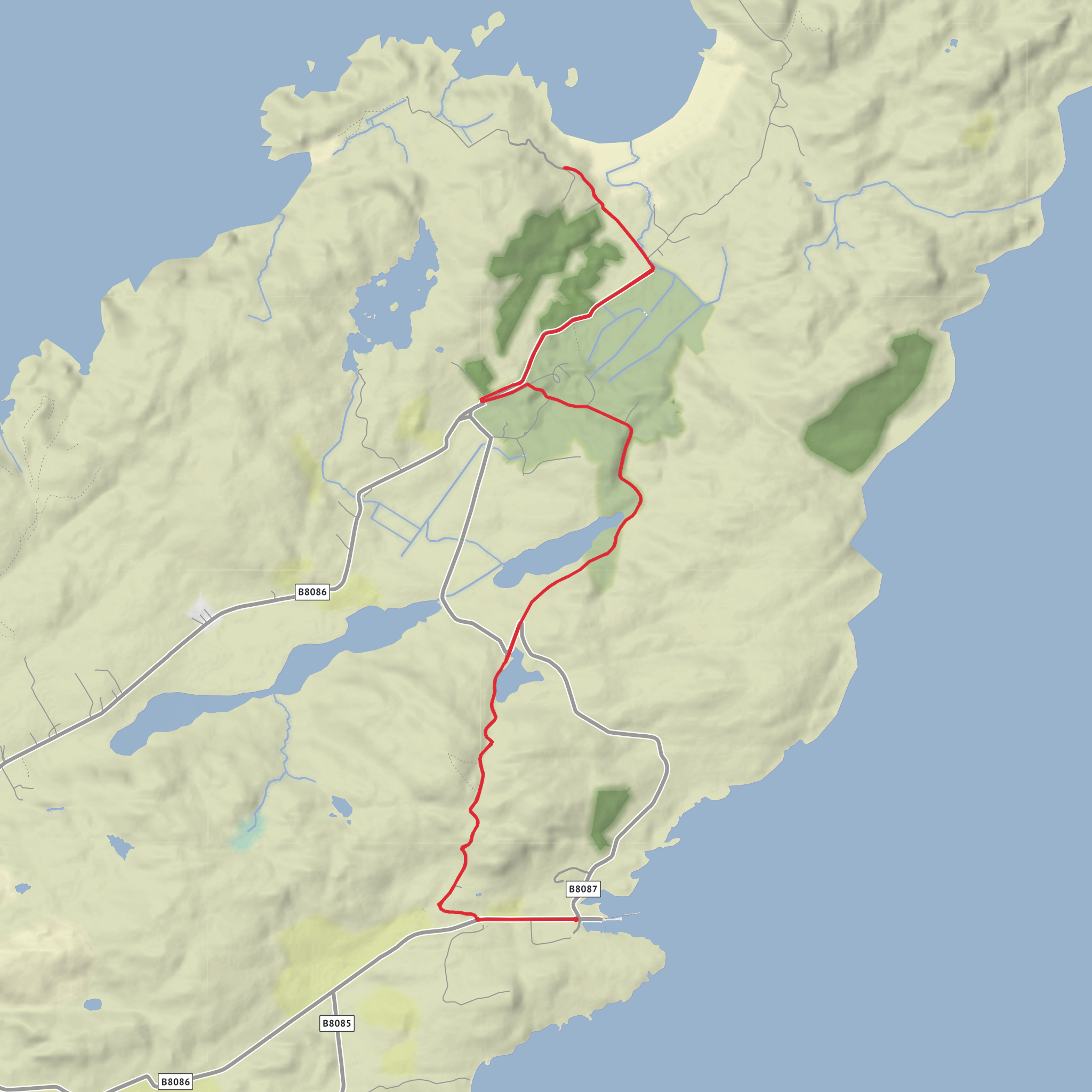
This easy cross-island walk links Colonsay’s ferry village with one of the Hebrides’ finest beaches, covering about 13 km / 8.1 miles with roughly 200 m / 656 ft of ascent. The start is best understood as Scalasaig Ferry Terminal, Scalasaig, Isle of Colonsay, Argyll PA61 7YX or the immediate village area by the pier, since Scalasaig is the island’s main settlement and port. Kiloran Bay lies on the north-west side of Colonsay beyond Colonsay House and its gardens. (britainexpress.com)
From the harbour at Scalasaig, the route heads away from the sea and crosses the island on an old inland line rather than staying on the modern road. That gives the walk a more traditional feel: quiet tracks, open moorland, low rocky rises, and broad views that gradually open toward the Atlantic side of the island. Although the overall difficulty is easy, expect a few uneven and sometimes boggier sections underfoot, especially after rain, so waterproof footwear is still a sensible choice. The climbing is gentle by Highland standards, spread across rolling ground rather than one long steep ascent. (walkhighlands.co.uk)
What the route feels like
The first part out of Scalasaig is a transition from village edge to open island interior. You leave behind the ferry activity quickly and move into a landscape of rough pasture, heather, rock outcrops, and old tracks. Colonsay is not a mountainous island—its highest ground is only around 143 m / 469 ft—so this walk is more about space, sea light, and changing views than hard climbing. On clear days, the higher points on the crossing give wide outlooks over the island and toward neighbouring Hebridean coasts. (en.wikipedia.org)
As you continue north-west, the route passes through ground shaped by long human use. This is an ancient routeway, and that sense of age suits the island well: Colonsay and nearby Oronsay have evidence of very early settlement, including Mesolithic archaeology, while later Christian and estate history are woven into the landscape around Kiloran and Colonsay House. (etheses.dur.ac.uk)
A key landmark on the crossing is Colonsay House, an 18th-century Georgian house built in 1722 and later extended, set within mature woodland that feels strikingly sheltered compared with the surrounding Hebridean moor. The house stands in a designed landscape looking north toward Kiloran Bay, and the woodland garden here is regarded as one of the finest of its kind in the UK. If access is available during your visit, this can add a worthwhile cultural stop to the walk. (parksandgardens.org)
Near the house and gardens, there is also deeper historical interest. The site includes Tobar Oran, associated with St Oran, and an early Christian cross dating to the 7th or 8th century. These details give the middle section of the walk more than scenic value; they connect the route to the island’s early religious past as well as its later estate era. (parksandgardens.org)
Kiloran Bay and the final approach
Beyond Colonsay House, the route continues to the B8086 and then on toward Kiloran Bay, the island’s best-known beach. The final approach changes character again: woodland and estate ground give way to open dunes, pale sand, and a broad Atlantic-facing bay. Depending on the exact line you take near the end, there may be a burn to cross or avoid, so it is worth checking the route carefully on HiiKER before setting out. (walkhighlands.co.uk)
Kiloran Bay is celebrated for its sweeping arc of sand and open setting. It is one of the visual highlights of Colonsay, and even hikers who are comfortable with the inland crossing often find the beach section the most memorable part of the day. If tides, weather, and energy levels allow, many walkers spend extra time exploring the sands and dunes before returning. Wind exposure can be significant here, even when the inland section feels calm. (walkhighlands.co.uk)
Nature and wildlife
This walk is excellent for hikers interested in Hebridean wildlife. Around Scalasaig and across the moorland sections, look for seabirds overhead and smaller ground-nesting or moorland species in season. Around Kiloran and the wider island, birdlife can include choughs, while the cliffs farther west support seab
Comments and Reviews
User comments, reviews and discussions about the Scalasaig to Kiloran Bay, Scotland.
average rating out of 5
0 rating(s)