Download
3D Flyover
Add to list
More
13.1 km
~2 hrs 48 min
116 m
Out and Back
“A wild shoreline scramble to Mull’s volcanic arches, where history, surf and solitude reward careful walkers.”
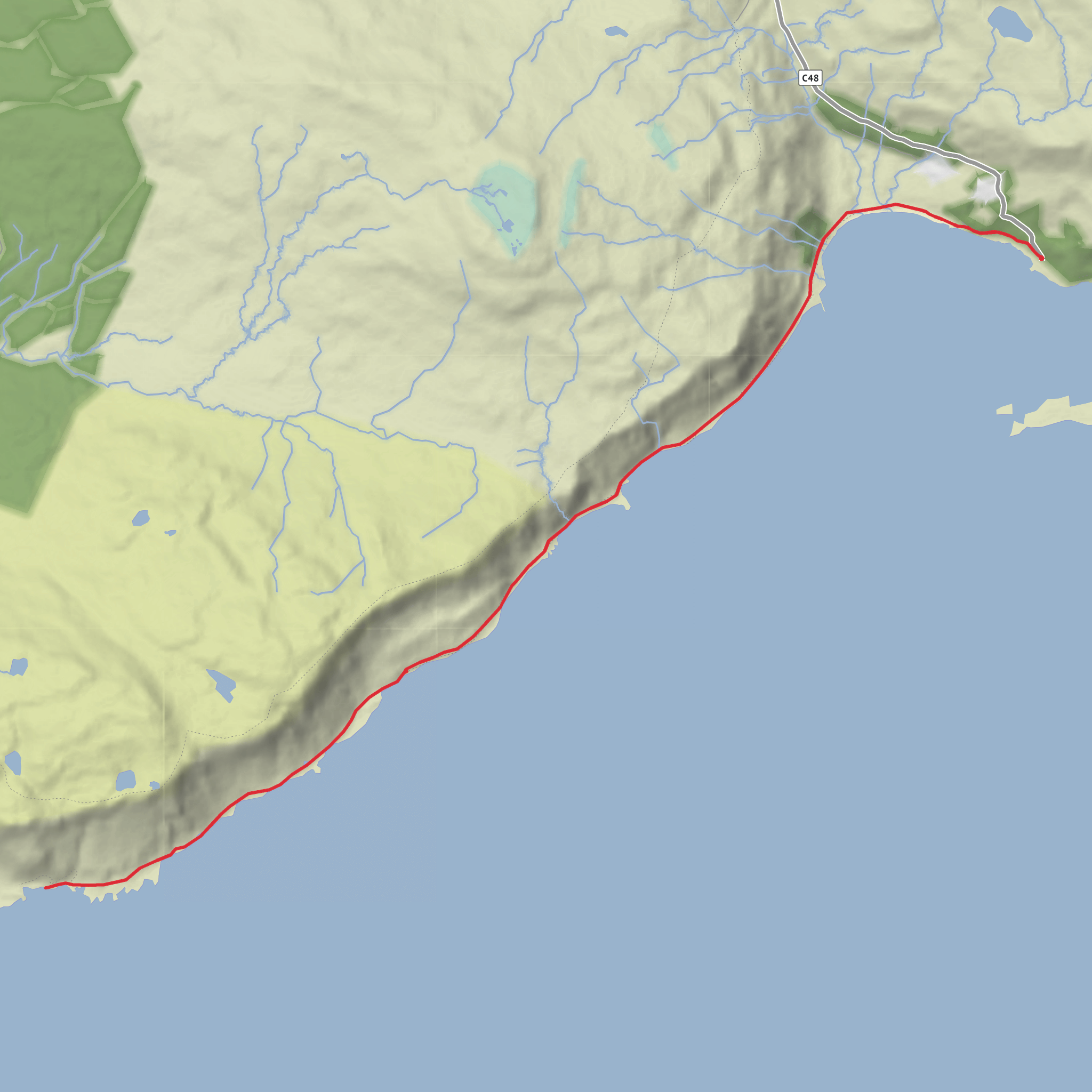
This coastal outing on the Ross of Mull is often described as an easy walk on paper because the total ascent is only around 100 metres / 330 feet, but that rating can be misleading. Over roughly 13 km / 8 miles return, the challenge comes less from climbing and more from the terrain: boulders, uneven shore sections, wet rock, muddy stretches, and short exposed traverses beneath cliffs. Hikers should plan for a slower pace than the distance suggests and allow plenty of time for careful foot placement. The route begins near Carsaig Pier, Carsaig Bay, Isle of Mull, PA70 6HD, reached by a minor single-track road branching off the A849 near Pennyghael. (outaboutscotland.com)
From the start near the pier, the route heads west along the back of the bay before joining the stony shoreline. Early on, the walking is straightforward enough, with broad views across Carsaig Bay and out toward the islands and sea lochs of the Inner Hebrides. On clear days, the southern horizon can open toward Jura, Colonsay and Islay, while behind you the Ross of Mull feels remote and sparsely settled. The old pier itself is part of that sense of isolation; Carsaig Pier dates to the mid-19th century, built in 1850, when coastal piers were vital links for transport and supplies in island communities. (visitmull.uk)
Terrain and route character
The path soon becomes much rougher than a typical low-level coastal walk. Sections alternate between faint trods, rocky ledges, grassy shelves and stretches of boulder-hopping. After rain, the route can be slippery, and at high water some shoreline sections may feel more awkward. Good boots are far more useful here than lightweight town shoes, even in dry weather. Because the line of travel is not always obvious on the ground, carrying the route in HiiKER is a sensible way to stay oriented, especially where the path fades into rock or grass. (walkhighlands.co.uk)
One of the first major landmarks is Nun’s Cave, reached partway along the outward leg. This cave is one of the most memorable historical features on the walk, with religious carvings traditionally said to date back to the 6th century. It adds a strong sense of human history to a landscape otherwise dominated by sea, cliff and volcanic stone. The cave also makes a natural pause point before the rougher continuation toward Malcolm’s Point. (isle-of-mull.net)
Beyond the cave, the route continues under increasingly dramatic cliffs. The coast here is geologically remarkable: the towering rock faces around Carsaig were formed during volcanic activity on Mull around 60 million years ago, and the cliffs near Malcolm’s Point include striking basalt formations and sedimentary layers that help explain the island’s ancient volcanic history. This is one of the reasons the walk is so well known: it is not just scenic, but one of Mull’s standout geology outings. (isle-of-mull.net)
Carsaig Arches and Malcolm’s Point
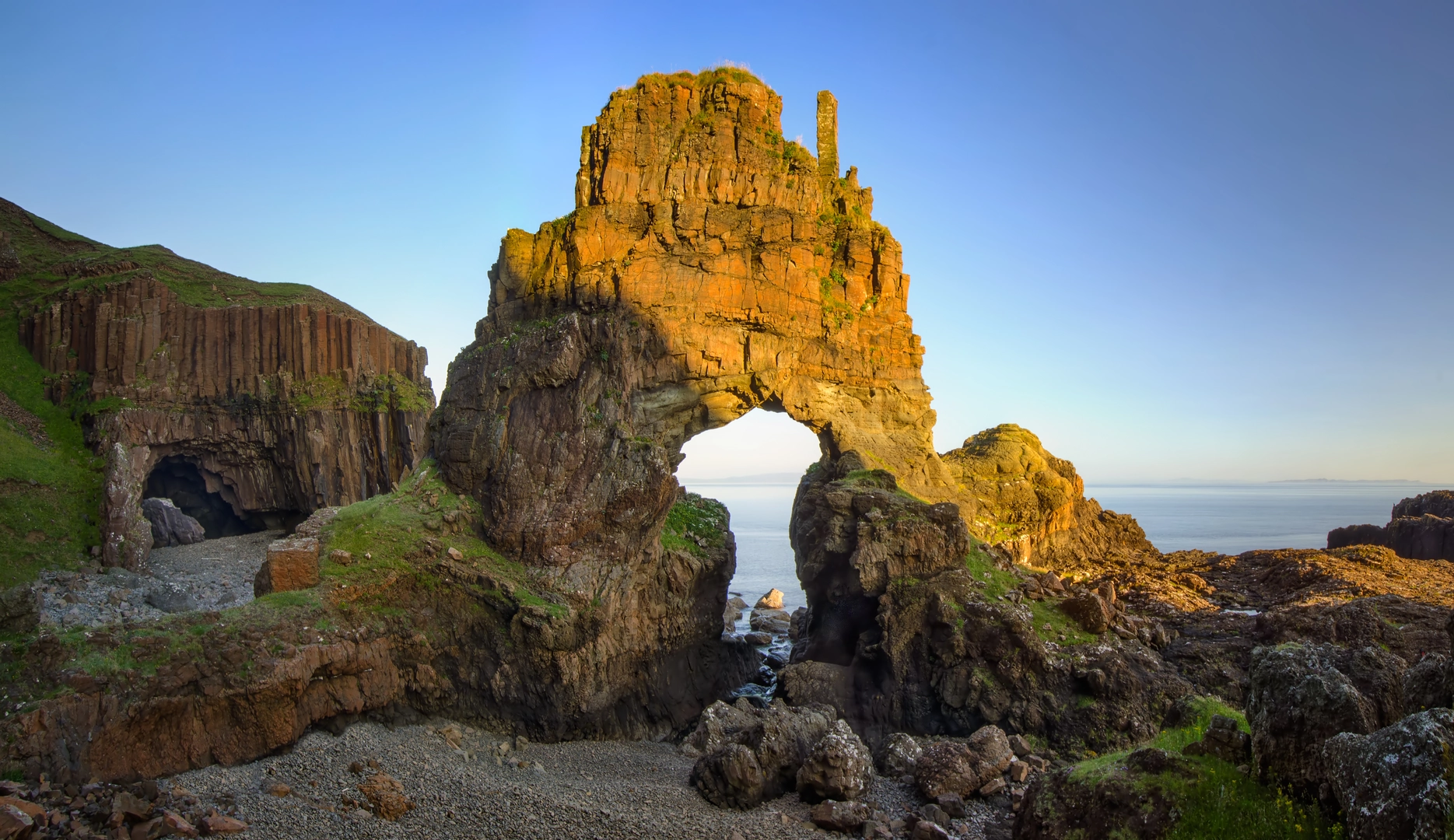
As you approach Malcolm’s Point, the cliffs become the main spectacle. The Carsaig Arches sit below the point at the base of the cliffs and are the signature feature of the walk: large natural rock arches cut into the coastal basalt by relentless marine erosion. Reaching them usually takes around 6.5 km / 4 miles from the start, though the rough ground means it can take longer than expected. Some descriptions refer to two principal arches, while others note the broader complex of cliff openings and sea-cut features in the area; either way, this is the dramatic payoff of the route. (en.wikipedia.org)
Expect booming surf in unsettled weather, dark volcanic walls, and a sense of scale that is much bigger than the modest elevation profile suggests. The cliffs around Rudha Fhaoilean and Malcolm’s Point are imposing, and care is needed near edges, on wet rock, and anywhere the route climbs briefly above the shore. If the sea is rough or visibility is poor, this is a place to be conservative with decisions. (en.wikipedia.org)
Wildlife is one of the pleasures of the route. The Carsaig coast is regularly noted for its variety of wildlife, and hikers should keep an eye out for seabirds along the cliffs and shore, as well as the wider marine life that frequents Mull’s coasts. Even when specific sightings are not guaranteed, this stretch is widely
Surfaces
Unknown
Ground
Comments and Reviews
User comments, reviews and discussions about the Carsaig Arches and Malcolm's Point, Scotland.
average rating out of 5
0 rating(s)
