Download
3D Flyover
Add to list
More
130.9 km
8 days
4020 m
Multi Day
“Embark on the mystical Nibelungensteig, a German trail of legends, nature, and epic views.”
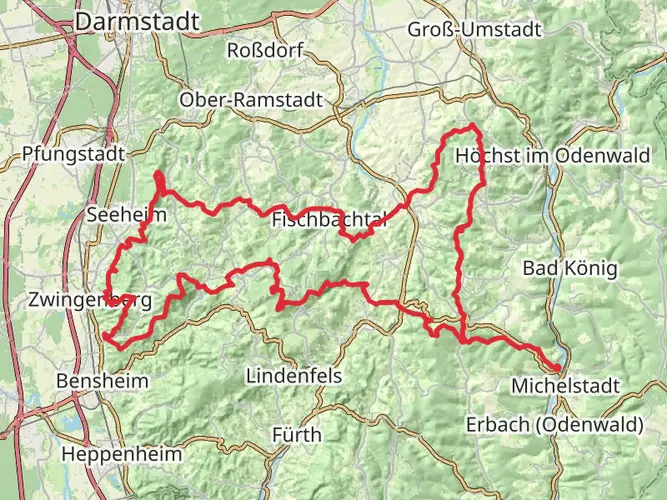
The Nibelungensteig is a captivating long-distance hiking trail that stretches approximately 131 kilometers (about 81 miles) and ascends roughly 4000 meters (around 13,123 feet) in elevation. This trail is nestled in the picturesque region of Kreis Bergstraße, Germany, and offers a point-to-point journey through a landscape steeped in myth and legend.
Getting to the Trailhead
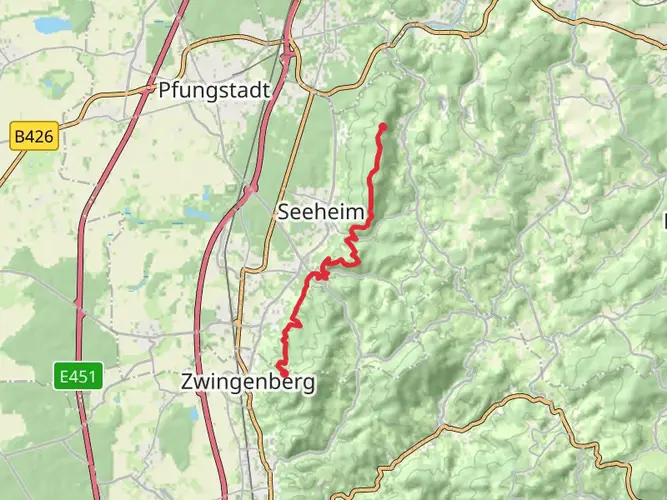
To embark on the Nibelungensteig, hikers can arrive at the trailhead near Zwingenberg, which is the northernmost town in the Bergstraße district. Access is convenient via public transportation, with Zwingenberg railway station connecting to major cities. For those driving, parking is available in the vicinity of the station.
Navigating the Trail
Hikers can utilize the HiiKER app for detailed maps and navigation assistance throughout the Nibelungensteig. The trail is well-marked with a dragon symbol, a nod to the saga that gives the trail its name.
Trail Highlights and Landmarks
The Nibelungensteig trail takes you through the Odenwald, a mountain range rich in dense forests, serene valleys, and striking geological formations. The path leads to the Felsenmeer, an impressive sea of rocks near Lautertal, and continues to the legendary Siegfriedbrunnen, a spring said to be where the hero Siegfried was slain.
As you progress, you'll encounter the historic town of Lindenfels, offering panoramic views from its castle ruins. The trail also passes through the quaint village of Grasellenbach, home to the Nibelungen Museum.
Wildlife and Nature
The diverse habitats along the Nibelungensteig support a variety of wildlife, including deer, foxes, and numerous bird species. The mixed forests of beech, oak, and pine are interspersed with clear streams and meadows, providing a tranquil backdrop for your hike.
Historical Significance
The Nibelungensteig is steeped in the lore of the Nibelungenlied, an epic poem that tells the tale of dragons, treasure, and heroic deeds. The region's history is palpable, with medieval castles and ancient Roman structures dotting the landscape.
Preparing for the Hike
Given the trail's medium difficulty rating, hikers should be in good physical condition and prepared for significant elevation changes. Weather can be variable, so layered clothing is recommended. Sturdy hiking boots are essential for the rocky and sometimes steep terrain.
Accommodation and Supplies
There are numerous guesthouses and inns along the route for overnight stays. It's advisable to book accommodations in advance, especially during peak hiking seasons. While there are opportunities to resupply in the towns and villages along the trail, carrying sufficient water and snacks for each day's hike is important.
Safety and Etiquette
Always respect the natural environment by staying on marked paths and practicing Leave No Trace principles. Be prepared for sections of the trail that may be challenging, and always let someone know your itinerary before setting out.
By following these guidelines and being well-prepared, hikers can fully enjoy the enchanting experience that the Nibelungensteig has to offer.
AI Planner
Days planned around your pace, with somewhere to stay each night.

Frequently asked questions
Where does the Nibelungensteig start and finish?
The Nibelungensteig is a point-to-point long-distance trail that starts in Zwingenberg on the Bergstraße and finishes in Freudenberg am Main. It crosses the Odenwald from west to east over about 130.94 km rather than forming a loop, so it is usually planned as an end-to-end walk.
How difficult is the Nibelungensteig hike?
The Nibelungensteig is a difficult multi-day hike. Over 130.94 km it gains about 4,020 meters of elevation, which means repeated steep climbs and descents through the Odenwald rather than a gentle long-distance route. It is better suited to experienced hikers with solid fitness and several full hiking days available.
How many stages is the Nibelungensteig usually split into?
The Nibelungensteig is commonly divided into 7 stages, although stronger hikers sometimes combine sections and others spread it over more days. A standard breakdown runs from Zwingenberg toward places such as Lindenfels, Grasellenbach, the Hesselbach area, Miltenberg, and finally Freudenberg am Main.
What are the main highlights on the Nibelungensteig?
Major highlights on the Nibelungensteig include the Felsenmeer near Lautertal, the legendary Siegfriedbrunnen, and the castle ruins above Lindenfels. The route also passes through forested Odenwald landscapes and links well-known trail towns including Zwingenberg, Lindenfels, Grasellenbach, Miltenberg, and Freudenberg am Main.
What is the best stage of the Nibelungensteig?
The most talked-about section of the Nibelungensteig is often the western part from Zwingenberg toward Lindenfels because it packs in major landmarks early, including the climb from the Bergstraße into the Odenwald and the Felsenmeer near Lautertal. That section also includes strong views and one of the trail’s best-known historic towns at Lindenfels.
Can you do the Nibelungensteig as a loop hike?
The Nibelungensteig is not a loop hike. It is a linear route from Zwingenberg to Freudenberg am Main, so anyone walking the full trail needs to plan transport back from the finish or return to the start before setting out. That point-to-point format is one reason many hikers break it into stages.
How do you get to the Nibelungensteig trailhead in Zwingenberg?
The usual northern trailhead for the Nibelungensteig is in Zwingenberg, which has a railway station on the Main-Neckar line. Regional trains connect Zwingenberg with larger cities on the corridor such as Darmstadt, Heidelberg, and Frankfurt, making rail access practical for starting the walk without a car.
Comments and Reviews
User comments, reviews and discussions about the Nibelungensteig, Germany.
4.4
average rating out of 5
5 rating(s)