
Download
3D Flyover
Add to list
More
1.3 km
~16 min
8 m
Out and Back
“Across Shetland’s wild moor, a brief boggy approach heightens the mystery of ancient Stanydale Temple.”
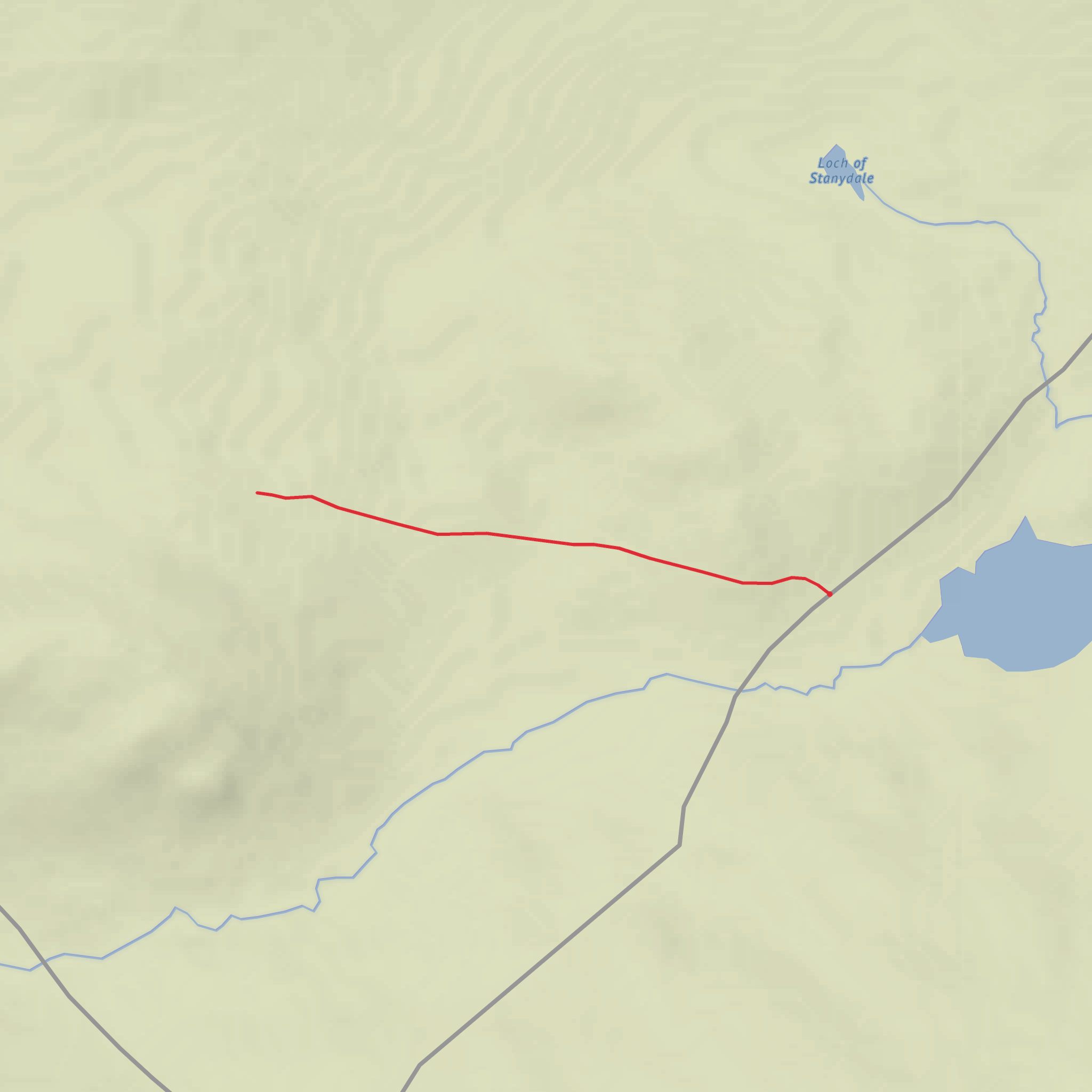
This short out-and-back walk leads across open West Mainland moorland to one of Shetland’s most intriguing prehistoric sites: Stanydale Temple, a large oval stone structure dating to roughly 2500–2000 BC. Although the walk itself is only about 1 km / 0.6 miles round trip with virtually no overall elevation gain, the setting can feel much bigger and wilder than the numbers suggest. The route is easy in distance and gradient, but the ground is often wet and peaty, so waterproof footwear is far more useful here than trail-running speed. Historic Environment Scotland specifically notes that the route can be very wet and asks visitors to stay strictly on the access path. (historicenvironment.scot)
The start is best described as being near Bixter on Shetland’s West Mainland, about 3 miles southwest of Bixter off the A971, with the signed access leading out across the moor toward the monument. The nearest practical landmark is Stanydale Temple itself, near Bixter and Gruting, rather than a formal street address, which is typical for rural Shetland. Historic Environment Scotland gives the location as near Bixter and provides the grid reference HU 285 502. (historicenvironment.scot)
By car, the approach is straightforward once you are on the A971 west of Lerwick. A minor roadside pull-off or layby-style stopping point is typically used for access, and from there you follow the marker poles across the moor. From Lerwick, the drive is roughly west across Mainland toward Bixter, then onward to the signed access point. Shetland’s tourism guidance also notes that the route toward Walls via the A971 passes the Stanydale Temple access, with a short waymarked walk over wild grassland. (shetland.org)
Public transport is possible, but it takes more planning than the walk itself. Shetland’s visitor transport guidance advises checking current bus routes and timetables through the Shetland Travel Information system, and the West Mainland timetable shows buses running between Lerwick and Bixter/Walls on Service 9/related variants. From the nearest roadside stop around Bixter, hikers should expect an additional roadside walk to the access point before starting the marked path to the monument. Because rural services can be limited and some journeys are request-based, it is wise to confirm the day’s timetable before setting out. (shetland.org)
What the walk is like
The walking itself is gentle and uncomplicated in profile, with around 0 m / 0 ft of net elevation gain, but the terrain is the real factor. This is open moorland, and even on a short route the footing may be soft, boggy, or uneven. Marker poles guide the way, which is helpful in mist or flat light, and this is one of those walks where route-finding is less about steepness and more about staying on the correct line through wet ground. For navigation, it is worth having the route loaded in HiiKER before you arrive. (historicenvironment.scot)
Because the outing is so short, many hikers combine it with other West Mainland stops, but it still rewards a slower pace. The landscape is broad, treeless, and exposed, with a strong sense of space. Even a brief walk here can feel atmospheric, especially in wind, low cloud, or evening light. The approach helps build anticipation: rather than seeing the monument immediately from the road, you cross the moor first, which gives the site a more remote and ceremonial feel. Archaeology Shetland notes that the surrounding valley has long been boggy and that peat growth has altered the landscape over time, while small streams likely still follow courses similar to those used in prehistory. (archaeologyshetland.org)
Landmarks, archaeology, and historical significance
The destination is the highlight from the first step to the last. Stanydale Temple is described by Historic Environment Scotland as the only truly megalithic structure surviving from prehistoric Shetland, with a wall of large boulders enclosing a broad oval interior that was once covered by a substantial timber roof. (historicenvironment.scot)
Despite the name, archaeologists do not all agree that it was literally a temple. Archaeology Shetland explains that the name was given in the 1940s because the structure seemed comparable in layout to Maltese temple sites, but the building may
Surfaces
Grass
Unknown
Comments and Reviews
User comments, reviews and discussions about the Stanydale Temple Out and Back, Scotland.
average rating out of 5
0 rating(s)



