Download
Preview
Add to list
More
8.8 km
~1 hrs 56 min
102 m
Out and Back
“Across Yell’s wild northern edge, this reflective coastal wander pairs sweeping sea views with quiet history.”
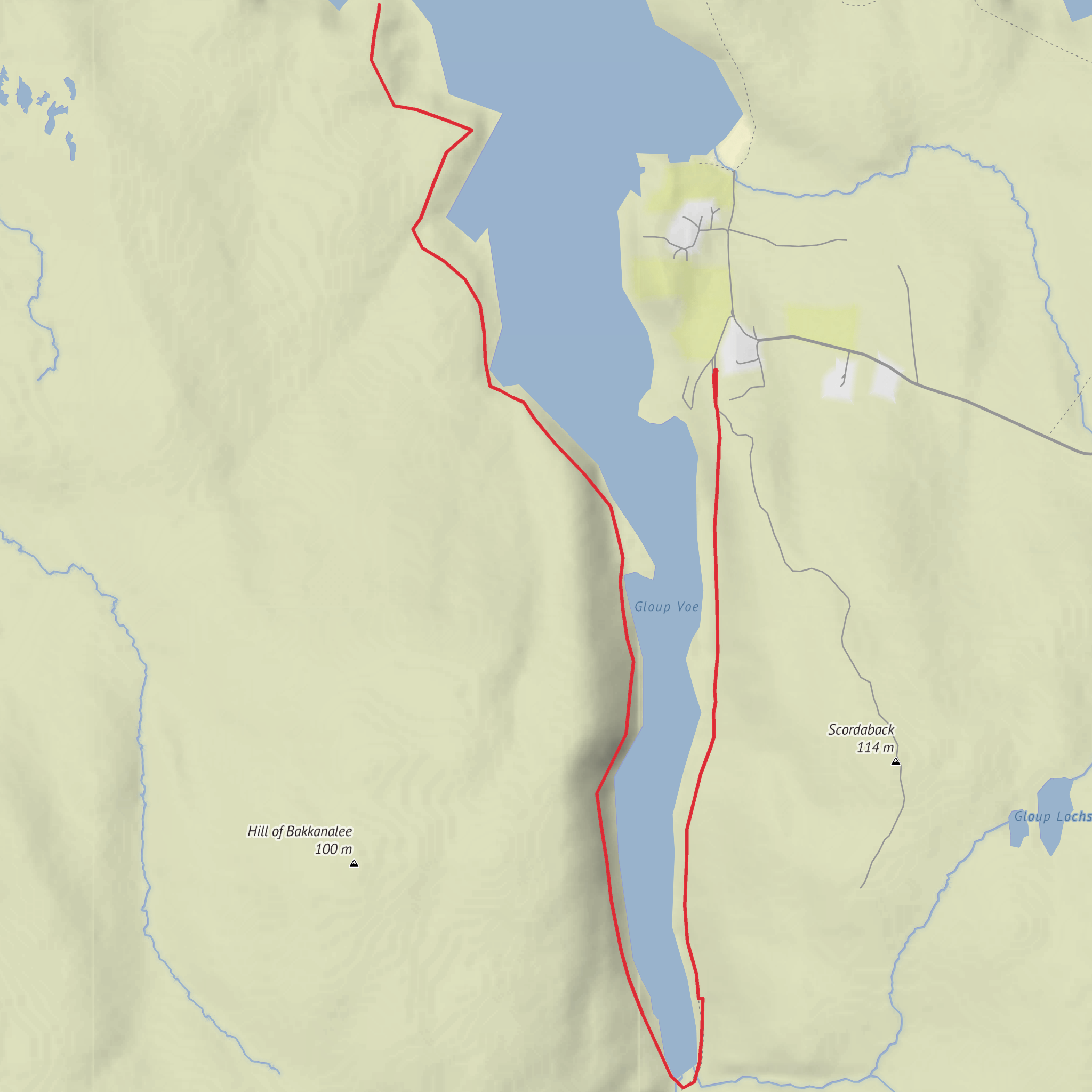
This easy coastal walk on the far north of Yell covers about 9 km / 5.6 miles with only around 100 m / 330 ft of ascent, so it is more about exposure, footing, and weather than steep climbing. The route links the scattered crofting landscape around Gloup with the indented shoreline of Gloup Voe, then continues by Tonga toward Stouraba, giving a varied outing of moor, rough pasture, sea inlets, and wide northern views. Expect a generally undulating line rather than any sustained hill, with most of the elevation gain coming in short rises above the voe and along low coastal ground. The terrain is usually straightforward in dry conditions, but it can become soft, boggy, and slippery after rain, especially where the path is faint or crosses wetter moorland. (komoot.com)
The start is best understood as being near Gloup on north Yell, close to the Gloup Memorial and the road end above Gloup Voe, rather than at a formal trailhead with major facilities. There is a small parking area used for walks in this area near the memorial track, and this is the most practical landmark to navigate to by car. If arriving by public transport, Yell is reached from the Shetland Mainland by the Toft–Ulsta ferry, and bus services operate through Yell and connect with ferry travel, including services that continue across Yell toward Gutcher; timetables should be checked carefully in advance because island connections can shape the whole day. HiiKER is the best tool to confirm the line of the route and help with timing on the ground. (shetland.org)
What the walk feels like
From the Gloup side, the first part of the walk has a distinctly open, northern-isles character: low croft land gives way to rougher coastal margins, with the sea never far away and the sense of space increasing as soon as the houses thin out. Gloup Voe is one of the defining features of the outing, a long, narrow inlet cutting into the land and creating a sheltered contrast to the more exposed outer coast. The walking here is rarely dramatic in gradient, but the scenery changes constantly—small burns, peaty ground, rocky edges, and broad views across the voe and out toward the surrounding sea. (walkhighlands.co.uk)
As the route continues via Tonga, the landscape becomes quieter and more remote-feeling. This is not a heavily engineered trail, so hikers should be prepared for sections where the route is more a matter of following old tracks, trods, or natural lines through the ground than walking on a built path. On an easy-rated day with calm weather, that makes for relaxed exploration; in mist or strong wind, it means paying closer attention to direction and to the edges of cliffs, inlets, and wet ground. Distances can feel longer than expected because of uneven footing and frequent pauses for views. (komoot.com)
Approaching Stouraba, the route keeps its low-level coastal character. The reward is the sense of moving through a sparsely settled edge-of-the-world landscape where the sea, geology, and old human use of the land are all visible at once. Even on a relatively short walk, the combination of voes, headlands, and open moor gives it a bigger feel than the mileage suggests. (shetland.gov.uk)
Landmarks, wildlife, and local character
One of the most significant landmarks near the route is the Gloup Memorial, which commemorates the 1881 Gloup fishing disaster. In July 1881, 58 fishermen were lost in a sudden storm, and the event had a profound impact on Yell and wider Shetland. The memorial stands above the voe from which boats had set out, and it gives this landscape a strong historical weight that goes far beyond its quiet appearance today. The disaster is closely tied to Shetland’s haaf fishing tradition, when open boats worked distant fishing grounds in demanding conditions. (shetland.org)
The area around Gloup Voe is also notable for coastal wildlife. Shetland’s voes and shorelines are good places to
Surfaces
Unknown
Grass
Comments and Reviews
User comments, reviews and discussions about the Gloup to Stouraba via Tonga and Gloup Voe, Scotland.
average rating out of 5
0 rating(s)
