Download
3D Flyover
Add to list
More
4.5 km
~56 min
19 m
Out and Back
“A wind-burnished coastal finger leads to Burgi, where stark seas and Iron Age shadows linger.”
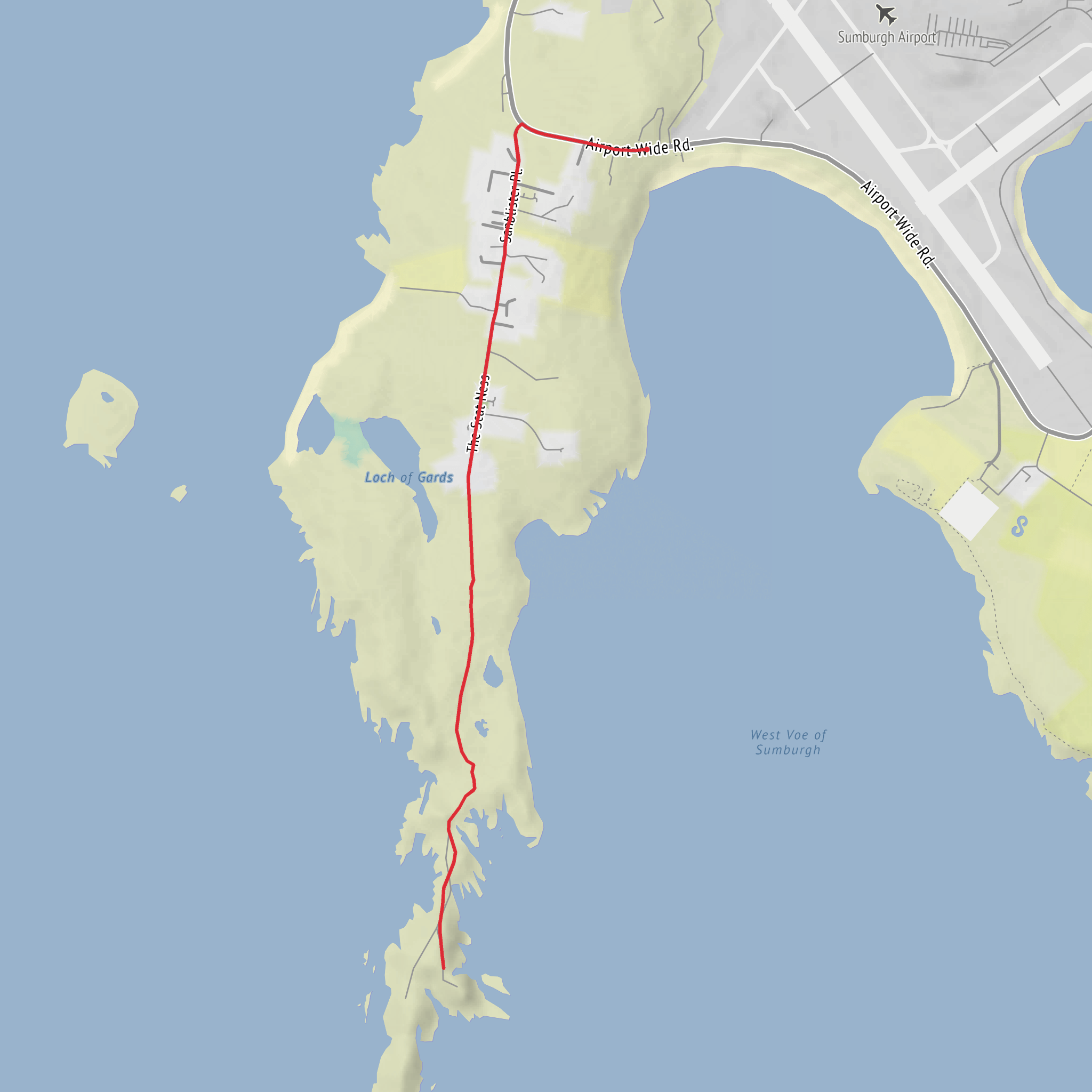
This easy out-and-back walk of around 5 km / 3.1 miles follows a narrow coastal promontory south from the Scatness area toward the Ness of Burgi, an Iron Age fort set dramatically above the sea near Sumburgh at the southern end of Mainland Shetland. The route is almost flat, with only negligible ascent and descent—roughly 0 m / 0 ft overall—so the main challenge is not climbing but exposure to wind, uneven ground, and the rougher footing near the far end of the ness. The start is best understood as being near Sumburgh Airport and the Old Scatness area, south of Virkie, rather than at a formal trailhead with extensive facilities. The nearest obvious landmark is Sumburgh Airport, Shetland, KW15 1QY area, with the walk beginning from the road end and access track near Scatness. (historicenvironment.scot)
From the outset, expect open views over low coastal grassland, rocky shore, and the voe, with the route stretching ahead along a slender finger of land. Because the terrain is largely level, this is a good choice for walkers who want a shorter archaeological outing without a sustained climb, but it should not be mistaken for a manicured path. Parts can be wet, soft, or rough underfoot, and in Shetland conditions even a short walk can feel more serious when strong winds, sea spray, or poor visibility move in. Waterproof footwear is useful, and windproof layers are often more important here than heavy mountain gear. (historicenvironment.scot)
Route and what to expect
The first section heads out from the Scatness side on comparatively straightforward ground, with broad coastal views and very little height change. Over roughly the first 1.5 to 2 km / 0.9 to 1.2 miles, the walking is mostly about following the line of the promontory southward. The landscape feels exposed and treeless, and the sea is never far away. In calm weather this can feel gentle and spacious; in wind, the same openness becomes the defining feature of the walk.
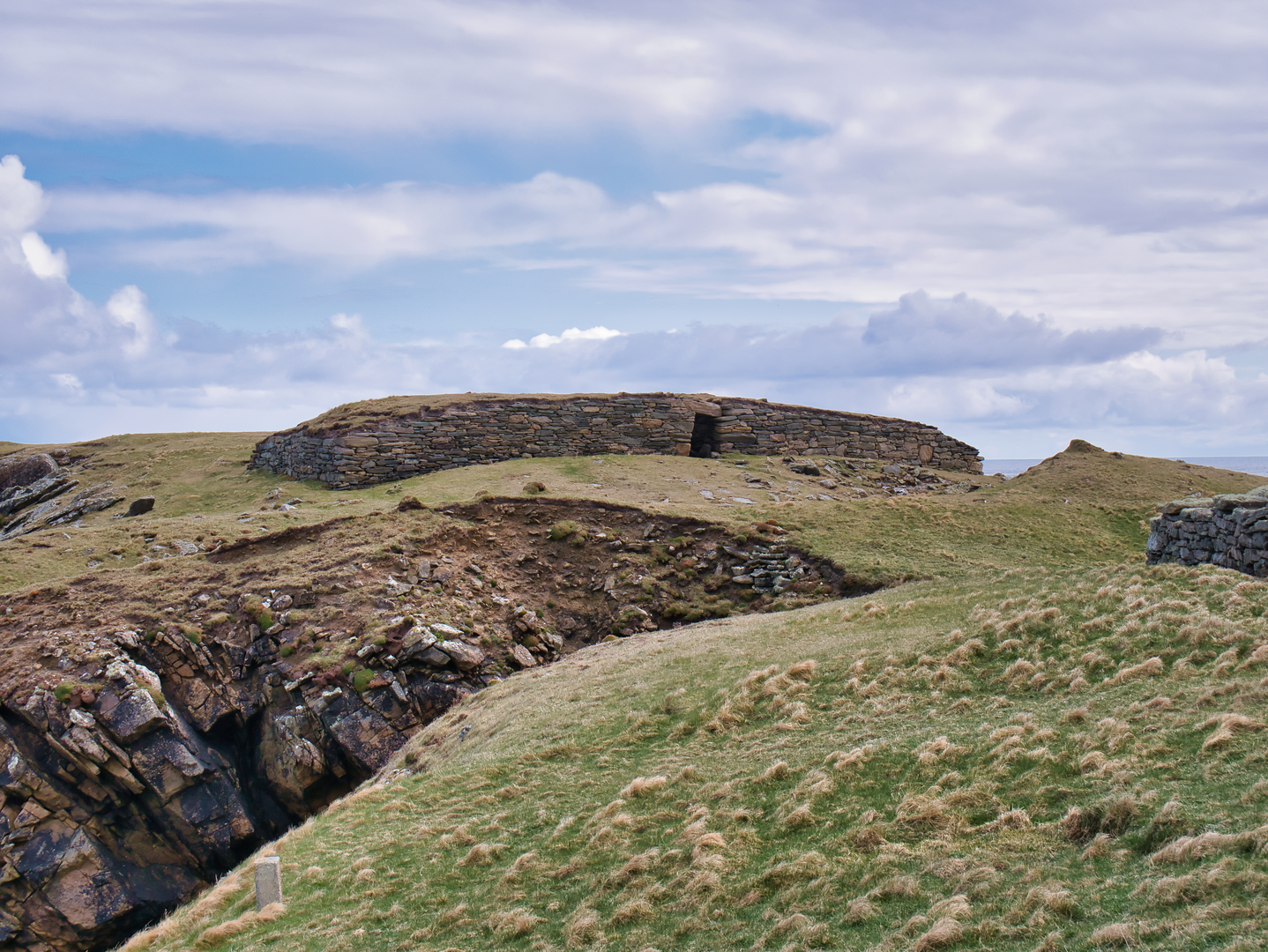
Farther out, the promontory narrows and the setting becomes more dramatic. The final approach to the fort is the part to treat with most care. Historic Environment Scotland notes that visiting the Ness of Burgi involves a walk with a clamber over rocks and a narrow causeway, which is the key terrain warning on this route. That means the last stretch may be awkward for anyone unsteady on uneven surfaces, and it is not ideal in very wet or gusty conditions. Allow extra time here rather than assuming the whole route will walk at the same easy pace from start to finish. (historicenvironment.scot)
At the turnaround point, the remains of the fort occupy a naturally defensive headland. This is where the walk becomes much more than a simple coastal stroll: the archaeology and the setting combine to make the destination feel remote, strategic, and unmistakably ancient. After exploring the site, return the same way to Scatness.
History and archaeology
The Ness of Burgi is one of Shetland’s notable Iron Age coastal forts, often described as a gatehouse or blockhouse fort, and it stands within the wider archaeological landscape of South Mainland alongside Old Scatness and Jarlshof. The fort is defended on the landward side by two rock-cut ditches and a broad rampart across the neck of the promontory, showing how carefully the site’s natural position was strengthened. Historic Environment Scotland and Shetland archaeology sources describe it as part of a distinctive Shetland Iron Age tradition, with only a very small number of comparable structures known. (historicenvironment.scot)
The wider region is exceptionally important for understanding Iron Age Shetland. Old Scatness, very close to the start area, is regarded as one of the best-preserved excavated Iron Age sites in Britain, with a broch and village remains that have helped reshape dating and interpretation of Atlantic Scottish prehistory. Nearby Jarlshof adds another layer, representing settlement over multiple periods. Taken together, this means the walk to Burgi is not an isolated monument visit but part of one of Scotland’s richest archaeological landscapes. (shetland.org)
The name “Burgi” is linked to the Old Norse word for fort, reflecting how later Norse settlers understood the site in the landscape. That layering of Iron Age remains within a Norse-named place is typical of Shetland, where prehistoric and later histories often sit very close together. (shetland.org)
Nature, wildlife, and conditions
This coastline is ideal for walkers who enjoy seabirds, marine views, and the stark character of Shetland’s southern shore. Depending on season, expect to see common coastal birdlife using the cliffs
Surfaces
Unknown
Grass
Gravel
Comments and Reviews
User comments, reviews and discussions about the Burgi Iron Age Fort, Scotland.
average rating out of 5
0 rating(s)