Teviot Bridge, Roxburgh Castle, Heiton Mill and Kelso Bridge Loop
Download
3D Flyover
Add to list
More
11.8 km
~2 hrs 25 min
41 m
Loop
“A tranquil Kelso loop weaves rivers, birdsong, and ruined royal history through open Border countryside.”
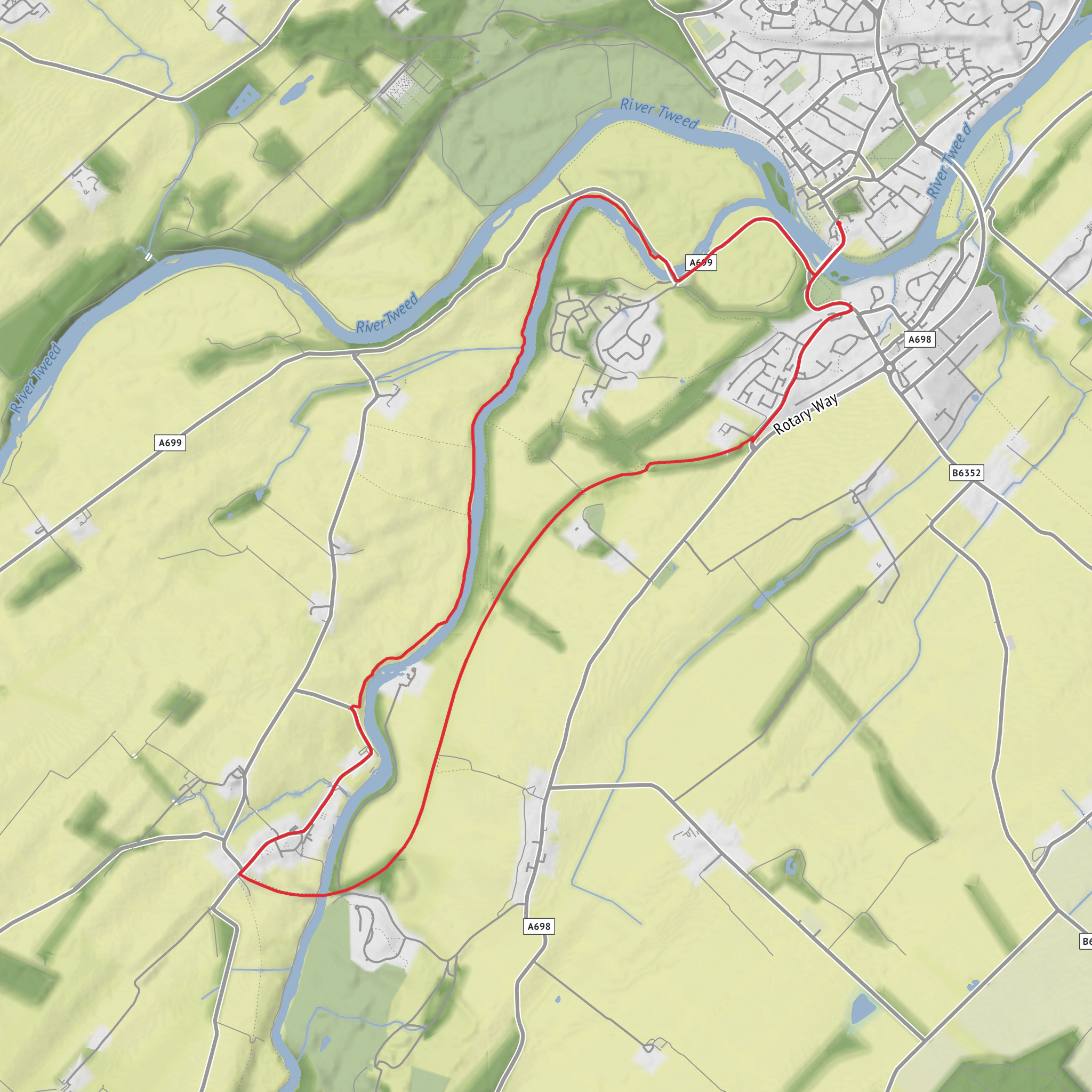
This easy loop of about 12 km / 7.5 miles is a gentle riverside and countryside walk around Kelso, with very little climbing—roughly 0 m / 0 ft of ascent overall—so it suits walkers looking for a relaxed half-day outing rather than a strenuous hill day. The route is best understood as a circuit from central Kelso, near Kelso Bridge, Bridge Street, Kelso TD5 7HT, heading out toward Teviot Bridge on the A699 near Roxburgh/Heiton, passing the earthworks and ruins of Roxburgh Castle, continuing by Heiton Mill, and returning via the old railway corridor and riverside paths. Kelso sits at the meeting point of the River Tweed and River Teviot, and that confluence gives the walk much of its character: broad water, open views, rich birdlife, and a strong sense of Border history. (en.wikipedia.org)
Getting to the start is straightforward for a Borders walk. If arriving by car, Kelso is well connected by road and is about 45 miles / 72 km south of Edinburgh, with town-centre parking and access roads leading toward the bridge and riverside. If using public transport, Kelso is served by regular bus links from other Borders towns as well as Edinburgh, Newcastle, and Berwick-upon-Tweed; the nearest rail option is Tweedbank or Galashiels, from where onward bus or taxi connections continue to Kelso. For planning the route itself, HiiKER is the most useful navigation reference. (visitkelso.com)
The opening section is usually the easiest underfoot, leaving Kelso on good paths and minor roads with immediate views over the Tweed and across to the landscaped grounds around Floors Castle. As the route bends toward the Teviot, the terrain stays mostly level, with a mix of pavement, riverside path, grassy edges, and farm-track walking. Because the elevation gain is negligible, the main things to prepare for are not steepness but surface changes: after rain, riverside stretches can be muddy, grassy sections may be slick, and some field-edge paths can feel uneven despite the overall easy grading. The walk is manageable in ordinary walking shoes in dry weather, but waterproof footwear is a better choice if conditions have been wet. (visitkelso.com)
Along the Teviot
One of the most memorable parts of the loop is the stretch beside the River Teviot, where the route heads toward Roxburgh. This section combines open riverbank scenery with a strong sense of the old Borders landscape—pasture, hedgerows, broad water, and long views across low-lying farmland. Around 2 km / 1.2 miles into the outward leg, Heiton Mill comes into view across the river, and the path continues along higher field edges in places, giving wider views back over the valley. Expect a peaceful rather than dramatic landscape: this is a walk of rivers, bridges, old transport lines, and historic sites rather than crags or mountain panoramas. (walkhighlands.co.uk)
Wildlife is one of the quiet rewards here. The river margins and wet meadows can attract ducks, swans, geese, and other waterbirds, while the wooded edges and hedgerows support smaller songbirds. Near the small bridge and riverside sections, walkers often keep an eye out for riparian wildlife, and the area is known as a good place to pause and scan the water rather than rush through. Seasonal conditions matter: spring and early summer usually bring greener banks and more birdsong, while autumn can offer softer light and clearer views through thinning foliage. (visitkelso.com)
Roxburgh Castle and the lost royal burgh
The historical centerpiece of the route is Roxburgh Castle, whose remains stand above the junction of the Tweed and Teviot. Although what survives today is ruinous, the site was once one of the most important royal strongholds in Scotland, associated with the reign of David I and the medieval royal burgh of Roxburgh nearby. The location was strategically powerful, occupying a defensible position between two rivers, and the surrounding area became a major center of medieval settlement and conflict during the Anglo-Scottish wars. Walking here, you are passing through ground that was once at the heart of royal, military, and commercial life in the Borders. (en.wikipedia.org)
That history adds depth to what might otherwise feel like a simple riverside circuit. The old town of Roxburgh, once one of the most significant burghs in Scotland, eventually declined and disappeared, largely because of warfare and the long struggle over the Border. The landscape now feels quiet and rural, but it overlays a place of major medieval importance. Kelso itself rose in prominence nearby, and the walk effectively
Surfaces
Unknown
Asphalt
Dirt
Ground
Cobblestone
Gravel
Wood
Comments and Reviews
User comments, reviews and discussions about the Teviot Bridge, Roxburgh Castle, Heiton Mill and Kelso Bridge Loop, Scotland.
average rating out of 5
0 rating(s)