Download
3D Flyover
Add to list
More
1.9 km
~28 min
51 m
Out and Back
“A short but stirring Hoy ramble blends wild moor, wartime ruins, and sea-battered solitude.”
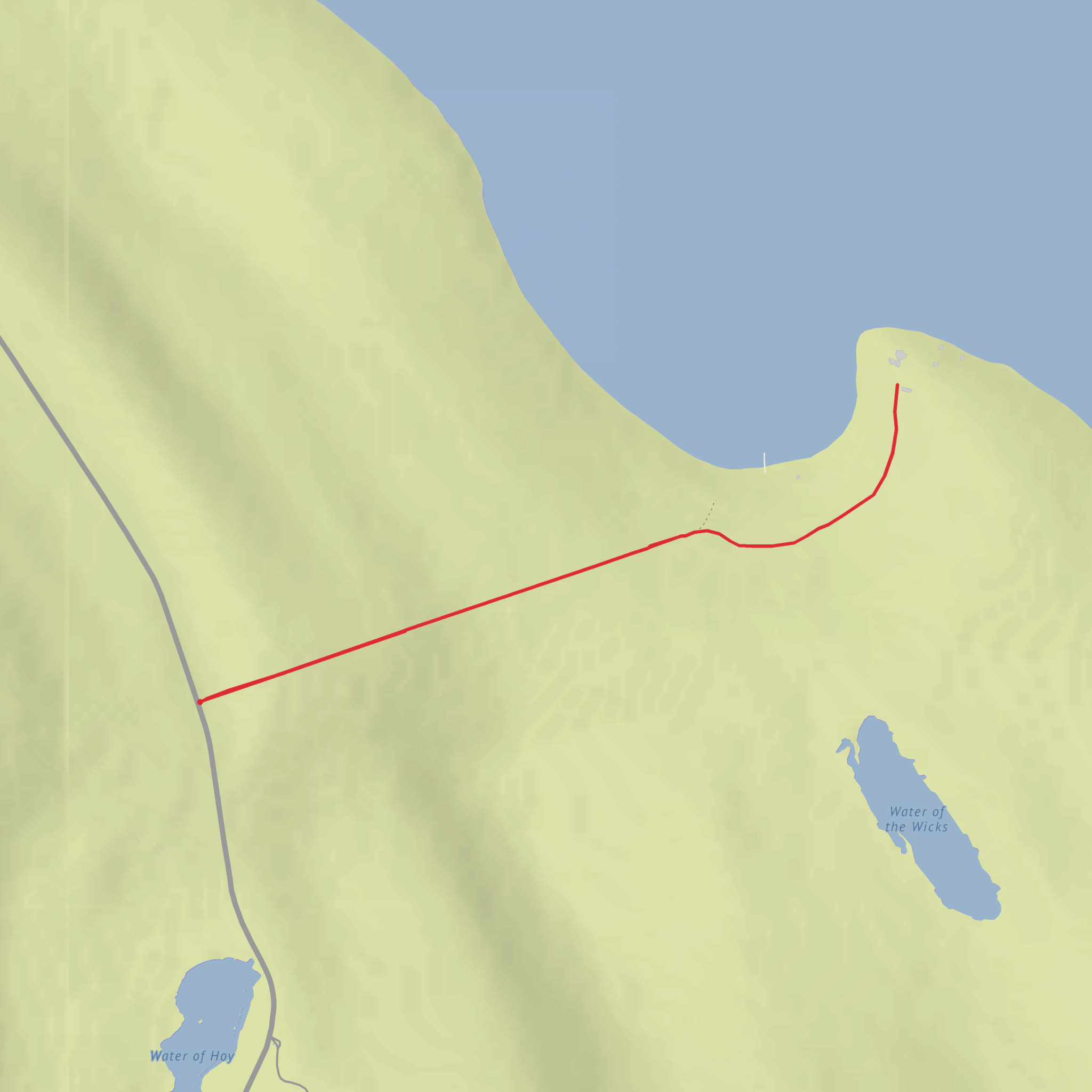
This short coastal outing on Hoy in Orkney packs a surprising amount into roughly 2 km / 1.25 miles, with about 100 m / 328 ft of ascent. Although the distance is modest, the terrain and exposure make it feel more serious than a simple stroll. Expect a medium-difficulty walk with uneven ground, short steep sections, and open moorland above a dramatic shoreline. The route is associated with Chalmers Hope and Scad Head on the east side of Hoy, near the B9047 and the layby by Betty Corrigall’s Grave, which is the most useful nearby landmark for locating the start. ScotWays places the end of the historic Scad Head tramway at Chalmers Hope, Hoy, Orkney, with parking noted by the roadside near Betty Corrigall’s Grave. (scotways.com)
For drivers, the easiest approach is via the B9047 on Hoy, using the roadside layby near Betty Corrigall’s Grave, Water of Hoy, Orkney as the practical trailhead reference. Walkhighlands describes this layby as the start point, about 7.5 km south of Moaness Pier and 8.5 km north of Lyness. If arriving by public transport, the main limitation is that there is no direct public transport to the start itself, so the usual approach is to reach Hoy by ferry and then continue by taxi, bike, or a longer walk from the ferry landing. (walkhighlands.co.uk)
The first impression is one of openness: moorland, sea views, and a sense of isolation that is very characteristic of Hoy. Scad Head is a headland overlooking the waters of Scapa Flow and the Bring Deeps, and the setting is more rugged than the short mileage suggests. The path network here can be faint in places, and the ground may be rough, damp, or boggy after rain, so sturdy footwear is a better choice than light trainers. Walkhighlands specifically notes rough moorland terrain, while Stromness Museum’s route notes mention a steep and rough descent in places. Using HiiKER before setting out is sensible for confirming the line of the route across the moor. (walkhighlands.co.uk)
What to expect on the route
From the roadside, the walk heads out across open ground toward the coast, gradually giving away height and then regaining it depending on the exact out-and-back or short circuit variation you follow. Over around 2 km / 1.25 miles, the total climbing of about 100 m / 328 ft is concentrated enough to be noticeable, especially on the return. Even though this is not a long hike, the combination of wind, wet ground, and coastal exposure can slow progress.
The route’s standout landmark is Scad Head itself, where the remains of wartime defenses give the walk much of its character. ScotWays records the Scad Head Tramway as a 0.65 km heritage path between the B9047 and Chalmers Hope, identifying it as a military road/tramway corridor and noting the remains of a coastal defence gun battery at Scad Head. The old incline tramway bed is still visible in the landscape, which helps explain the unusual engineered feel of parts of the route. (scotways.com)
If you extend slightly beyond the shortest version, the area around Lyrawa Hill and Scad Head adds more context: wartime structures, broad views over Scapa Flow, and a descent through heather moorland toward the battery site. Stromness Museum notes that the wider walk includes the remains of the WWII Scad Head Coast Battery, including gun emplacements, an observation post, engine room, and searchlight positions, as well as the route of a 900-yard / 820 m two-foot-gauge incline railway linking the battery to the road above. (stromnessmuseum.org.uk)
Nature, wildlife, and landscape
This is a good walk for hikers who enjoy coastal birdlife and moorland plants as much as historical features. The heathland around the route supports typical Orkney moor species, and Stromness Museum highlights bog asphodel and cross-leaved heath among the plants found in the damp ground here. Along the shore and around the bay, the same source notes shags, black guillemots, and various waders, while the moorland can hold skylarks, snipe, and wheatears. It also notes that grey seals breed along this coast in November. (stromnessmuseum.org.uk)
Because the route is short and close to the sea, weather has an outsized effect on the experience. In calm conditions, the views across the water toward Graemsay and the Orkney Mainland are a major highlight; in strong wind or rain, the same exposed ground can feel much more committing. Waterproof layers are worth carrying even for a brief outing, and extra care is needed near cliff edges or steep
Comments and Reviews
User comments, reviews and discussions about the Chalmer's Hope and Scad Head, Scotland.
average rating out of 5
0 rating(s)