
Download
3D Flyover
Add to list
More
1.2 km
~14 min
0 m
Loop
“A gentle Hebridean wander through flower-rich machair, bird-haunted shores, and crofting landscapes steeped in history.”
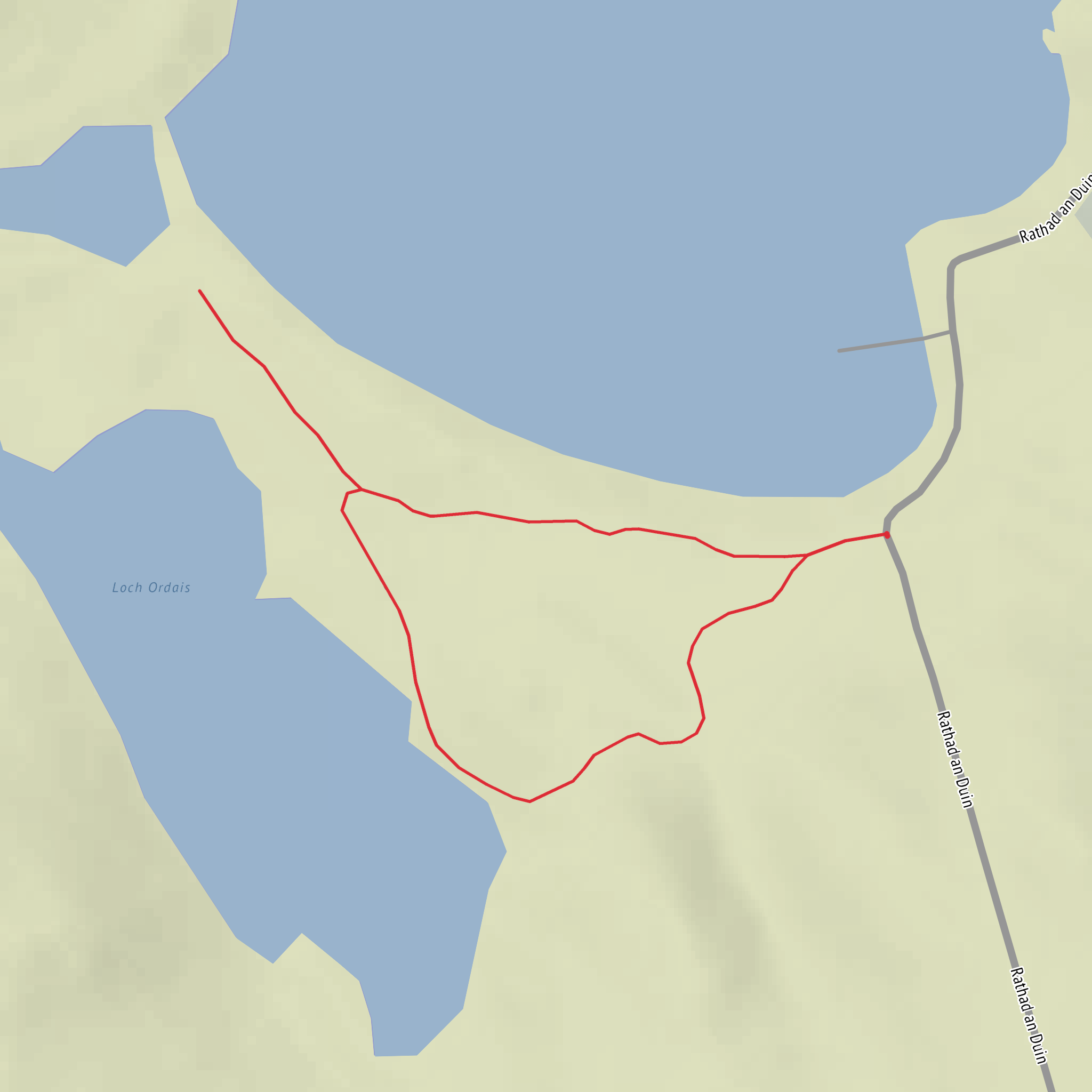
This short, easy outing explores the machair and shoreline around Loch Ordais on the west side of the Isle of Lewis, near Bragar in the Outer Hebrides. At roughly 1 km / 0.6 miles with almost no ascent—about 0 m / 0 ft—it is more of a gentle coastal wander than a demanding hike, and it suits walkers looking for scenery, birdlife, and a feel for the island’s crofting landscape rather than a big physical challenge. Loch Ordais lies near Port Mhòr Bhràgair and the Bragar area, with the nearest practical landmark for planning purposes being Bragar Old School / Grinneabhat, North Bragar, Isle of Lewis, HS2 9DA. (grinneabhat.com)
The terrain is generally flat and straightforward, but “easy” here still comes with Hebridean caveats. Expect a mix of short grassy paths, machair ground, sandy or shell-rich edges, and potentially damp or soft patches depending on recent rain and tide conditions. Even on a very short route, waterproof footwear is useful because low-lying coastal ground can hold water, and wind exposure can make the weather feel much harsher than the distance suggests. If visibility drops, HiiKER is the best tool to keep your bearings clear across the open ground.
What the walk feels like
From the Bragar side, the walk unfolds through a classic west Lewis coastal setting: open croftland, low-lying machair, and the loch itself sitting close to the Atlantic shore. The landscape is broad rather than dramatic, with long views, shifting light, and a strong sense of space. Because there is almost no climbing, the route is accessible to most walkers, including families and anyone wanting a short leg-stretcher between longer island drives. (grinneabhat.com)
Machair is one of the defining features here. This rare coastal grassland, formed from windblown shell sand, is found mainly in the north and west of Britain and Ireland. Around Bragar it creates a patchwork of fertile ground that has long been shaped by traditional crofting. In the warmer months, that means a rich display of wildflowers rather than rugged mountain flora—orchids, yellow rattle, wild carrot, eyebrights, knapweed, trefoils, vetches, bugloss, clovers, and corn marigold are all associated with the local machair habitat. (grinneabhat.com)
Wildlife and seasonal highlights
Loch Ordais is especially rewarding for birdwatchers. The shoreline and sandy margins are known feeding areas for waders including dunlin, ringed plover, sanderling, turnstone, golden plover, purple sandpiper, oystercatcher, and redshank. In summer, Arctic terns feed here and corncrakes breed in the adjacent machair; ducks such as shelduck, wigeon, and teal also use the loch. In winter, the area can attract twite, skylark, reed bunting, meadow pipit, linnet, and even snow buntings near the shore, while raptors such as peregrine, merlin, and hen harrier may appear at any time of year. (grinneabhat.com)
There is more than birdlife to watch for. The coastland around Bragar is also noted for otters, and the area supports the Great Yellow Bumblebee, one of Britain’s rarest bees. If visiting in summer, it is worth moving slowly and scanning both the loch edge and the machair rather than rushing to the end of the walk. (grinneabhat.com)
Because this is sensitive habitat, walkers should take extra care during the breeding season. Keep dogs under close control, avoid trampling through taller vegetation, and be cautious around wet ground where nests and feeding birds may be easily disturbed.
Landmarks and local history
Although the walk itself is short, it sits in a landscape with deep historical interest. Historic Environment Scotland records an enclosure at Loch Ordais, and the wider Bragar area contains several notable historic sites nearby, including Port Mhòr Bhràgair, the Bragar Whalebone Arch, the scheduled broch at Dùn Loch an Dùna in South Bragar, and the horizontal mills at Allt na Muilne. (trove.scot)
That wider setting matters because this is not just a scenic loch; it is part of an old inhabited and worked landscape shaped by crofting, fishing, and long settlement history on Lewis. The nearby coast also connects with places associated with early Christian remains in the Ness area and with the long
Surfaces
Unknown
Asphalt
Comments and Reviews
User comments, reviews and discussions about the Loch Ordais, Scotland.
average rating out of 5
0 rating(s)

