
Download
3D Flyover
Add to list
More
12.5 km
~2 hrs 54 min
242 m
Out and Back
“A gentle wander through North Harris, where quiet lochs and wild moorland deepen into solitude.”
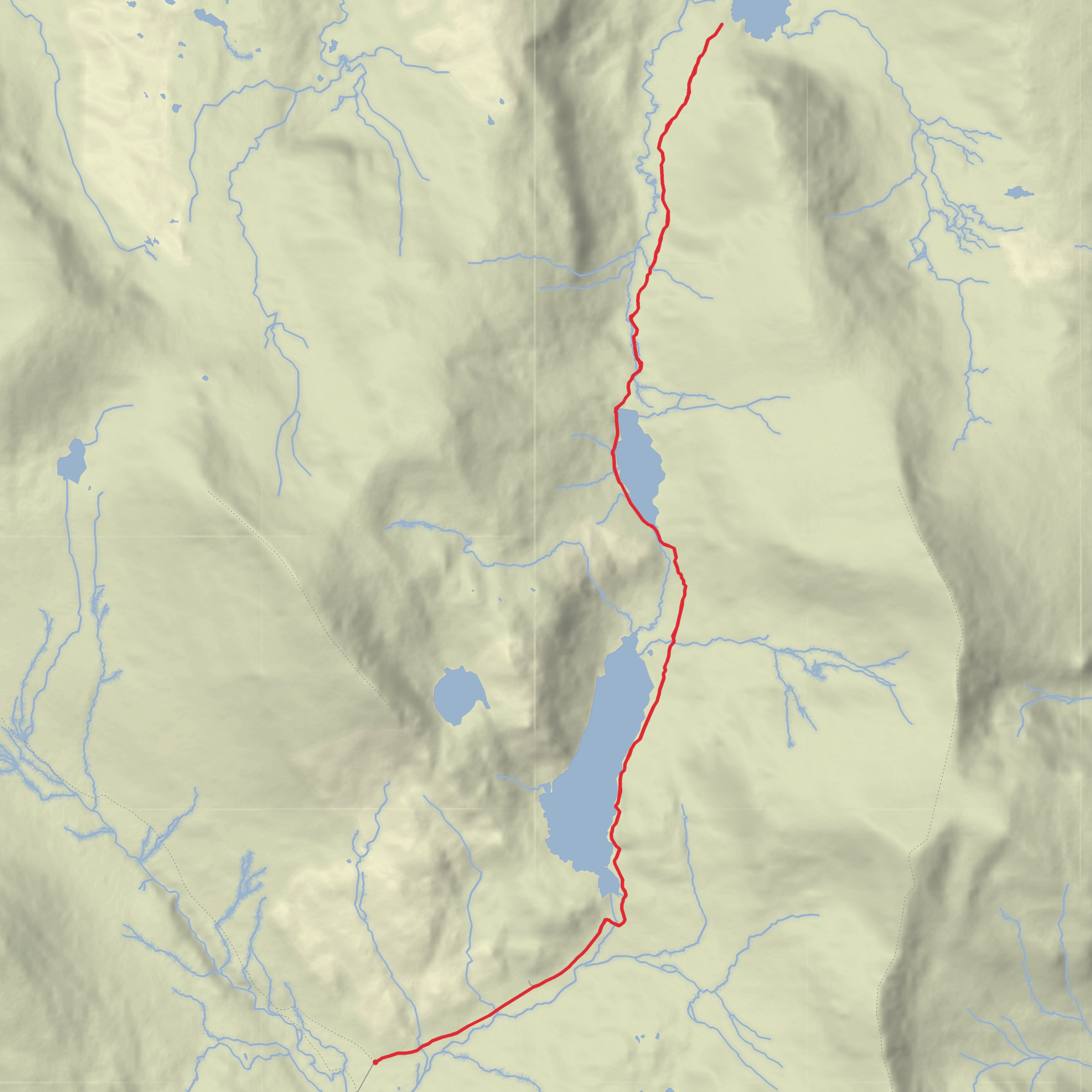
This easy-going loch walk in North Harris explores a quieter side of the island, following a well-made estate path past Loch Chliostair and on toward Loch Ashavat before reaching the more secluded basin of Loch Ulladale. Over roughly 13 km / 8.1 miles, with about 200 m / 656 ft of ascent, the route is more about space, water, moorland, and atmosphere than steep climbing. The terrain is generally straightforward for regular walkers, but the setting is remote enough that it still feels wild and exposed. The route is associated with the path from Loch Chliostair toward Sròn Uladail, and North Harris Trust notes that there are no parking facilities at the path itself, which is an important detail when planning the day. (north-harris.org)
The start is best understood as being near the Loch Chliostair dam / dam road on the B887 west of Amhuinnsuidhe, Isle of Harris, rather than at a formal trailhead with services. The nearest significant landmark is Amhuinnsuidhe Castle, on the road between Tarbert and Hushinish, and the route lies in the North Harris hills beyond it. Older route descriptions also refer to approaching the walk from Amhuinnsuidhe and heading up through Gleann Chliostair past the three lochs. (en.wikipedia.org)
Getting there
By car, the usual approach is from Tarbert on Harris. Follow the A859 north and west, then turn onto the B887 toward Amhuinnsuidhe and Hushinish. The road passes Amhuinnsuidhe and continues into increasingly open, rugged country. Because the path does not have dedicated parking, drivers should plan carefully and avoid obstructing passing places, gates, estate access, or the roadside. (north-harris.org)
By public transport, the most practical option is the Tarbert–Amhuinnsuidhe–Hushinish bus service. Current visitor information for the Outer Hebrides confirms bus links across Lewis and Harris, and Comhairle nan Eilean Siar publishes a timetable showing buses serving Amhuinnsuidhe on the Hushinish route from Tarbert. Service frequency is limited, so it is worth checking the day’s timetable carefully and building in extra time. (visitouterhebrides.co.uk)
What the route feels like
The first section is usually the easiest underfoot, using an estate track or stalkers’ path beside Loch Chliostair. This opening stretch is gentle and gives a good sense of the landscape: broad moor, rock outcrops, peatland, and long water margins rather than sharp mountain drama. Walkhighlands describes the route as following the east side of Loch Chliostair, crossing a bridge, and climbing onward to Loch Aiseabhat/Ashavat. (walkhighlands.co.uk)
From the start to Loch Ashavat is roughly the first 4 to 5 km / 2.5 to 3.1 miles, with only modest ascent. The gradients are mild, but the ground can feel more committing than the numbers suggest because of wind exposure, wet patches, and the sense of distance from roads and buildings. Even on an easy-rated day, this is a place to carry waterproofs, extra layers, and enough food and water for a self-sufficient outing.
Landmarks, scenery, and route character
Loch Chliostair is the first major feature and sets the tone for the walk. The loch sits in a stark, open landscape shaped by ancient rock, glaciation, and water management. The nearby dam is a useful visual marker at the start, and the path beyond quickly leaves behind any sense of settlement. (lets.fish)
Beyond the bridge and rise toward Loch Ashavat, the route becomes more scenic and more enclosed by the surrounding hills. This middle section often feels like the heart of the walk: a quiet inland corridor where the path threads between loch shore, moor, and rising ground. Expect expansive views back over the earlier loch and, in clearer weather, a strong sense of the layered North Harris landscape.
The approach to Loch Ulladale is the most dramatic part. Sources describing access to the loch note that the **descent into Loch Ulladale is steep
Surfaces
Gravel
Asphalt
Unknown
Comments and Reviews
User comments, reviews and discussions about the Loch Chliostair, Loch Ashavat and Loch Ulladale, Scotland.
average rating out of 5
0 rating(s)



