
Pico do Pedro, Pico da Esperança, Fajã do Ouvidor and São Jorge
Download
3D Flyover
Add to list
More
16.8 km
~3 hrs 52 min
302 m
Point to Point
“A cloud-brushed ridge walk tracing São Jorge’s volcanic spine before tumbling to dramatic Fajã do Ouvidor.”
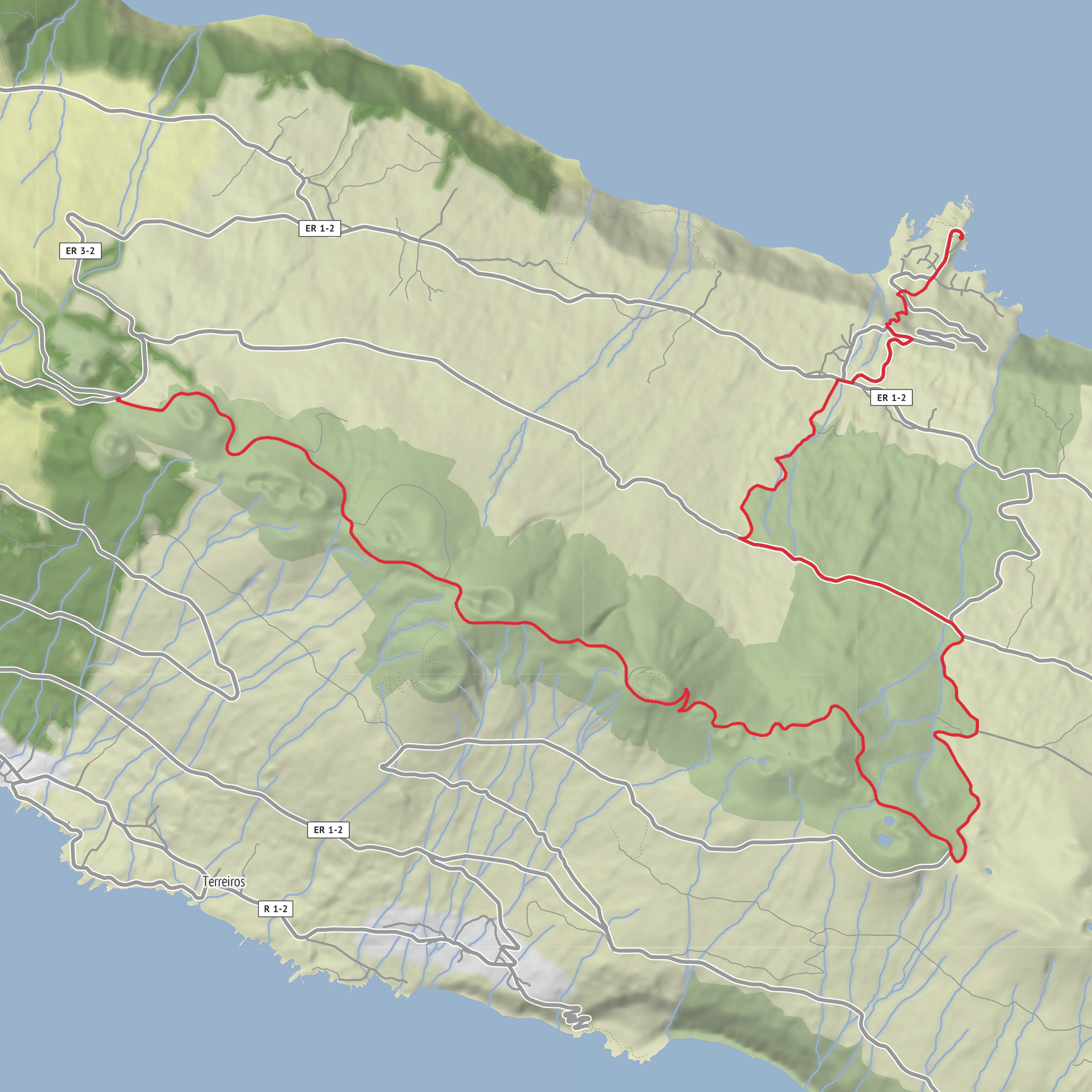
This point-to-point walk crosses the high spine of São Jorge before dropping to one of the island’s best-known coastal fajãs, giving you a route that feels much bigger than its modest statistics suggest. Expect roughly 17 km / 10.6 miles overall, with about 300 m / 985 ft of ascent, but don’t let the “easy” rating fool you into thinking it is flat throughout. Much of the route trends downhill from the uplands toward the north coast, yet there are still rolling sections along the ridge, exposed stretches in wind and mist, and a long descent that can feel harder on knees than the elevation profile suggests. The official PR04 SJO route is generally listed at about 16.9 km / 10.5 miles and around 4 hours of walking time. (saojorge.com)
The walk begins near the base of Pico do Pedro in the upland interior of São Jorge, in the municipality of Velas, and finishes at Fajã do Ouvidor on the island’s north coast. Pico do Pedro itself is associated with the parish of Urzelina, so the nearest practical start reference is the upland road near Pico do Pedro above Urzelina rather than a village-center address. The finish is the well-known settlement and natural-pool area at Fajã do Ouvidor, Velas. (pt.wikipedia.org)
From the outset, the character of the route is defined by São Jorge’s central volcanic ridge. This is the island’s backbone: a long, elevated chain of cones and pastures that forms one of the most distinctive landscapes in the Azores. The trail passes through the protected uplands around Pico da Esperança and the central plateau, an area recognized for habitat value and volcanic landforms. (parquesnaturais.azores.gov.pt)
What the route feels like
The first part of the hike stays high, often between about 800 m and 1,000 m / 2,625 to 3,280 ft, with broad views when the weather is clear and a very different experience when cloud sits on the ridge. In good visibility, this section is all about open horizons, green pastureland, volcanic domes, and the sense of walking along the crest of the island. In poor visibility, it becomes a navigation-and-conditions day where wind, damp grass, and fog can make the route feel more serious than the distance suggests. HiiKER is the navigation tool to rely on for checking the line of the trail and key junctions. (parquesnaturais.azores.gov.pt)
A highlight comes at Pico da Esperança, the highest point on São Jorge at about 1,053 m / 3,455 ft. From this area, on clear days, you may be able to see Pico and Faial, and sometimes Graciosa and Terceira as well. There is also a nearby viewpoint where the alignment of volcanic cones becomes especially clear, helping you read the island’s geology as you walk. (fajas-de-sao-jorge.reservasdabiosfera.pt)
After the high ground, the trail gradually commits to the descent toward Fajã do Ouvidor. This is where the scenery shifts from open ridge walking to a more enclosed, coastal approach. The drop toward sea level is what gives the route its variety: you start in cool, elevated volcanic country and end beside a lava-built fajã on the north coast. Fajã do Ouvidor is known for its natural pools and for being one of São Jorge’s lava fajãs. (parquesnaturais.azores.gov.pt)
Landmarks, geology, and what to notice
The most important landmark is Pico da Esperança, but the route’s real identity comes from the transition between two classic São Jorge landscapes: the central volcanic cordillera and the fajã coast. The central ridge is a geosite of the Azores Geopark, and the Fajã do Ouvidor–Ribeira da Areia area is also recognized for its geological significance. That means this is not just a scenic walk; it is a cross-section through the island’s volcanic story. (parquesnaturais.azores.gov.pt)
The word fajã matters here historically and geographically. On São Jorge, fajãs are flat coastal platforms created either by lava flows or by landslides from the cliffs above. They became crucial places for settlement, farming, and access to
AI Planner
Days planned around your pace, with somewhere to stay each night.
Surfaces
Gravel
Asphalt
Unknown
Concrete
Comments and Reviews
User comments, reviews and discussions about the Pico do Pedro, Pico da Esperança, Fajã do Ouvidor and São Jorge, Portugal.
average rating out of 5
0 rating(s)
