
Download
3D Flyover
Add to list
More
6.5 km
~1 hrs 26 min
84 m
Point to Point
“A breezy ramble through basalt vineyards and sea cliffs, where Graciosa’s past meets Atlantic drama.”
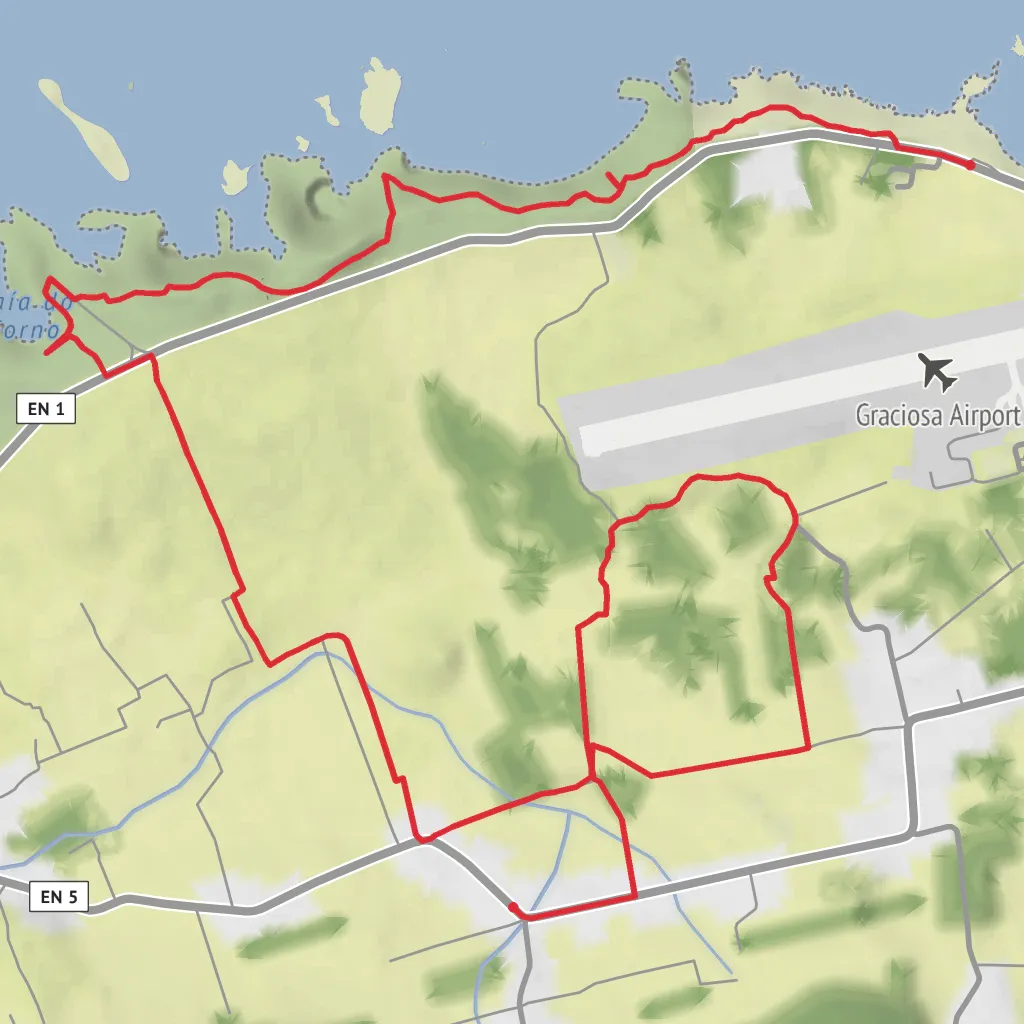
This easy coastal-and-vineyard walk on Graciosa covers about 6.6 km / 4.1 miles with only modest climbing, roughly 100 m / 330 ft overall, but it feels more like a scenic ramble than a sustained ascent. The route links the rural settlement of Bom Jesus, near the old primary school and 19th-century fountain in Santa Cruz da Graciosa, to the bathing area at Barro Vermelho, passing through vineyard country, lava-built field enclosures, sea cliffs, and one of the island’s standout coastal viewpoints. Official trail information places it in the parish of Santa Cruz da Graciosa and describes it as a linear route ending at Barro Vermelho. (trails.visitazores.com)
The opening section moves through a distinctly Azorean agricultural landscape. You begin beside traditional rural houses and soon enter the vineyard zone of Bom Jesus and Achada, where the land is divided by countless basalt-stone currais—small protective enclosures built to shelter vines from salt spray and wind. These walls are one of the defining visual features of the hike, and they also carry much of its historical significance: they reflect centuries of adaptation to volcanic terrain and harsh Atlantic exposure, and the ruins of former wine cellars along the route show how important viticulture once was here. Graciosa is one of the Azorean islands with a long wine tradition, and the trail is effectively a walk through that cultural landscape. (trails.visitazores.com)
What the route feels like
Underfoot, expect a mix of quiet paved lanes, old cobbled stretches, and dirt or farm-track sections rather than technical mountain terrain. The elevation profile is gentle, so the main challenge is not steepness but exposure: there is little shelter from sun, wind, or sea spray in places. Even on an easy day, sturdy walking shoes are worthwhile because the stone surfaces can be uneven, especially where old paving or rough volcanic ground appears. The official average time is about 2 hours 30 minutes, which suits a relaxed pace with stops at viewpoints. (trails.visitazores.com)
A notable landmark early to mid-route is the Achada windmill, a classic Graciosa feature. The island is known for its traditional windmills with red domes, reminders of the cereal production that once earned Graciosa the nickname of the “breadbasket of the Azores.” Passing the windmill and nearby water reservoir adds another layer to the walk: this is not just a coastal outing, but a route through an inhabited working landscape shaped by farming, grain, and wine. (trails.visitazores.com)
Coastline, lighthouse, and wildlife
After the vineyard sections, the route turns toward the sea and reaches Baía do Forno, then continues to the Ponta da Barca Lighthouse. This lighthouse is especially significant because its tower rises 23 m / 75 ft, making it the tallest lighthouse in the Azores. From here, one of the signature sights is Ilhéu da Baleia, a geosite formed from the volcanic chimney of an ancient cone, later sculpted by marine erosion into its striking whale-like form. This is one of the best places on the walk to pause, scan the horizon, and appreciate how volcanic geology defines the island’s coastline. (trails.visitazores.com)
The coastal stretch is also the section where hikers should pay closest attention to conditions. The route passes near bays and inlets exposed to Atlantic weather, and while the walking itself is not difficult, wind can be strong and cliff-edge areas deserve care, especially in wet weather or with children. If visibility is poor, using HiiKER to keep track of the linear route is sensible, particularly where farm tracks and paved connectors meet. The trail is waymarked, but open terrain can make junctions feel less obvious than they look on paper. The same exposed coastline supports seabird habitat, and the official trail notes the presence of species such as Monteiro’s storm petrel, Cory’s shearwater, Barolo shearwater, and common tern in the surrounding coastal environment. (trails.visitazores.com)
One of the most memorable visual moments comes at the natural lookout over the grid of quadrangular vineyard enclosures surrounding the airport runway. It is an unusual juxtaposition: traditional stone-walled vine plots beside modern island infrastructure, all set against the ocean. That contrast says a lot about Graciosa itself—small-scale,
Surfaces
Ground
Grass
Unknown
Asphalt
Comments and Reviews
User comments, reviews and discussions about the Das Vinhas ao Mar, Baia do Forno and Barro Vermelho, Portugal.
average rating out of 5
0 rating(s)


