
Download
3D Flyover
Add to list
More
19.3 km
~4 hrs 47 min
559 m
Point to Point
“From emerald caldera heights to Capelinhos’ ash-blown shore, Faial’s volcanic story unfolds step by step.”
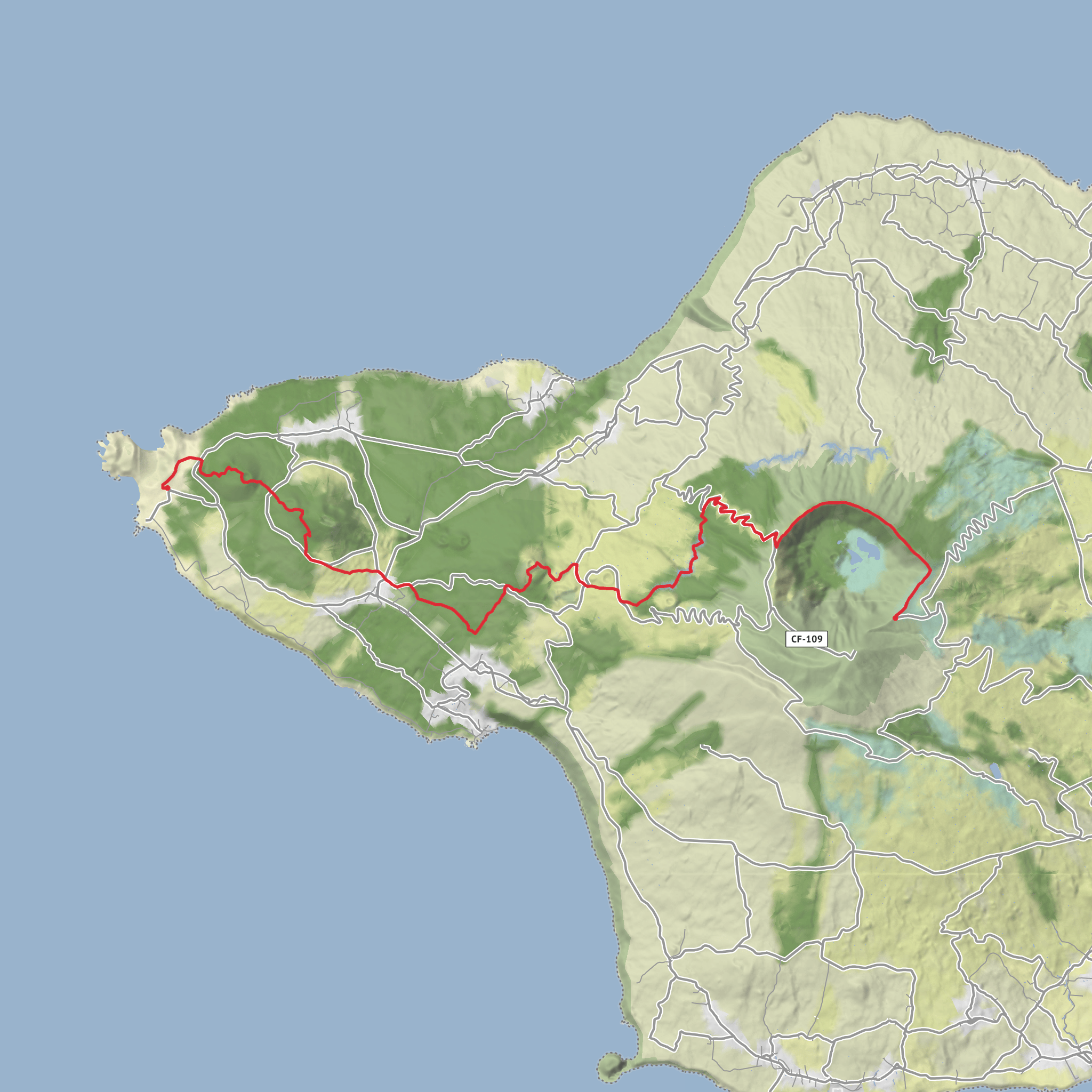
This is one of Faial’s great volcanic traverses: a point-to-point walk of about 19 km / 11.8 miles with roughly 600 m / 1,970 ft of ascent, starting high on the island near the Caldeira Viewpoint (Miradouro da Caldeira / Cabeço Gordo area) and finishing by the Capelinhos Volcano Interpretation Centre car park on the far western end of Faial. The route links the island’s central caldera to the Capelo volcanic ridge and the stark ash fields of Capelinhos, crossing protected landscapes that show, almost step by step, how Faial was built by fire. (trails.visitazores.com)
Although often rated medium, it feels more serious than many hikes in that category because of its length, exposed upland sections, frequent weather changes, and the sustained descent from the high interior toward the coast. The trail begins around 800–900 m / 2,625–2,950 ft above sea level and ends at sea level, so even though the total climbing is moderate, your legs still take a long pounding on the way down. Good visibility matters here: official trail information specifically advises doing this route in good weather because cloud, wind, and mist can transform the caldera rim and volcanic ridge into a much more committing day. (trails.visitazores.com)
The opening section near the Caldeira is among the most dramatic on Faial. The caldera itself sits in the island’s central volcano and is about 2 km / 1.2 miles across and roughly 400 m / 1,312 ft deep, with a lush interior of native vegetation protected for its ecological value. Early on, expect broad views into this immense crater and across the island if the cloud lifts. This is not a place to rush: the terrain is volcanic, the weather can be raw, and the scenery is the kind that rewards frequent stops. (turismo.azores.gov.pt)
What the route feels like
From the caldera area, the trail trends away from the central volcano and onto the line of cones that forms the Capelo volcanic complex. This is where the walk earns its name. You move through a sequence of old volcanic landforms, forest tracks, open slopes, and pastoral ground, with the landscape gradually changing from green uplands to darker, younger volcanic terrain. The official route description notes passages through woods, cultivated areas, and pastures, as well as landmarks including Furna Ruim, Algar do Caldeirão, Cabeço do Canto, and the Cabeço do Fogo viewpoint before the final approach toward Capelinhos. (trails.visitazores.com)
A useful way to think about the day is in thirds. The first third is the high volcanic world around the Caldeira, often cool, damp, and windy. The middle third moves through the ridge and cone country, where you begin to notice more variation in footing and more signs of Faial’s agricultural landscape. The final third becomes increasingly stark and geologically raw as you approach Capelinhos, where ash, cinder, and exposed coastal views dominate. (trails.visitazores.com)
Landmarks, geology, and historical significance
The historical and geological interest on this hike is exceptional. Faial is entirely volcanic, and this route effectively traces the island’s structure from the central caldera toward one of the Azores’ most famous eruption sites. The line from Caldeira to Capelinhos follows the volcanic alignment of the Capelo peninsula, marked by scoria cones and lava fields. (trails.visitazores.com)
One of the most important landmarks is Cabeço do Fogo, associated with the historic 1672–73 eruption, an event that reshaped part of Faial and remains one of the island’s major volcanic episodes before Capelinhos. On clear days, viewpoints in this section help you understand how successive eruptions built overlapping cones and lava landscapes across western Faial. (itrails.visitazores.com)
The finish at Capelinhos Volcano carries even greater modern historical weight. The 1957–58 Capelinhos eruption enlarged Faial, buried parts of the old landscape in ash, damaged settlements, and triggered a major wave of emigration from the island. The lighthouse and the Interpretation Centre are powerful reminders that this is not ancient geology alone but living, recent history within local memory. Reaching Capelinhos on foot
AI Planner
Days planned around your pace, with somewhere to stay each night.
Surfaces
Unknown
Unpaved
Dirt
Asphalt
Ground
Gravel
Sand
Cobblestone
Comments and Reviews
User comments, reviews and discussions about the Dez Vulcões - Faial, Portugal.
average rating out of 5
0 rating(s)

