
Download
3D Flyover
Add to list
More
2.5 km
~50 min
204 m
Loop
“A short, punchy volcanic ramble through forest and craters, with unexpectedly rugged Azorean drama.”
This short but surprisingly rugged volcanic walk on Faial Island packs a lot into roughly 3 km / 1.9 miles, with about 200 m / 656 ft of climbing, so it feels much more demanding than the distance suggests. The route is generally identified as PRC 01 FAI Cabeço do Canto and is set within the protected central landscape of Faial, on the volcanic ridge of the Capelo Peninsula, an area known for its chain of around 20 volcanic cones stretching toward Capelinhos. (trails.visitazores.com)
The start is near the access road to Cabeço Verde, close to the volcanic highlands above Capelo, Horta, Faial, Azores, with the mapped trailhead at approximately 38°35'36.39"N, 28°48'5.68"W. The nearest practical landmark for most hikers is Cabeço Verde Viewpoint / Miradouro do Cabeço Verde, which is the clearest place to aim for by car or taxi. (trails.visitazores.com)
By car, the easiest approach is from Horta via the roads leading west toward Capelo and Capelinhos, then turning onto the access road for Cabeço Verde. Parking is typically done near the trail access road rather than at a large formal trailhead. Public transport on Faial can be limited, but the official trail material indicates bus access in the area; in practice, hikers usually need to check current island bus service toward Capelo/Capelinhos and be prepared for a short road walk or to use a taxi from Horta if schedules do not line up well. For route-finding on the ground, HiiKER is the best tool to use alongside local trail signage. (trails.visitazores.com)
What the route is like
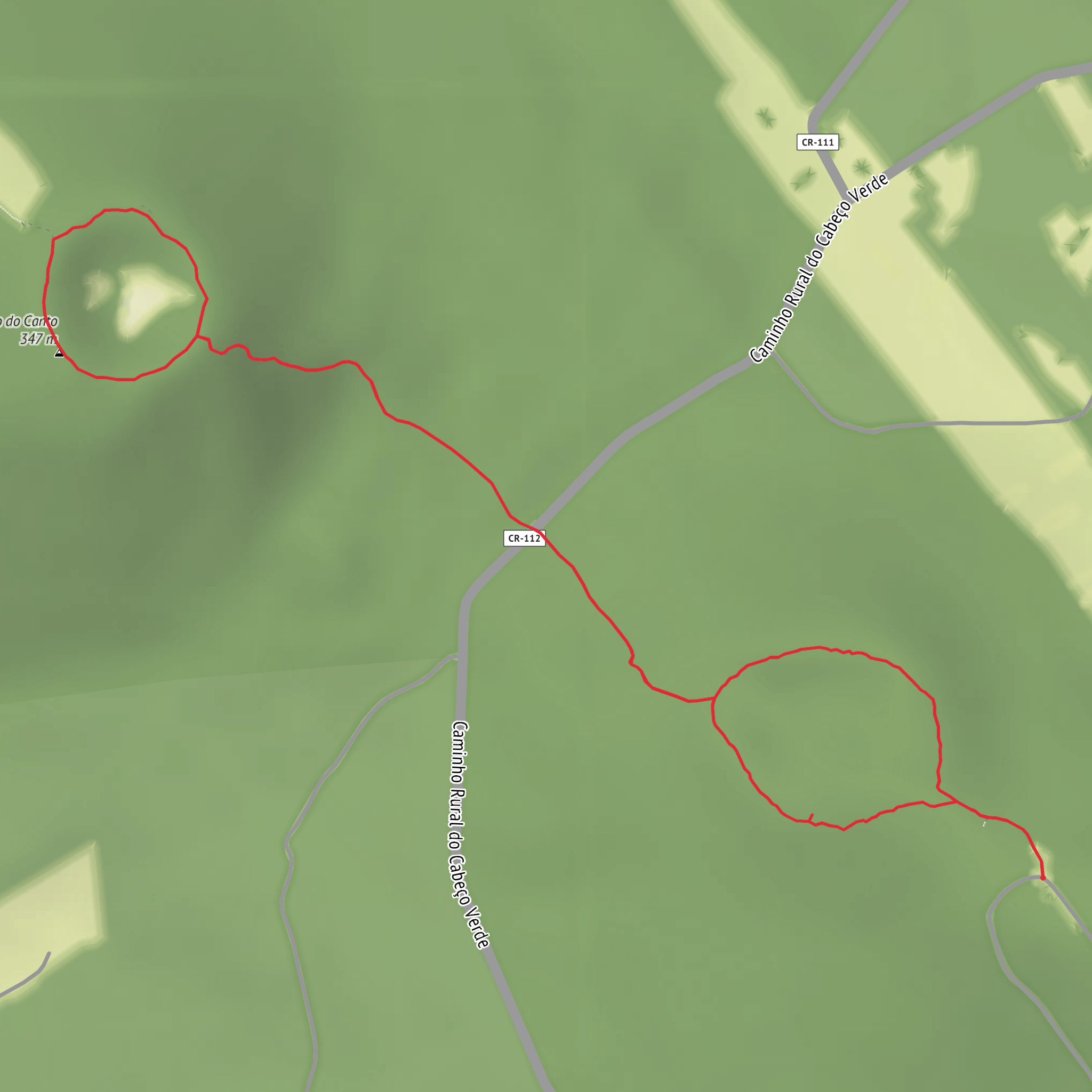
The walk begins by heading left through woodland toward Furna Ruim, a lava pit around 55 m / 180 ft deep. This is one of the first major features and immediately sets the tone: this is a hike through raw volcanic terrain rather than a gentle countryside stroll. The path then continues toward Algar do Caldeirão, another volcanic cavity that the route skirts on the right, before dropping through forest and later climbing again toward Cabeço do Canto. After crossing a lapilli or cinder road carefully, the trail rises by a staircase to the cone itself, which is then circled on the left before returning by the same general line. (trails.visitazores.com)
Although the official route length is about 2.6 km / 1.6 miles, hikers often round it to around 3 km / 1.9 miles. The terrain is described as undulating, but the combination of short steep sections, loose volcanic surfaces, and repeated ups and downs can make it feel strenuous, especially in wet or windy weather. (trails.visitazores.com)
Terrain, exposure, and difficulty
A “difficult” expectation is reasonable for many walkers, even though some official material rates the route as medium. The challenge comes less from distance and more from footing and gradient. Expect narrow trail sections through woodland, uneven ground around volcanic features, cinder or gravel road crossings, and a sharper climb up steps toward Cabeço do Canto. In damp conditions, roots, mud, and loose lapilli can make the route more slippery than the mileage suggests. (trails.visitazores.com)
Good footwear matters here. Boots or trail shoes with solid grip are far more useful than lightweight casual shoes. Windproof layers are also worth carrying because this part of Faial can change quickly from sheltered forest to exposed volcanic ridge. Low cloud is common in the Azores, and visibility can shift fast, so even on a short route it is wise to carry water, a waterproof shell, and enough layers for cooler summit conditions. (trails.visitazores.com)
Landmarks, views, and natural interest
The standout landmarks are the volcanic features themselves: Furna Ruim, Algar do Caldeirão, and the cone of Cabeço do Canto. From the higher ground, the route opens up views toward Vulcão dos Capelinhos, one of the Azores’ most famous volcanic landscapes. At the end, many hikers also continue by road to Cabeço Verde, which offers a broader panorama over **Praia
Surfaces
Ground
Unpaved
Unknown
Paved
Comments and Reviews
User comments, reviews and discussions about the Caldeirao and Cabeço do Canto, Portugal.
average rating out of 5
0 rating(s)
