
Download
3D Flyover
Add to list
More
125.5 km
7 days
0 m
Multi Day
“A wind-bared, water-hugging loop of dikes and reedbeds beneath huge skies—best for well-prepared walkers.”
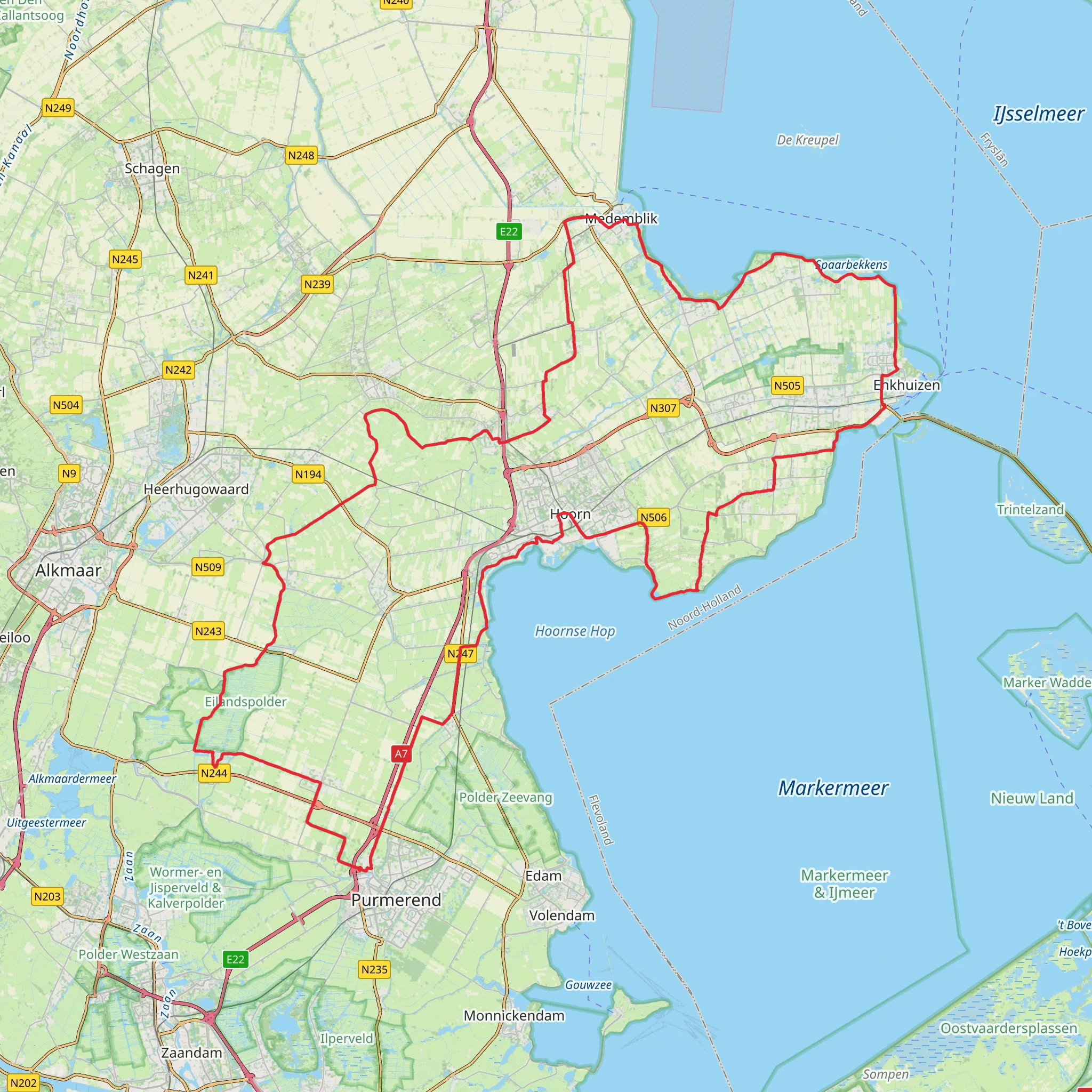
This is a big, flat, water-shaped loop through North Holland’s classic “low country”: long dikes, huge skies, reedbeds, and wide views over the Markermeer and IJsselmeer, then inland through the Eilandspolder’s wet meadows and canals. At roughly 125 km (78 mi) with about 0 m / 0 ft of climbing, the challenge isn’t elevation—it’s wind exposure, long distances between shelter, and staying oriented on a web of dikes, farm roads, and canal-side paths.
A practical place to base the start is De Rijp, a historic village on the edge of the Eilandspolder. A reliable landmark/address to aim for is the VVV office in De Rijp (Kleine Dam 1, 1483 BJ De Rijp, Netherlands), which is commonly used as a start point for routes around the Eilandspolder. (natuurwegwijzer.nl)
Getting to the start (De Rijp / Kleine Dam 1)
By public transport
- De Rijp is reachable by regional buses; one commonly referenced option is bus line 100 from Amsterdam Centraal (Amsterdam CS) (also serving Purmerend), then walk into the village center toward Kleine Dam. (natuurwegwijzer.nl)
- For planning exact connections and walking links on the day, build the trip in HiiKER (and cross-check with local transit planners once you’ve chosen your exact start time).
By car - Drive toward De Rijp via the N244, take the De Rijp exit, and follow signs to the center (parking availability varies by day/time; arrive early if you want an easy spot). (natuurwegwijzer.nl)
What the terrain is like (and why “easy” still needs planning)
Expect paved dike tops, narrow asphalt farm lanes, compacted gravel, and grassy levee edges. After rain, the grassy margins and canal-side tracks can be slick. Because you’re often walking on raised dikes with open water or drainage canals on one or both sides, the “hazards” are mostly: - Strong crosswinds off the Markermeer/IJsselmeer and across open polders (fatigue and chill add up fast). - Long, straight, exposed sections with few services. - Navigation complexity where multiple dikes and parallel farm roads look identical—use HiiKER to keep the correct line when the landscape becomes repetitive.
Plan this as a 2–4 day hike for most walkers (or longer if you want time for towns, museums, and birdwatching). Even though the elevation gain is near zero, the distance is substantial.
Along the big water: Markermeer and IJsselmeer edges
As you swing out toward the lake edges, the landscape becomes a study in Dutch water engineering: long, ruler-straight defenses and reclaimed land patterns. The Markermeer and IJsselmeer are both products of the Zuiderzee Works, the massive 20th-century project that transformed a dangerous saltwater inlet (the Zuiderzee) into managed freshwater lakes and polders. The Afsluitdijk closed off the Zuiderzee in 1932, creating the IJsselmeer; later works and dikes separated waters and enabled further land reclamation. (en.wikipedia.org)
You’ll notice how “engineered” the horizons feel: dike crests, pumping infrastructure, straight drainage lines, and towns that historically lived by the sea but now sit beside freshwater. This is also where wind can be most relentless—if the forecast calls for sustained wind, consider timing these exposed legs early in the day.
Eilandspolder: wet meadows, reedbeds, and big birdlife
Inland, the character shifts to the Eilandspolder, a protected wetland-polder mosaic wedged between the reclaimed lands of Beemster and Schermer. It’s a **Natura 200
AI Planner
Days planned around your pace, with somewhere to stay each night.
Surfaces
Asphalt
Unknown
Grass
Concrete
Paved
Wood
Comments and Reviews
User comments, reviews and discussions about the Markermeer, Ijsselmeer and Eilandspolder Loop, Netherlands.
average rating out of 5
0 rating(s)



