
Download
3D Flyover
Add to list
More
40.6 km
2 days
0 m
Multi Day
“A big-sky Zeeland polder loop of arrow-straight dikes, creeks, and sea-bound horizons—best for walkers ready for wind and all-day sameness.”
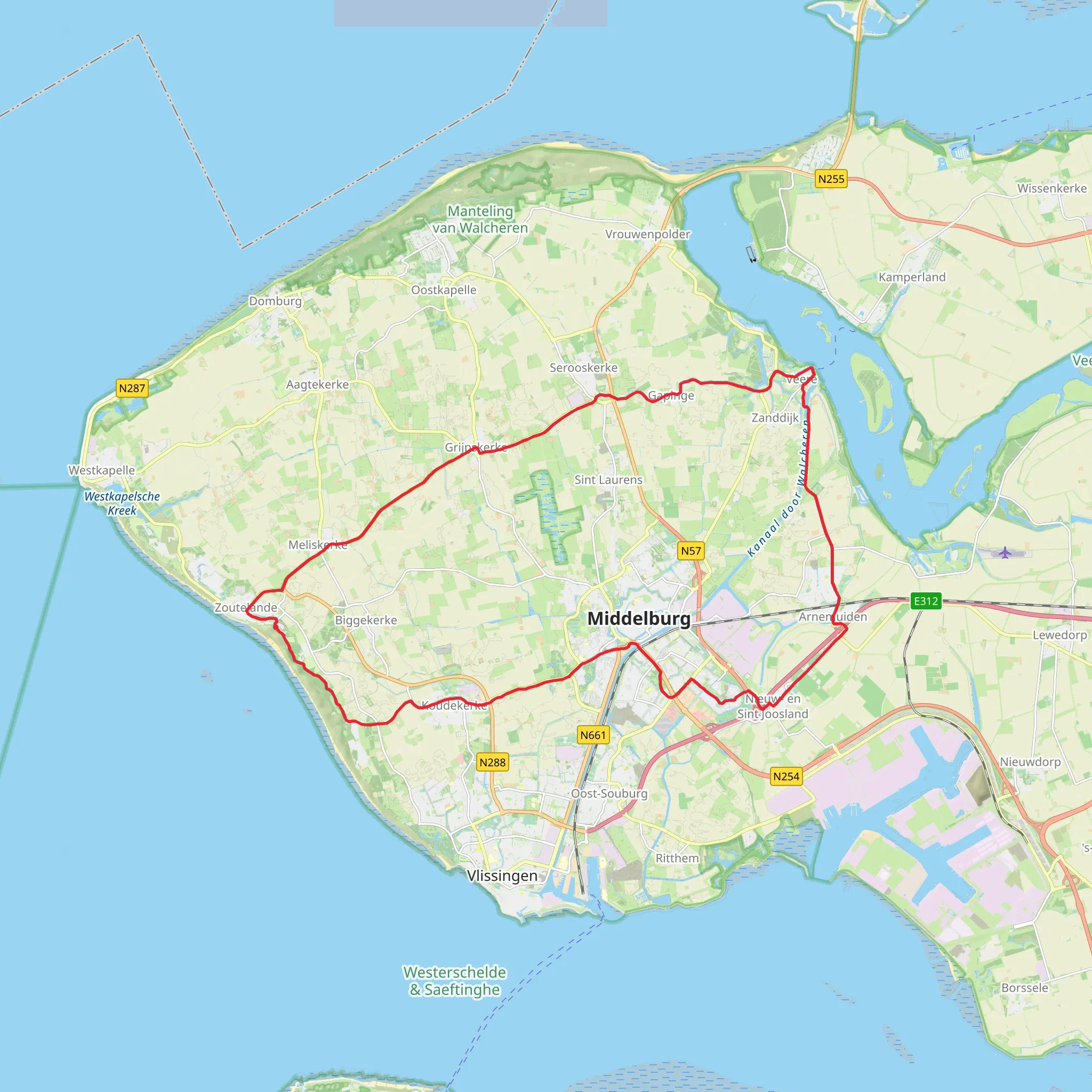
A flat, big-sky loop through Zeeland’s coastal polders and creek-country, this walk strings together long, straight dike-top paths, quiet farm lanes, and open views that seem to run all the way to the North Sea. At roughly 40 km / 24.9 mi with about 0 m / 0 ft of climbing, it’s physically “easy” in terms of elevation, but it’s a full-day distance where wind exposure and underfoot monotony can be the real challenge.
Getting to the start (car + public transport)
Because the start point is listed only as “near” (no coordinates provided), the most reliable way to pinpoint the exact trailhead is to open the route in HiiKER and use its start-point pin to identify the closest village/road junction. Once you have that pin, you can match it to the nearest signed road or landmark.
That said, this loop’s road names (Strandweg, Kreekweg, Hondegemsweg) strongly suggest a rural Zeeland setting (Netherlands/Belgium border region style polder lanes). Typical access looks like this:
- By car: Aim for the nearest village center to the HiiKER start pin and park where you won’t block farm traffic—common options are church squares, small public pull-ins near dikes, or designated village parking bays. Avoid parking on narrow dike roads or on verges with soft shoulders (they can collapse under a wheel).
- By public transport: Zeeland and Zeeuws-Vlaanderen-style rural areas often mean bus-to-village, then a short walk to the start. Use the nearest village name from the HiiKER pin, then check regional bus routes to that village. Plan for limited service on Sundays/holidays and earlier last buses than you’d expect.
If you share the start coordinates (or a HiiKER link), I can convert the lon/lat to the nearest known address or prominent landmark precisely.
What the terrain feels like (and why “easy” still needs planning)
Expect dead-flat grades on: - Dike crests (often gravel, compacted dirt, or short grass) - Farm access lanes (asphalt or concrete strips) - Field-edge tracks (can be muddy after rain)
With essentially no elevation gain, pacing is straightforward—your main variables are wind, surface softness, and distance. On a 40 km / 24.9 mi day, even a small headwind can add an hour or more of effort.
Underfoot + footwear
- In dry spells: firm, fast walking on dikes and lanes.
- After rain: clay-rich polder soils can turn slick and sticky, especially on field-edge tracks; traction matters more than cushioning.
- Footwear: light hikers or trail shoes are fine, but choose something with reliable grip for wet grass and mud.
Navigation
The landscape can look repetitive—parallel ditches, straight roads, and long dikes that all resemble each other. Keep HiiKER handy and check it at every major junction, especially where multiple farm tracks meet or where a dike path drops to a lane.
The route character: Strandweg → Kreekweg → Hondegemsweg
While the exact sequence depends on the mapped line, the names hint at three distinct “feels” you’ll cycle through:
Strandweg stretches (coastal edge feel)
“Strandweg” typically indicates a road historically tied to the shoreline, dunes, or former shoreline. Even if you’re not directly on sand, you’ll often get: - Wider horizons and stronger wind - Brackish drainage channels and reedbeds - Occasional glimpses toward coastal defenses (dikes, sluices, pumping infrastructure)
Look out for fast-moving cyclists if it’s a shared path, and for open, unshaded exposure—sun and wind are constant companions here.
Kreekweg sections (creek ridges and old waterways)
“Kreek” refers to tidal creeks—old channels that once carried seawater inland before land reclamation and diking reshaped the region. These creek lines often sit slightly higher than surrounding fields (sometimes only subtly), and they’re ecological corridors: - Reeds, willows, and wetter margins - More bird activity along water edges - Occasional small bridges/culverts where drainage is managed
Wildlife you’re likely to notice: - Geese, swans, ducks, and waders in wetter plots - Grey heron and possibly egrets along ditches - Raptors (like kestrels) hovering over fields in open country
Hondegemsweg lanes (quiet agricultural backroads)
These are the long, steady kilometers where you settle into rhythm: - Big fields, drainage ditches, and farmyards - Very limited services—plan as if there are no water taps and no shops - Potential for farm machinery: tractors can appear suddenly and take up the full lane
Be prepared for gates or livestock fencing if the route uses permissive paths; if you encounter cattle, give them space and pass calmly and wide.
Landmarks, nature, and what to watch for
Water management infrastructure
This region’s “landmarks” are often functional rather than monumental: - Sluices, pumping stations, culverts, and canal locks - Dike reinforcement works (rock armoring, sheet piling, new gravel caps)
These features are part of the long history of land reclamation and flood defense that defines Zeeland and the wider Low Countries. Even when you don’t see a museum plaque, the straight canals, raised
AI Planner
Days planned around your pace, with somewhere to stay each night.
Surfaces
Unknown
Asphalt
Concrete
Cobblestone
Paved
Comments and Reviews
User comments, reviews and discussions about the Strandweg, Kreekweg and Hondegemsweg Loop, Netherlands.
average rating out of 5
0 rating(s)



