
Download
3D Flyover
Add to list
More
30.9 km
2 days
30 m
Multi Day
“A long, gentle estate loop of forest lanes and breezy heath—easy on climbs, steady on stamina.”
This is a long, low-relief loop of roughly 31 km (19.3 mi) with essentially 0 m (0 ft) of sustained climbing—expect it to feel “easy” in terms of elevation, but moderate in terms of time-on-feet (most hikers take 6–8+ hours depending on pace and stops). The terrain is typically a mix of wide forest tracks, sandy paths, heathland lanes, and quiet estate roads, so it’s ideal for steady walking and efficient pacing.
Because your start point is listed only as “near” (and no coordinates were provided), I can’t convert a lon/lat to a nearby address or landmark yet. If you share the start coordinates (or the GPX), I’ll pin it to the nearest recognizable place (for example, a station, car park, or named estate entrance) and tailor the access directions precisely.
Getting to the start (car + public transport)
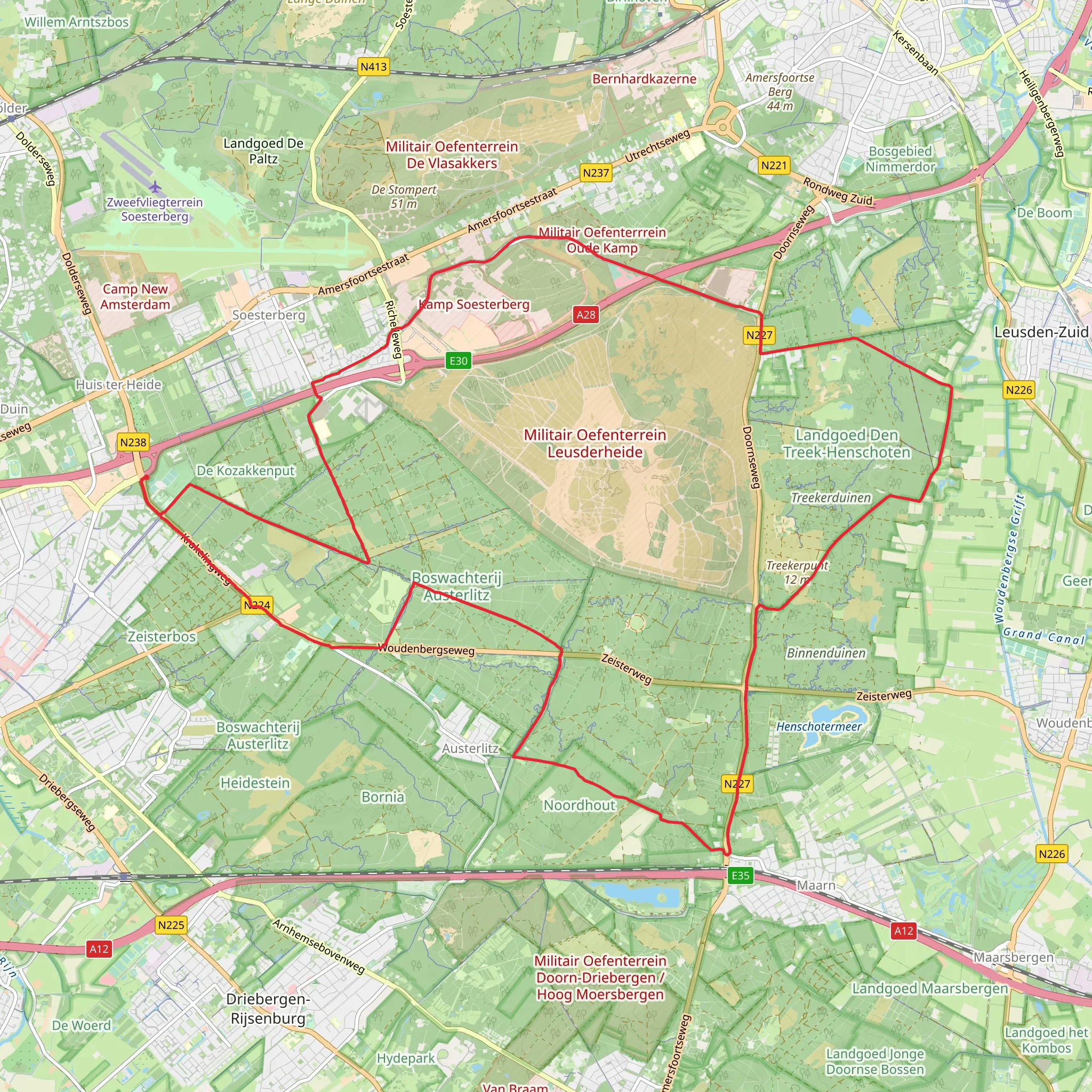
This loop’s place names strongly suggest the Utrechtse Heuvelrug / Leusden–Woudenberg area in the central Netherlands, where “Treekerpunt” and “Het Witte Huis” are commonly associated with the Treekerlandgoed (Treeker Estate) and surrounding heath/woodland.
- By car: In this region, starts are often easiest from a signed trailhead car park (P-plaats) near an estate entrance or a recreation area on the edge of the woods/heath. Plan for paid parking in some lots and busier conditions on weekends, especially near popular heathland viewpoints.
- By public transport: The most practical approach is usually train to a nearby town station (often in the Amersfoort/Leusden/Woudenberg orbit) and then bus + short walk to an estate edge or trailhead. In the Netherlands, buses can be frequent on weekdays but thinner on Sundays—check the last return service before committing to the full 31 km (19.3 mi).
If you tell me the intended start (coordinates or a meeting point), I’ll give you the exact station/bus stop pairing and the most straightforward walking link to the trail.
What the route feels like underfoot
With negligible elevation gain, the main “difficulty” variables are: - Surface: sandy stretches can be energy-sapping, especially if dry; forest tracks are faster. - Exposure: heathland can be windy and feel colder than the forest even on mild days. - Distance management: 31 km (19.3 mi) rewards a conservative start—keep the first 5–8 km (3–5 mi) relaxed.
Expect long, runnable straights through managed woodland alternating with more open heath where the horizon widens and navigation becomes more “choose the correct junction” than “follow the obvious corridor.”
Landmarks and character along the loop
The names in your loop hint at three distinct “anchors,” which typically break the day into natural segments:
- Oude Kamp: Often used locally for older field/encampment/place-name areas tied to historic land use—think older agricultural clearings, estate boundaries, and long-established tracks. In these landscapes, you’ll often notice straight lines of planted forest (production woodland) giving way to irregular edges where older land parcels once met.
- Treekerpunt: “Punt” suggests a notable point—commonly a junction, viewpoint, boundary marker, or named spot on the estate. These points are frequently where multiple tracks converge, so it’s a good place to confirm your position in HiiKER and decide whether you want a short pause before the next long leg.
- Het Witte Huis (“The White House”): In Dutch countryside contexts, this is often a named building, inn, farmhouse, or estate structure that stands out visually and historically. Even when it’s not open to the public, it’s typically a reliable navigation reference and a good mental milestone late in the loop.
Forest, heath, and estate edges
A hallmark of this region is the mosaic of: - Heathland (heide): open, low vegetation with sandy soils; late summer can bring purple heather blooms in places. - Mixed woodland: pine and deciduous stands; you’ll often see managed forestry patterns. - Estate lanes and boundary features: ditches, old banks, and long straight rides that reflect centuries of land management.
You’ll likely pass through zones where the path alternates between soft sand and firm compacted track—if you’re trying to keep a steady pace, adjust effort rather than speed on the sandy parts.
Nature and wildlife to look out for
In central Dutch heath-and-wood landscapes, common sightings and signs include: - Roe deer (roe hert): most active early/late; you may see them crossing rides or standing at woodland edges. - Foxes and hares: often more visible in open heath margins. - Birdlife: buzzards overhead, woodpeckers in mature stands, and heath-associated species in open areas. - Insects/ticks: in warmer months, ticks can be present in grass/heath edges—long socks and a post-hike check are sensible.
Stay on established paths where requested—heathland can be ecologically sensitive, and some areas may have seasonal management or grazing.
Navigation and wayfinding (HiiKER)
This is the kind of loop where you can feel like you’re “always on a path,” yet still lose time at multi-track junctions. Use HiiKER to: - confirm you’ve taken the correct branch at major intersections (especially near named points like Treekerpunt), - watch for short “connector” segments that can be easy to
AI Planner
Days planned around your pace, with somewhere to stay each night.
Surfaces
Asphalt
Unknown
Concrete
Sand
Unpaved
Dirt
Comments and Reviews
User comments, reviews and discussions about the Oude Kamp, Treekerpunt and Het Witte Huis Loop, Netherlands.
average rating out of 5
0 rating(s)

