Download
3D Flyover
Add to list
More
21.2 km
~4 hrs 14 min
0 m
Point to Point
“From Ysselsteyn’s quiet lanes to Overloonsche Duinen’s pine-and-heather sands, a flat-but-effortful drift through changing Dutch countryside.”
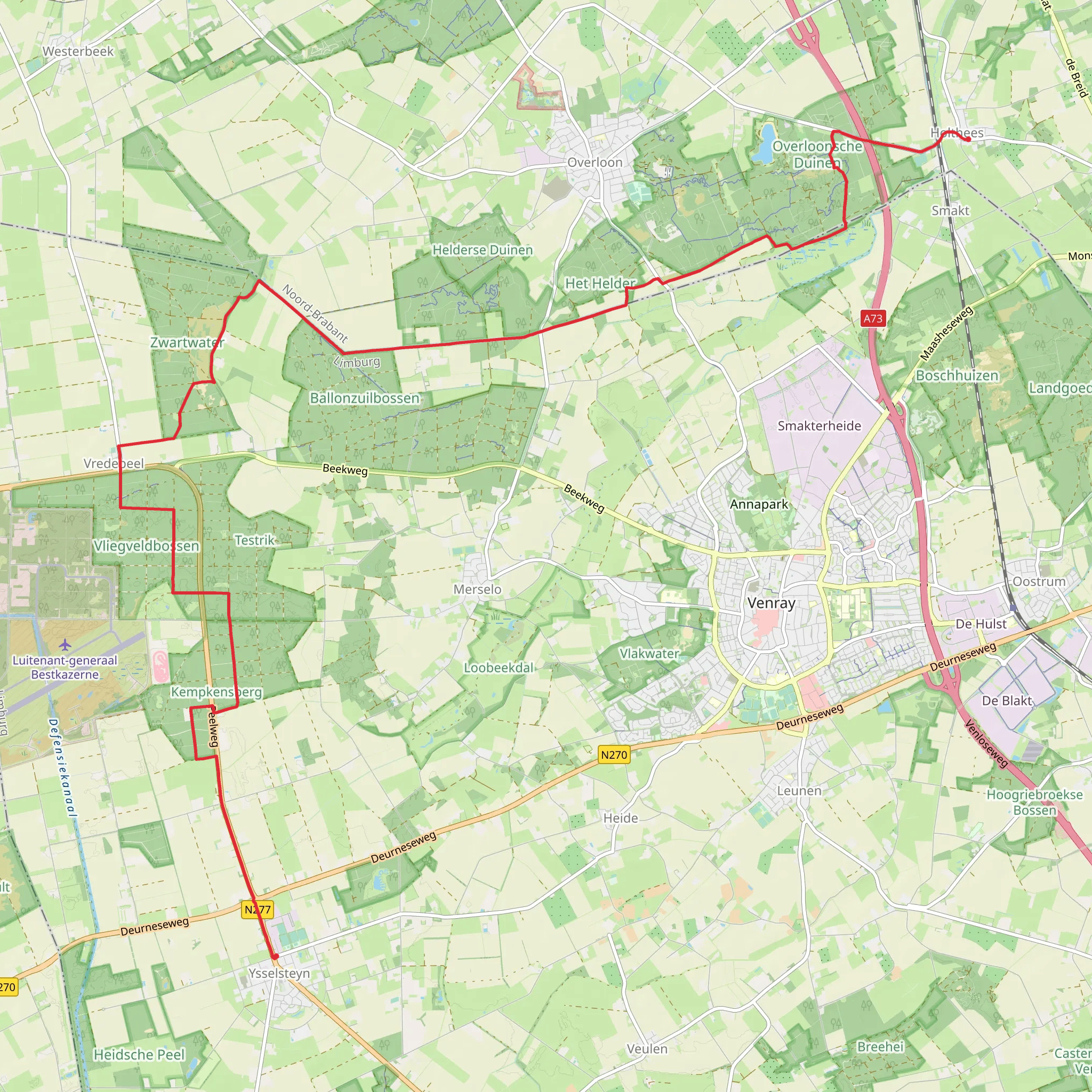
This is a mostly level, point-to-point walk of about 21 km (13.0 mi) with negligible elevation gain (≈0 m / 0 ft), linking the village edge of Ysselsteyn through quiet Limburg/Brabant countryside and into the sandy, pine-and-heath landscapes around Overloonsche Duinen, finishing near Rodermansstraat (a local street name used in the Overloon area). Expect a mix of farm tracks, village lanes, forest paths, and sandy sections where footing can slow you down despite the “easy” profile.
Getting to the start (Ysselsteyn area)
Start area landmark (nearest known place): the walk is best approached from the village center around St. Oda Church (Sint-Odac kerk), Ysselsteyn (Limburg, NL) and the nearby main village streets. If you’re using HiiKER, match your start pin to the closest access point on the route near the village edge.
By car - Ysselsteyn is a small village near Venray. The simplest approach is to drive toward Ysselsteyn village center and park considerately on public roadside spaces near the church or designated village parking areas (where signed). Avoid blocking farm gates—this route quickly transitions onto agricultural access roads that are actively used.
By public transport - The most practical rail hub is typically Venray. From there, local buses/taxis or a short bike ride can get you to Ysselsteyn. Bus routing can be infrequent in rural areas, so check the day-of schedule and plan a buffer. If you’re coordinating a point-to-point finish, it’s often easiest to arrange a pickup near Overloon (close to Rodermansstraat) and use public transport only on one end.
What the route feels like underfoot
The first third is generally firm and fast: village pavements, compacted farm lanes, and straight agricultural tracks. As you approach Het Helder and then the Overloonsche Duinen, surfaces become more varied—pine-needle singletrack, sandy stretches, and occasional rooty patches. Even with essentially no climbing, the sand can add effort; allow extra time if it’s dry and loose.
Plan roughly: - 21 km (13.0 mi) total - 4.5–5.5 hours at an easy-to-moderate walking pace with short stops (sand and navigation checks can slow you)
Early kilometres: Ysselsteyn to Het Helder (approx. 0–7 km / 0–4.3 mi)
Leaving the village edge, you’ll move through open farmland typical of this part of the Netherlands: long, straight field boundaries, drainage ditches, and shelterbelts of trees that break the wind. The walking is uncomplicated, but pay attention at junctions where multiple farm tracks run parallel—use HiiKER to confirm you’re on the correct line, especially if visibility is reduced by hedgerows or seasonal crops.
Wildlife here is subtle but present: - Hares and rabbits in field margins - Buzzards and kestrels hovering over open ground - In wetter ditch lines, you may spot frogs and water-loving birds
Look out for: - Agricultural traffic (tractors move quickly and quietly on straight lanes) - Soft verges beside ditches—step carefully, especially after rain
Middle section: Het Helder and the transition into Overloonsche Duinen (approx. 7–15 km / 4.3–9.3 mi)
Forest edge, heath hints, and sand underfoot
As you near Het Helder, the landscape begins to shift from open fields to more wooded ground. You’ll start seeing more conifers and mixed woodland, and the path character changes: narrower tracks, occasional sandy patches, and more frequent turns. This is where “easy” can feel deceptively tiring—sand and uneven forest floor demand more from ankles and calves than flat pavement.
Expect: - Pine forest with a springy needle layer - Heathland pockets (seasonal color changes; late summer heather can be striking) - Sandy soil that can be loose in dry spells and compact after rain
Wildlife becomes more forest-oriented: - Roe deer are possible at dawn/dusk along forest edges - Woodpeckers and small songbirds in the pines - In warm months, insects can be persistent—bring repellent if you’re sensitive
Practical notes: - In the dunes/forest, landmarks are fewer than in farmland. Keep HiiKER handy at intersections where multiple sandy tracks braid together. - After storms, watch for fallen branches and occasional short detours around windthrow.
Overloonsche Duinen to Rodermansstraat (approx. 15–21 km / 9.3–13.0 mi)
The Overloonsche Duinen area is known for its inland dune character—low, rolling sandy terrain rather than dramatic hills, but enough micro-relief to create constant small changes in footing. You’ll likely pass through a mosaic of pine stands, open sandy clearings, and scrubby edges where birch and heather take hold.
Footing and pacing: - Sandy stretches can slow you by 10–20% compared with firm tracks. - If it’s been wet, sand firms up but can hide puddles in low spots.
As you approach the finish near Rodermansstraat (Overloon vicinity), you’ll transition back toward more managed edges—wider tracks, occasional
AI Planner
Days planned around your pace, with somewhere to stay each night.
Surfaces
Unknown
Concrete
Asphalt
Paved
Sand
Unpaved
Comments and Reviews
User comments, reviews and discussions about the Ysselsteyn to Rodermansstraat via Het Helder and Overloonsche Duinen, Netherlands.
average rating out of 5
0 rating(s)