
Download
3D Flyover
Add to list
More
14.7 km
~2 hrs 57 min
12 m
Loop
“Drift through quiet estate lanes and sun-dappled woods, linking Tonnenberg, Kamperklippen, and Vosbergen’s castle calm.”
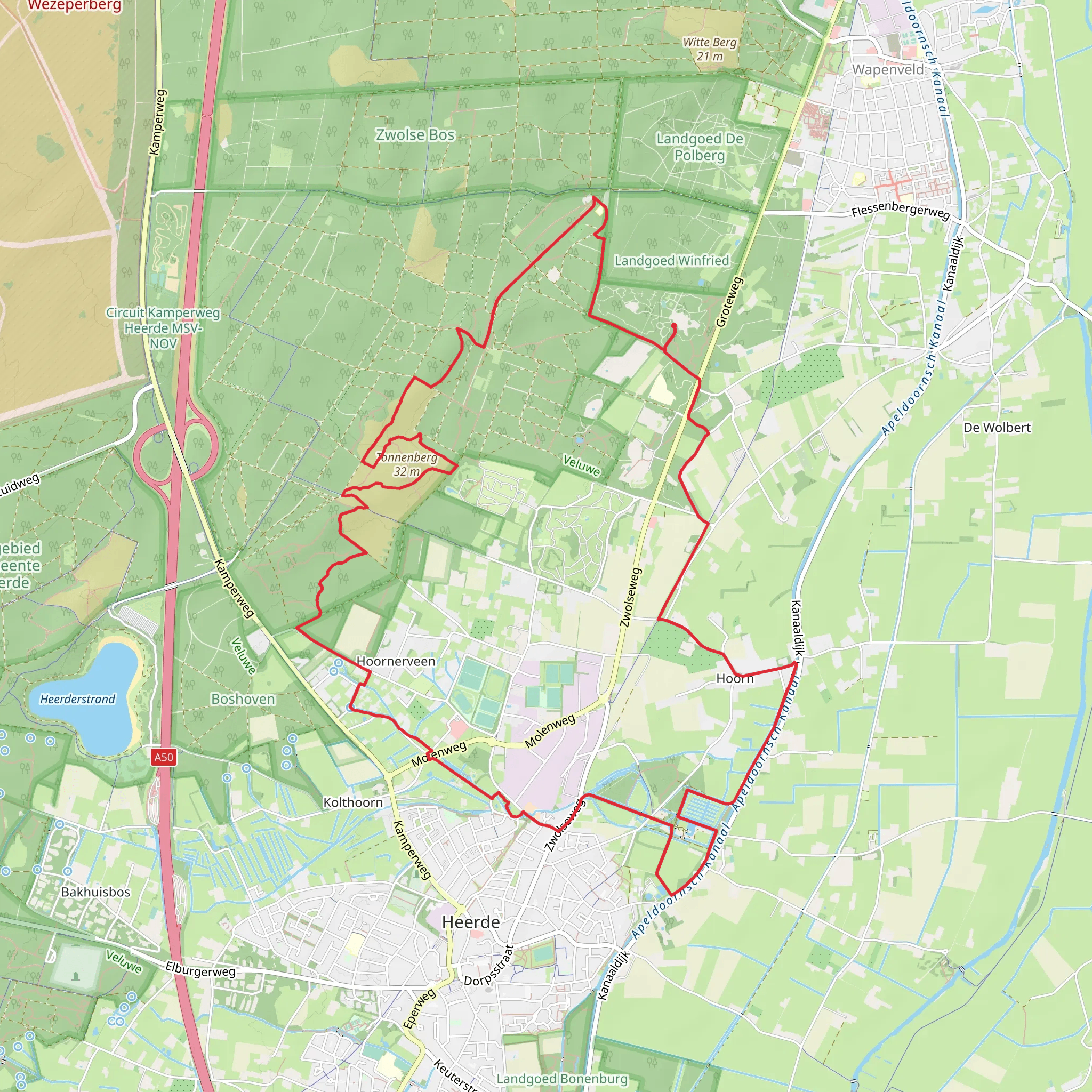
This easy, mostly level loop of about 15 km (9.3 miles) is ideal for a relaxed day out: broad forest tracks, quiet estate lanes, and short, more intimate woodland stretches linking three standout points—Tonnenberg, the Kamperklippen area, and Kasteel Vosbergen. With the terrain in this part of Drenthe/Groningen being characteristically flat, expect roughly 0–30 m (0–100 ft) of total ascent depending on small undulations, bridges, and how closely you follow the loop line.
Getting to the start (car + public transport)
Because your start point is listed only as “near” (no coordinates provided), the most practical reference for planning is to begin near the most obvious anchor on the loop: Kasteel Vosbergen (Vosbergen Estate), near Eelde/Paterswolde (south of the city of Groningen, Netherlands). A common, convenient approach is to navigate to the estate area around Kasteel Vosbergen / Landgoed Vosbergen, using HiiKER for the exact trailhead pin and the closest legal parking.
- By car: Aim for the Eelde–Paterswolde area and follow signs toward the Vosbergen estate/woodland parking areas. Parking is typically on small forest car parks or roadside pull-ins near estate entrances—arrive early on weekends to avoid full lots.
- By public transport: The nearest major hub is Groningen. From there, regional buses commonly run toward Eelde and Paterswolde; you’ll usually finish with a short walk to the estate edge. Use HiiKER to choose a start point that minimizes road walking from the nearest bus stop.
If you share the loop’s lon/lat (or a GPX), I can convert the start to the nearest known address/landmark precisely and tailor the transport directions to the exact trailhead.
What the route feels like underfoot
Most of the loop is on firm, well-drained paths: compacted forest track, estate roads, and occasional narrower dirt singletrack. After rain, expect soft patches and shallow puddling in low woodland sections, but you’re unlikely to face sustained mud like you would on peat-heavy routes deeper into Drenthe.
Because the elevation change is minimal, the main “effort” comes from distance rather than climbing. Plan on 3–4 hours of walking time at an easy pace, plus stops for viewpoints and the castle grounds.
Tonnenberg and the Kamperklippen area
Early in the loop you’ll move through mixed woodland typical of northern Dutch estates—stands of beech and oak, with conifers in places where forestry has shaped the canopy. “Berg” here usually signals a subtle rise rather than a true hill; Tonnenberg is more about a gentle high spot in the landscape and a change in forest character than a panoramic summit.
As you approach the Kamperklippen section, look for: - Sandy, slightly higher ground with a drier feel underfoot - More open patches where light reaches the forest floor, encouraging heather, grasses, and mosses depending on management and season - Occasional erratic boulders and stonier edges (the “klippen” name often hints at rocky features, even if modest)
Wildlife is often subtle but rewarding if you slow down:
- Roe deer are common in quiet woodland edges (most likely at dawn/dusk)
- Buzzards and other raptors circling above clearings
- In spring and early summer, a strong chorus of songbirds in the deciduous sections
Ticks can be present in grassy margins and leaf litter—long socks and a quick check after the hike are sensible.
Kasteel Vosbergen and estate landscapes
The loop’s most distinctive landmark is Kasteel Vosbergen, set within a landscaped estate environment. Even if access to the immediate building area varies, the surrounding grounds typically feature: - Long, straight estate avenues (classic formal planning) - Water features—ponds, ditches, and small channels that reflect the lowland hydrology - Mature trees and managed woodland edges that create a “park-forest” transition
This region’s estates and woodlands reflect centuries of land use: from agricultural reclamation and drainage to aristocratic/landed estate design and later conservation-minded management. The “castle” setting is a reminder that, in the northern Netherlands, power and wealth often expressed itself not through mountain strongholds but through country houses, formal grounds, and controlled landscapes—avenues, canals, and carefully shaped woodland.
Navigation, wayfinding, and practical planning
Wayfinding is generally straightforward, but the estate setting can create a few common pitfalls: - Multiple parallel tracks: broad lanes can run side-by-side; confirm junctions with HiiKER rather than assuming the widest track is correct. - Seasonal/management diversions: forestry work or estate events can temporarily reroute foot traffic. If a path is signed closed, follow the posted detour and use HiiKER to rejoin the loop. - Quiet road crossings: you may cross small local roads—easy walking, but stay alert for cyclists and local traffic.
What to bring for an easy, flat 15 km (9.3 mi): - Comfortable walking shoes (water-resistant helps after rain) - A light layer for wind in open stretches - Water and a snack; cafés may be nearby in Eelde/Paterswolde, but don’t rely on them mid-loop - Insect repellent in warmer months
Surfaces
Unknown
Asphalt
Grass
Concrete
Sand
Ground
Wood
Comments and Reviews
User comments, reviews and discussions about the Tonnenberg, Kamperklippen and Kasteel Vosbergen Loop, Netherlands.
average rating out of 5
0 rating(s)


