
Download
3D Flyover
Add to list
More
24.9 km
~4 hrs 58 min
0 m
Point to Point
“A wind-swept polder ramble of big skies, water-laced dikes, and quiet lanes—best for steady walkers.”
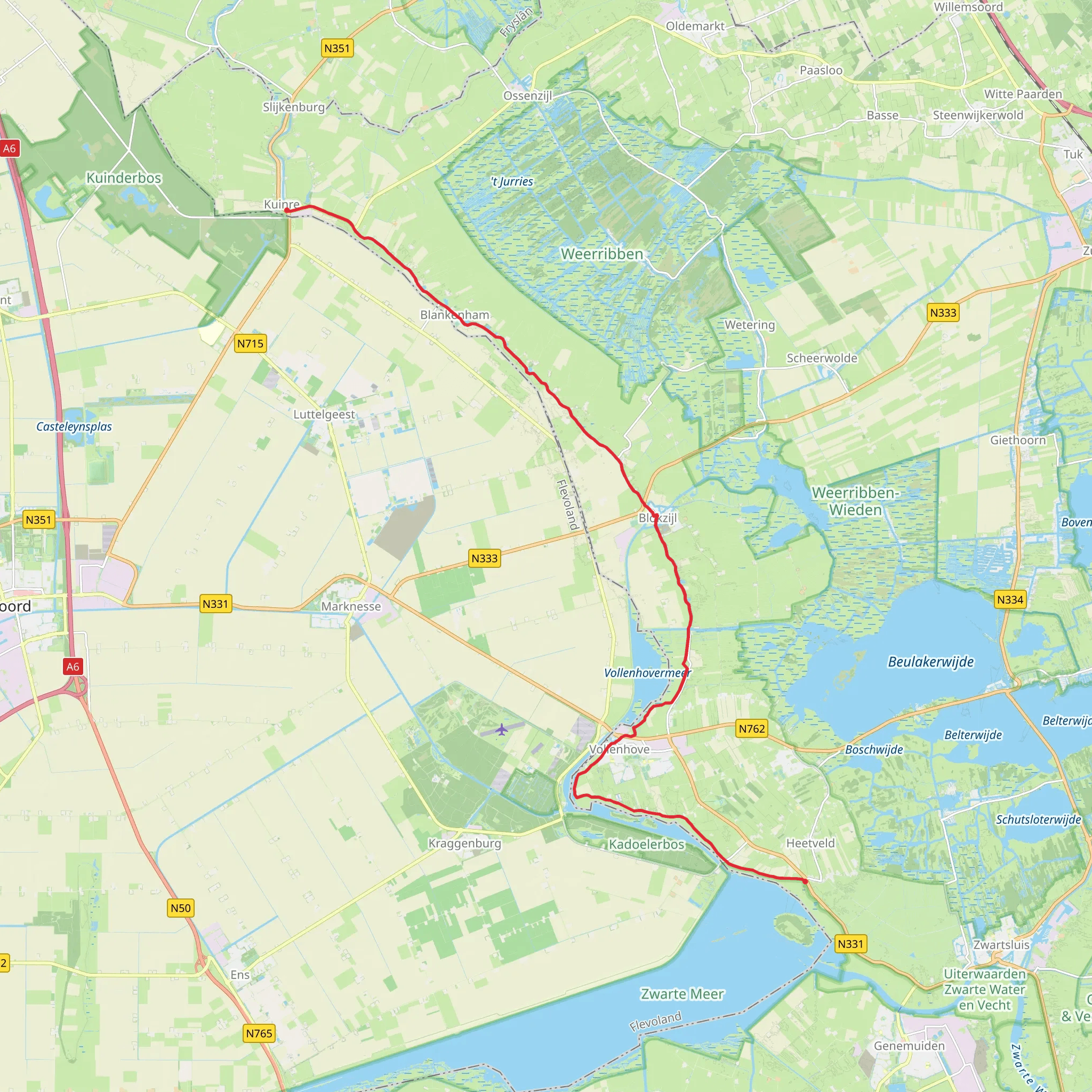
This is a long, flat, lowland walk of roughly 25 km (15.5 mi) with essentially 0 m (0 ft) of climbing—expect it to feel more like a steady countryside ramble than a “hike” in the mountainous sense. The route links small settlements, dikes, drainage canals, and farm tracks, using the Bentendijkpad, Zeegienpad, and Punterweg to thread through classic Dutch polder scenery: open skies, long sightlines, and water everywhere.
Because your start is listed only as “near,” I can’t reliably convert the start lon/lat to a nearby address or landmark yet. If you paste the start coordinates (or a HiiKER link), I’ll pin it to the nearest recognizable place (e.g., a church, bridge, ferry landing, station, or named road junction) and tailor the access directions precisely.
Getting to the start (car + public transport)
By car - In this region, trailheads are often easiest to access via a dike road pull-off, a small village car park, or parking near a church/primary school/sports field. Plan for narrow lanes with limited shoulder space—park only where signage allows and never block farm gates or passing places. - If your start point is near a dike (likely, given the trail names), look for parking near a bridge over a canal or a dike access ramp—these are common, legal stopping points.
By public transport - Most flatland routes like this are reached by combining train to the nearest town station plus a regional bus to a village stop, then a short walk to the dike/tracks. - If you share the start coordinates, I can identify the closest stop and the most practical approach on foot. For navigation on the ground, load the route in HiiKER and keep an eye on where farm tracks split—many junctions look identical.
What to plan for logistically: - Water/food: services can be sparse between villages; carry enough for 6–8 hours depending on pace and breaks. - Wind exposure: with no elevation gain, the main “difficulty” is often headwind and lack of shelter. - Footwear: light hiking shoes are fine, but choose something that handles muddy edges and wet grass along canal banks.
What the walk is like underfoot
You’ll likely alternate between: - Dike-top paths (firm, sometimes paved or compacted gravel) - Farm access tracks (hard-packed dirt, occasional loose gravel) - Canal-side grass paths (can be slick after rain) - Short connectors through village streets near Burchtstraat
Even though the elevation gain is near zero, expect frequent micro-undulations where the path crosses small bridges, culverts, and dike ramps—nothing strenuous, but it breaks rhythm.
Route flow and key sections
0–6 km (0–3.7 mi): Settling into the polder The opening kilometres typically feel very open: straight lines, drainage channels, and big skies. You’ll pass working farmland—fields can change dramatically by season (freshly ploughed earth, bright green pasture, or tall crops). Early on, pay attention to signed path access: some tracks are public rights of way, others are private farm lanes that look tempting but aren’t part of the route. Use HiiKER at every major junction to avoid drifting onto parallel tracks.
6–14 km (3.7–8.7 mi): Bentendijkpad and dike-country walking On the Bentendijkpad section, expect classic dike walking: long, level stretches with water on one side and fields on the other. This is where the “easy” rating really shows—steady, predictable terrain—but it can be mentally demanding if the wind is up. If the surface is grassy, the crown of the dike is usually driest; the edges can be soft and rutted.
Wildlife to watch for here: - Waterfowl (ducks, geese, swans) along canals and ditches - Waders (herons, egrets) stalking shallow margins - Raptors (kestrels, buzzards) hovering over fields - In warmer months, expect plenty of insects near still water; consider repellent if you’re sensitive.
14–20 km (8.7–12.4 mi): Zeegienpad—quiet lanes, reedbeds, and drainage canals This middle portion often feels quieter and more enclosed where reeds and shrubs line the watercourses. After rain, this is the section most likely to have soft ground and puddled tractor ruts. If you’re walking in spring, you may encounter temporary electric fencing for grazing management—follow the marked line of the path and use gates/stiles where provided.
Look out for: - Narrow bridges with steep sides—take care if it’s windy or if the surface is slick. - Cyclists on shared dike paths; keep right and be predictable when stepping aside.
20–25 km (12.4–15.5 mi): Punterweg into Burchtstraat—return to settlement The final kilometres typically transition back toward more built-up edges: scattered houses, small industrial/agricultural buildings, and then a proper street approach as you near Burchtstraat. Fatigue tends to show up here because the terrain stays flat and repetitive—plan a short break around 18–20 km (11–12.5 mi) so the last
AI Planner
Days planned around your pace, with somewhere to stay each night.
Surfaces
Asphalt
Concrete
Unknown
Comments and Reviews
User comments, reviews and discussions about the De Krieger to Burchtstraat via Bentendijkpad, Zeegienpad and Punterweg, Netherlands.
average rating out of 5
0 rating(s)


