Download
3D Flyover
Add to list
More
13.8 km
~2 hrs 45 min
0 m
Loop
“Wander wind-sculpted dune valleys on sandy threads—flat yet testing, with salt air and shifting tracks.”
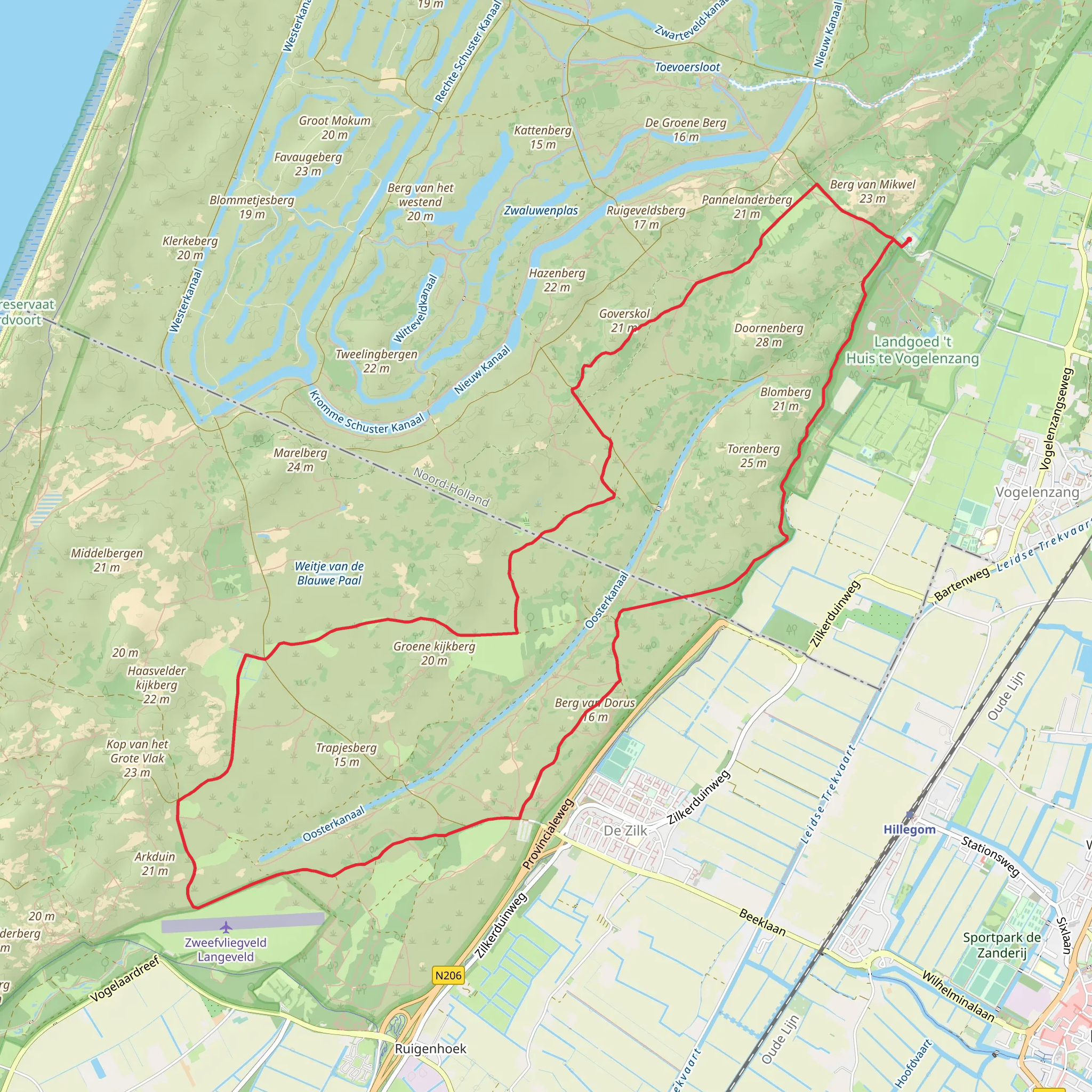
A flat, coastal-dune loop of about 14 km (8.7 mi) with roughly 0 m (0 ft) of climbing, this walk is all about wide sandy paths, low scrub, and open dune “valleys” where the wind and salt air shape everything. Because the terrain is essentially level, the main challenges are usually soft sand underfoot, exposure to wind, and **finding the best line through a web of intersecting dune tracks.
Getting to the start (car + public transport)
Because the start point is only given as “near,” the most reliable way to pinpoint the exact trailhead is to open the route in HiiKER and use the start marker to identify the nearest access point and parking area. For this loop, you’ll typically be looking for a dune access/parking area on the edge of the Panneland / Zuid-Kennemerland dune system (common access points in this region are near Overveen, Bloemendaal aan Zee, or Zandvoort—HiiKER will show which one matches your track).
- By car: Aim for a designated dune entrance car park (often signed for dune access or nature reserve entry). Arrive early on weekends and fair-weather days—coastal parking fills quickly.
- By public transport: The usual pattern is train to Haarlem / Overveen / Zandvoort area, then a bus or short taxi/bike ride to the dune entrance. If you’re comfortable cycling, this region is generally bike-friendly, and bikes can be a practical last-mile option to the trailhead.
If you share the route’s lon/lat, I can convert it to the nearest known address or landmark and tailor the directions precisely.
What the route is like underfoot
Expect a mix of: - Firm, compacted sandy tracks (fast and easy walking) - Looser sand sections (slower, more tiring—especially if it’s dry and windy) - Occasional shell grit and short grassy/scrubby stretches in sheltered hollows
Even though the elevation gain is near zero, dunes can create subtle rises and dips that don’t register much as “climb” but still affect effort—particularly in soft sand.
Landmarks and landscape: Dooie Hoek, De Wouwen, and Panneland
The names you’re hiking through point to distinct dune features and zones within a larger coastal dune complex:
- Dune “valleys” and hollows: These are the calmer pockets between dune ridges. They often hold different plant communities than the exposed crests—look for mosses, grasses, and low flowering plants in season.
- Scrub and thickets: You’ll likely pass through areas of sea buckthorn and other hardy shrubs. These can form dense, wind-shaped corridors along the trail.
- Open dune ridges: The most exposed parts of the loop. On windy days, these sections can feel dramatically different—cooler, louder, and more abrasive with blowing sand.
Because this is a loop, you’ll usually get a satisfying variety: outward leg through more open dune terrain, then a return leg that threads different tracks back through sheltered sections.
Nature and wildlife to look out for
Coastal dunes are deceptively rich habitats. Common things to watch for:
- Birdlife: Expect a lot of movement—small songbirds in scrub, and larger birds riding the wind over open dunes. In migration periods, activity can spike.
- Mammals: You may spot rabbits and signs of them (tracks, burrows). In many Dutch dune systems, grazing animals (often cattle, horses, or deer depending on the reserve) are used for habitat management—give them space, don’t approach for photos, and pass calmly.
- Insects and reptiles (seasonal): On warm, still days, sheltered sandy edges can be good for butterflies and other insects. Reptile sightings depend heavily on exact location and season.
Stay on established paths where required—dune vegetation is fragile, and off-trail shortcuts accelerate erosion.
Historical significance and why these dunes matter
Much of the Dutch coastal dune belt has long been valued for two big reasons:
- Coastal defense: Dunes are a natural barrier against storm surges and sea incursions. Their shape and vegetation help stabilize sand and reduce inland flooding risk.
- Freshwater supply: Many dune areas (including “pannens”/dune slacks and managed infiltration zones in parts of the Dutch coast) are tied to freshwater collection and filtration. Even when you don’t see obvious infrastructure, the landscape often reflects decades of careful water and habitat management.
Place names in dune regions frequently preserve older local references to terrain features, wildlife, or land use—so you’re walking through a landscape that’s both natural and culturally mapped.
Planning notes: timing, navigation, and what to carry
- Time estimate: For 14 km (8.7 mi) on mostly flat ground, many hikers take 3–4 hours depending on sand softness, wind, and stops.
- Navigation: Dune trail networks can be confusing because many tracks look similar. Keep HiiKER handy and check it at junctions rather than trying to “feel” the right path.
- Wind management: Bring a windproof layer even in mild temperatures; exposed ridges can feel significantly colder.
- Footwear: Light hiking shoes are usually fine, but choose something that handles sand well and won’t fill too easily. Gaiters can be helpful if you dislike sand in your shoes.
- Water and sun: There’s often little shade. Carry
Surfaces
Unknown
Dirt
Unpaved
Gravel
Sand
Paved
Comments and Reviews
User comments, reviews and discussions about the Dooie Hoek, De Wouwen and Panneland Loop, Netherlands.
average rating out of 5
0 rating(s)