Download
3D Flyover
Add to list
More
36.7 km
~7 hrs 23 min
34 m
Point to Point
“A long, flat Lower Rhine loop where peat lakes, reedbeds, and arrow-straight canals invite steady focus.”
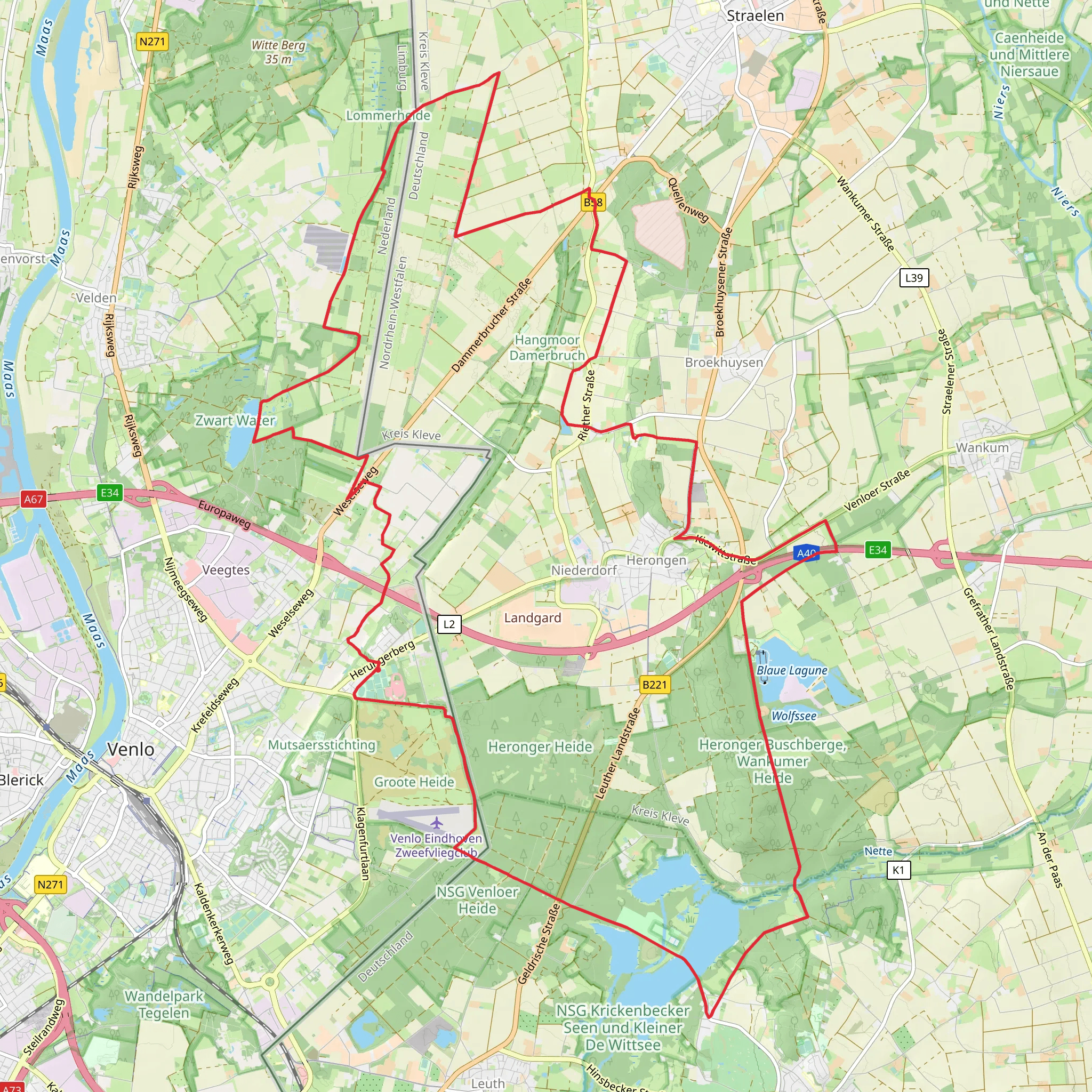
This is a long, flat Lower Rhine loop through a patchwork of peat-cut lakes, heath-forest edges, and canal-side paths near the German–Dutch border. At roughly 37 km (23.0 mi) with about 0 m (0 ft) of climbing, the challenge is less about elevation and more about time on feet, firm pacing, and staying oriented through a dense trail network.
A practical “hike head” to plan around is the recreation area at Wankumer Heidesee (Blaue Lagune), Am Heidesee 5, 47669 Wachtendonk, Germany. (blauelagune.de)
From there, the loop typically links west/northwest toward the Krickenbecker Seen lake district (including Glabbacher Bruch) near Nettetal-Hinsbeck, then swings back via woodland/heath and long straight water-management corridors.
Getting to the start (car + public transport)
By car
- Set your destination to “Blaue Lagune / Wankumer Heidesee, Am Heidesee 5, 47669 Wachtendonk”. (blauelagune.de)
- Expect dedicated parking around the leisure complex; on warm weekends it can be busy because it’s a popular swimming/recreation lake.
By public transport - The area is rural; the most reliable approach is usually train to a larger hub (e.g., Kempen, Geldern, or Venlo NL) and then bus/taxi toward Wachtendonk/Wankum. Service patterns vary by day and season, so check the current timetable before committing to a 37 km day.
What the terrain feels like (and why it’s “easy” but still serious)
- Surface: mostly compact gravel, forest track, canal towpath, and short paved connectors. After rain, expect muddy edges in low-lying sections and slick boardwalk/bridge planks near wetlands.
- Grade: essentially flat; you’ll notice only gentle rises on dikes/embankments.
- Navigation: the biggest “difficulty” is junction density—many intersecting tracks around lakes, nature reserves, and farmland edges. Load the route in HiiKER and keep an eye on turns where straight-looking tracks split. (Flat country can make “it all looks the same” a real issue.)
The loop’s highlights and how they unfold
Early on, you’ll likely skirt Wankumer Heidesee, a clear, deep lake used heavily for recreation (swimming, beach areas, and general day-use). It’s known as a fish-rich waterbody (species commonly listed include eel, perch, pike, zander, catfish, tench), which also hints at why you often see fish-hunting birds working the margins. (fisch-hitparade.de)
Because this is a leisure lake, the first kilometers can feel lively—expect joggers, families, and cyclists, especially in good weather.
As you transition away from the busiest shoreline, the character shifts into quiet, lowland nature: reedbeds, wet woodland pockets, and long straight lines of drainage/canal infrastructure. One of the most distinctive linear features in this region is the Nordkanal, a partially built canal project begun under Napoleon intended to connect major river systems; remnants and alignments still shape paths and landscapes around Straelen/Wachtendonk. (lobberich.de)
Even when the canal itself isn’t obvious as “a canal,” you’ll feel it in the engineered straightness of certain corridors and the way paths run arrow-straight for long stretches.
Mid-loop: Glabbacher Bruch and the Krickenbecker Seen landscape
The most nature-rich section is around Glabbacher Bruch, which is part of the Krickenbecker Seen complex in the Maas-Schwalm-Nette Nature Park area. These lakes are historically tied to peat cutting—they’re not simply “natural ponds,” but waters shaped by centuries of extraction and hydrological change. (en.wikipedia.org)
Glabbacher Bruch itself is described as one of the four Krickenbecker lakes and is associated with the old peat-working landscape; the name is linked
AI Planner
Days planned around your pace, with somewhere to stay each night.
Surfaces
Asphalt
Unknown
Ground
Paved
Concrete
Gravel
Unpaved
Comments and Reviews
User comments, reviews and discussions about the Glabbacher Bruch, Wankumer Heidesee and Venkoelen Loop, Netherlands.
average rating out of 5
0 rating(s)