
Download
3D Flyover
Add to list
More
28.4 km
~5 hrs 52 min
126 m
Loop
“A big-sky farmland loop of old ways—gentle underfoot, yet testing in mud and junctions.”
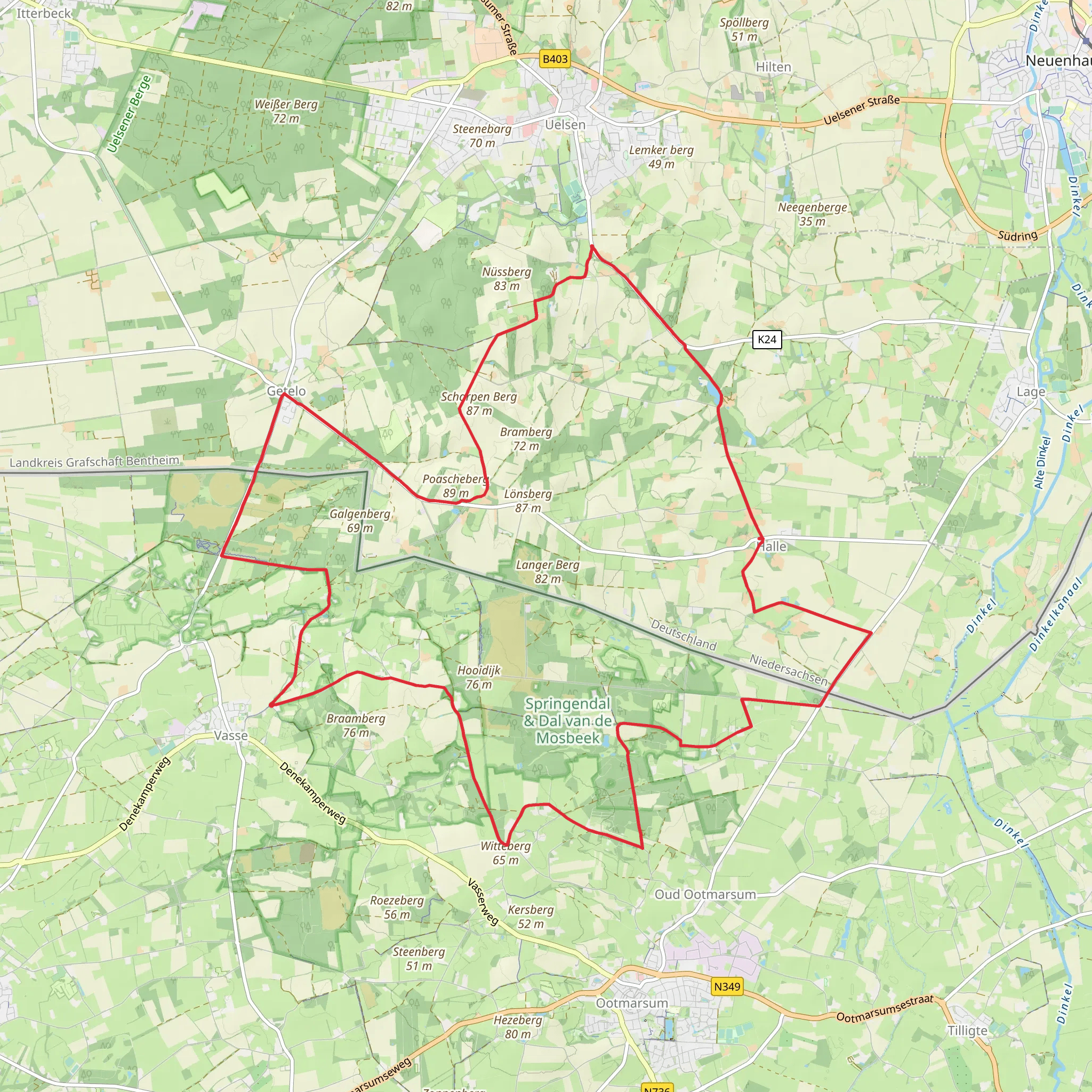
This is a long, low-relief countryside loop of roughly 28 km / 17.4 mi with only about 100 m / 330 ft of total climbing—ideal for steady, all-day walking on a mix of farm tracks, quiet lanes, and field-edge paths. Because the elevation gain is modest, the main challenges tend to be distance, surface conditions (mud/standing water after rain), and wayfinding at frequent junctions rather than steepness.
Getting to the start (car + public transport)
Because the start point is listed only as “near” (no town, coordinates, or landmark provided), I can’t reliably convert the location to a nearest address or significant landmark yet. If you share a lat/long, a plus code, or the nearest village/town, I’ll pin it to the closest recognizable place and tailor directions precisely.
In the meantime, here’s the practical approach that usually fits loops like this in rural Western/Central Europe (the trail names strongly suggest a German-speaking region):
- By car: Plan to park at a village center car park, church square, or sports club/football ground—these are the most common legal, all-day parking options near long farm-track loops. Avoid blocking farm gates and field access points; agricultural traffic can be constant even on weekends.
- By public transport: Aim for the nearest regional rail station or bus hub in the closest larger town, then a local bus to a village stop (often “Kirche,” “Mitte,” “Schule,” or “Rathaus”). Rural bus frequency can be limited, especially Sundays—check the last return departure before committing.
If you’ll be navigating, load the loop in HiiKER and download offline maps; these areas often have many similar-looking track junctions where a wrong turn can add several kilometers.
What the route feels like underfoot
Expect a predominantly flat-to-gently rolling profile. With only ~100 m / 330 ft of ascent spread across the day, climbs are likely to be short rises over low ridges, embankments, or gradual undulations between fields and small wooded patches.
Surfaces typically include: - Compacted farm tracks (fast walking when dry; can become slick clay when wet) - Gravel lanes and quiet tarmac connectors - Field-edge paths that may be narrow, overgrown in summer, or softened by tractor ruts
After rain, the “easy” rating can feel more demanding due to mud, puddling, and slippery grass, especially where tracks run between hedgerows that hold moisture.
Landmarks, scenery, and the character of the landscape
A loop with segments named Hoellweg, Blauweweg, and Drieschichtsweg usually indicates a network of older local ways—paths that historically linked fields, hamlets, and woodland resources rather than dramatic mountain terrain. You’ll likely move through a patchwork of:
- Open agricultural land: broad views, big skies, and long straight track sections where you can settle into a rhythm.
- Hedgerows and tree lines: these act as windbreaks and wildlife corridors; they’re also where paths can be shaded and damp.
- Small woodlots: short, cooler sections with leaf litter and roots; watch for slick patches in autumn and winter.
- Drainage ditches/streams: common in low-relief farmland; crossings are usually bridged, but heavy rain can flood low points.
If the loop passes through villages, you may see stone crosses, small chapels, wayside shrines, or historic farmsteads—features that often mark old route alignments and local boundaries. In many parts of the German-speaking countryside, today’s farm tracks follow centuries-old rights-of-way used for moving livestock, hauling timber, and reaching communal grazing or woodland.
Wildlife and seasonal notes
Even in heavily farmed landscapes, wildlife can be excellent—especially at dawn/dusk and along hedges and woodland edges.
Commonly encountered (region-dependent) are: - Roe deer along field margins and in woodlots - Hares and foxes in open farmland - Buzzards/kites circling over fields; woodpeckers in wooded pockets - Amphibians near ditches and wet hollows in spring
Ticks can be a real consideration in grassy margins and low scrub from spring through autumn. Long socks, light-colored clothing, and a post-hike check are sensible.
Pacing, timing, and planning for a 28 km / 17.4 mi day
At an easy, steady pace with brief stops, many hikers take 6–8 hours for this distance, depending on surfaces and how often you pause in villages. The low elevation gain means your legs won’t be taxed by climbing, but foot comfort becomes the deciding factor.
What to bring: - Footwear: light hiking shoes are usually enough; choose something with grip for mud and wet grass. - Water: plan for 1.5–2.5 L depending on temperature and sun exposure; farmland routes can be surprisingly exposed. - Food: enough for a full day; don’t assume shops will be open when you pass. - Layers/wind protection: open fields amplify wind chill; shade can be limited in summer. - Navigation: keep HiiKER handy for frequent junctions and parallel tracks.
Things to look out for (the “easy” hazards)
- Farm operations: tractors, sprayers, and livestock movements. Give machinery space and avoid freshly worked field edges.
- **
AI Planner
Days planned around your pace, with somewhere to stay each night.
Surfaces
Asphalt
Unknown
Concrete
Paved
Sand
Ground
Comments and Reviews
User comments, reviews and discussions about the Hoellweg, Blauweweg and Drieschichtsweg Loop, Netherlands.
average rating out of 5
0 rating(s)


