
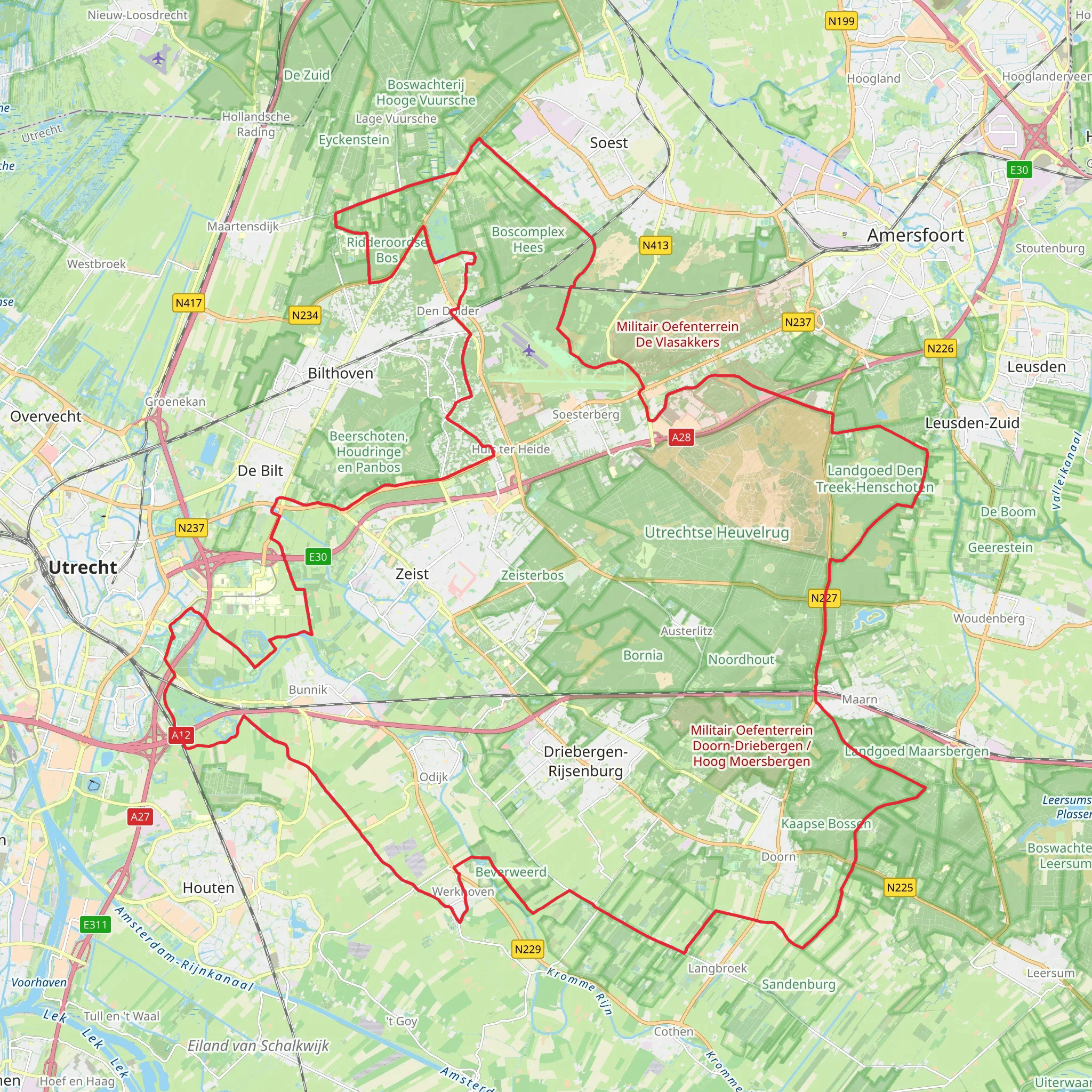
Panbos, Willem Arntszbos, Ridderoordse Bossen, Treekerpunt and Fort bij Vechten Loop
Download
3D Flyover
Add to list
More
83.4 km
5 days
89 m
Multi Day
“A time-rich wander through Utrecht’s whispering sand-ridge woods, ending at storied Fort bij Vechten.”
This is a long, low-relief day (or a relaxed 2‑day) through the wooded “sand ridge” landscapes east of Utrecht, linking several named forest blocks—Panbos, Willem Arntszbos and the Ridderoordse Bossen—before swinging out toward Landgoed Den Treek (Treekerpunt) and finishing with one of the most historically significant landmarks in the region: Fort bij Vechten. Expect roughly 83 km / 52 mi with about 100 m / 330 ft of total ascent—so the effort comes far more from time on feet than from climbing.
Where to start (and what “near …” most likely means)
A practical, well-known start for Panbos is the Panbos parking area at Amersfoortseweg 1D, Bosch en Duin (near Zeist). (ivn.nl)
If your GPX start point is a lon/lat close to Panbos, this address/landmark is the nearest “clean” navigation target to aim for.
Getting to the start
By car - Set your destination to Panbos parking (Amersfoortseweg 1D, Bosch en Duin). It’s a straightforward approach from the A28/A27 area, with local roads into Bosch en Duin/Zeist. (ivn.nl)
By public transport - The easiest rail hubs for this whole corridor are typically Utrecht Centraal and Driebergen‑Zeist (then bus/taxi or a short local connection to Bosch en Duin). If you’re stitching this as a point‑to‑point, you can also plan the end around Bunnik / Utrecht connections near Fort bij Vechten.
What the terrain feels like (and why it’s “easy” but not “short”)
Most of the route sits on the Utrechtse Heuvelrug landscape: sandy soils, pine and mixed woodland, long straight estate lanes, and occasional open heathy patches. The “ups and downs” are subtle—short rises on old sand ridges rather than sustained hills—so your pacing limiter will be: - distance and foot comfort (blisters, hot spots) - surface variety (firm forest track, soft sand, occasional paved connectors) - navigation discipline at junction-dense woodland edges
Using HiiKER for the full line is ideal here because the forests are crisscrossed with parallel tracks that can look identical for long stretches.
Panbos → Willem Arntszbos → Ridderoordse Bossen (approx. 0–30 km / 0–19 mi)
From Panbos you’ll quickly settle into quiet woodland walking—birdsong, filtered light, and that typical central‑Netherlands mix of conifer stands and deciduous pockets. Panbos is well-known locally for short nature walks, so early on you may see dog walkers and families near trailheads before it thins out. (ivn.nl)
As you transition toward Willem Arntszbos, the feel becomes more “estate woodland” with a patchwork of paths and clearings. IVN highlights it as a varied nature walk area—good cue that you’ll encounter changing forest structure rather than one monotonous plantation block. (ivn.nl)
Reaching the Ridderoordse Bossen, note a key practical detail: the area is split by Gezichtslaan. The east side has a parking area and waymarked routes; the west side is less guided and you’ll need to be more deliberate with navigation. (ivn.nl)
On an 83 km day, this is exactly where small errors can snowball—double-check HiiKER at every major crossing, especially if you drift onto attractive straight lanes that run parallel to your intended line.
Wildlife & nature to look for (through these forests) - Common woodland birds (woodpeckers, tits, jays), and in quieter stretches you may spot roe deer at dawn/dusk. - Seasonal highlights: fungi and mossy ground layers in wetter months; dry, sandy tread in summer. - Watch for soft sand in places—easy on joints but harder on calves over long distance.
Ridderoordse Bossen → Treekerpunt (approx. 30–60 km / 19–37 mi)
This middle third is where the route starts to feel more expansive, pushing out toward **Landgoed Den Tre
AI Planner
Days planned around your pace, with somewhere to stay each night.
Surfaces
Asphalt
Unknown
Concrete
Gravel
Grass
Paved
Sand
Comments and Reviews
User comments, reviews and discussions about the Panbos, Willem Arntszbos, Ridderoordse Bossen, Treekerpunt and Fort bij Vechten Loop, Netherlands.
average rating out of 5
0 rating(s)



