
Download
3D Flyover
Add to list
More
24.5 km
~4 hrs 54 min
0 m
Point to Point
“From Urk’s salty harbour to Houtmolen’s windmill hush, follow big skies, birds, and relentless dikes.”
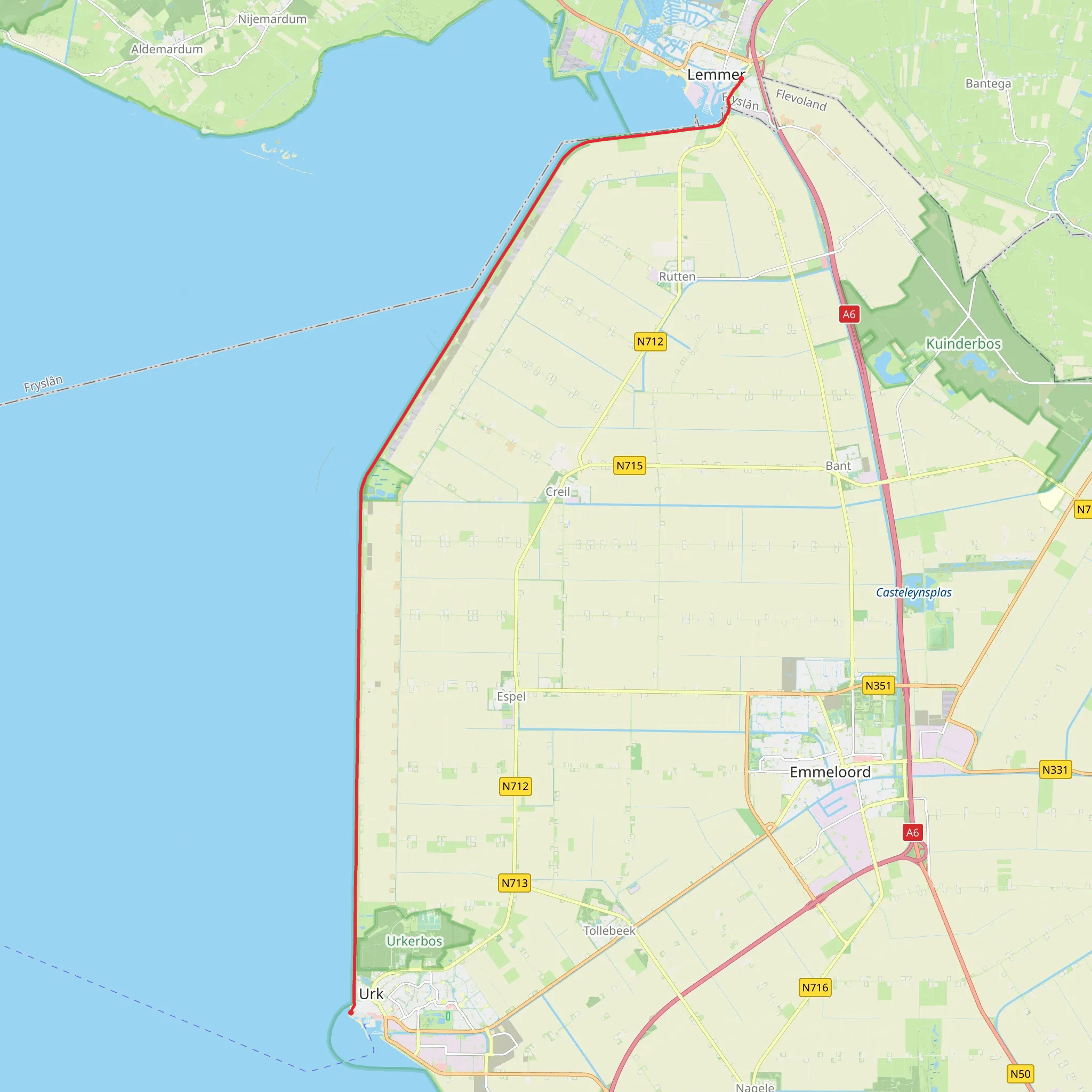
This is a long, flat coastal-and-polder walk that links the old fishing town of Urk with the Houtmolen (a historic drainage/windmill landmark) by tracing the edge of the IJsselmeer and the engineered landscapes of Flevoland. At roughly 25 km (15.5 mi) with about 0 m (0 ft) of climbing, it’s more about steady pacing, wind management, and staying comfortable on exposed dikes than it is about elevation.
Getting to the start (Urk)
By car - Aim for Urk town center/harbor area—a practical landmark to navigate to is Urk Harbour (Haven van Urk) near the old town. Parking is typically easiest around the harbor/edge-of-center lots rather than trying to squeeze into the oldest streets.
By public transport - Urk doesn’t have a train station; you’ll usually come via bus from larger hubs such as Emmeloord (common transfer point in Noordoostpolder) and then continue to Urk. Plan for a bus-to-bus connection and check the day’s timetable before you commit to a start time, especially on weekends/holidays.
Route character and what to expect underfoot
You’ll spend much of the day on dike-top paths, paved multi-use tracks, and compacted gravel typical of Dutch water-management corridors. The walking is straightforward and the grade is essentially level, but the route can feel “bigger” than the numbers suggest because: - Wind exposure off the IJsselmeer can be relentless, especially with a headwind. - Little natural shade on dikes and open polder edges. - Long, straight sections where mental pacing matters as much as physical pacing.
A good planning rhythm for an easy 25 km (15.5 mi) day is to break it into three chunks: - 0–8 km (0–5 mi): urban/harbor edge and dike access - 8–18 km (5–11 mi): the most exposed IJsselmeer-facing stretches - 18–25 km (11–15.5 mi): inland-leaning polder corridors toward the mill area
Landmarks, scenery, and the “why this place looks like this”
Urk is famous for feeling like an island—because it essentially was. Historically, Urk sat as an island in the Zuiderzee, and the region’s identity is tied to fishing and maritime life. The transformation came with the Zuiderzee Works and the creation of the IJsselmeer, followed by the reclamation of Flevoland. The result is the landscape you’ll walk through: straight lines, dikes, canals, pumping stations, and reclaimed fields—a living demonstration of Dutch water engineering.
As you leave Urk, you’ll notice the shift from tight-knit historic streets and harbor infrastructure to wide horizons. The IJsselmeer side delivers big-sky views and a constant sense of openness; inland, the polder side shows the geometry of reclaimed land—drainage channels, field boundaries, and service roads.
The destination area—Houtmolen—signals another layer of history: traditional wind-powered drainage and milling. Even where modern pumping stations now dominate water control, older mills remain as cultural markers of how the Netherlands managed water long before electric infrastructure.
Nature and wildlife (what you’re likely to see)
This is a strong route for waterbirds and open-country species rather than forest wildlife.
Along the IJsselmeer edge - Expect gulls, terns (seasonal), cormorants, grebes, and ducks. - In migration periods, the shoreline and adjacent wetlands can be busy with waders and mixed flocks. - If the route passes reedbeds or sheltered inlets, listen for reed-dwelling birds; even when you can’t see them, you’ll often hear them.
Polder and canal corridors - Canals and ditches often hold coots, moorhens, herons, and occasionally birds of prey hunting over fields. - Mammal sightings are less predictable, but you may spot hares in open farmland margins.
Wildlife etiquette here is mostly about staying on the path (dike slopes and field edges can be sensitive), keeping noise moderate near reedbeds, and giving cyclists space on shared tracks.
Weather, exposure, and comfort planning
Even on an “easy” profile, this route can feel demanding in poor conditions.
- Wind: The biggest factor. A steady headwind can add significant time and fatigue. Bring a windproof outer layer even in mild temperatures.
- Sun/heat: With minimal shade, pack sun protection (hat, sunscreen) and consider starting earlier on warm days.
- Rain: Light rain is manageable, but wind-driven rain off the lake can chill you quickly—use a shell that blocks wind as well as water.
- Footwear: Road/trail hybrids work well. The surfaces are generally firm; prioritize comfort over aggressive tread.
Navigation and services
Navigation is typically uncomplicated because dikes and canals create obvious corridors, but intersections of service roads and multi-use paths can still cause wrong turns. Load the route in HiiKER and keep an eye on: - Dike access points (where you transition from town streets to the top of the dike) - Canal junctions (where parallel tracks can look similar) - Any short inland detours around infrastructure or restricted shoreline segments
Food/water - Urk is the best place to stock up before you commit to the long exposed
AI Planner
Days planned around your pace, with somewhere to stay each night.
Surfaces
Asphalt
Paved
Unknown
Concrete
Comments and Reviews
User comments, reviews and discussions about the Urk to Houtmolen via Ijsselmeer, Netherlands.
average rating out of 5
0 rating(s)

