Download
3D Flyover
Add to list
More
72.0 km
4 days
202 m
Multi Day
“A long, leg-friendly loop of straight lanes and woodland edges—quiet, reflective, and wind-led.”
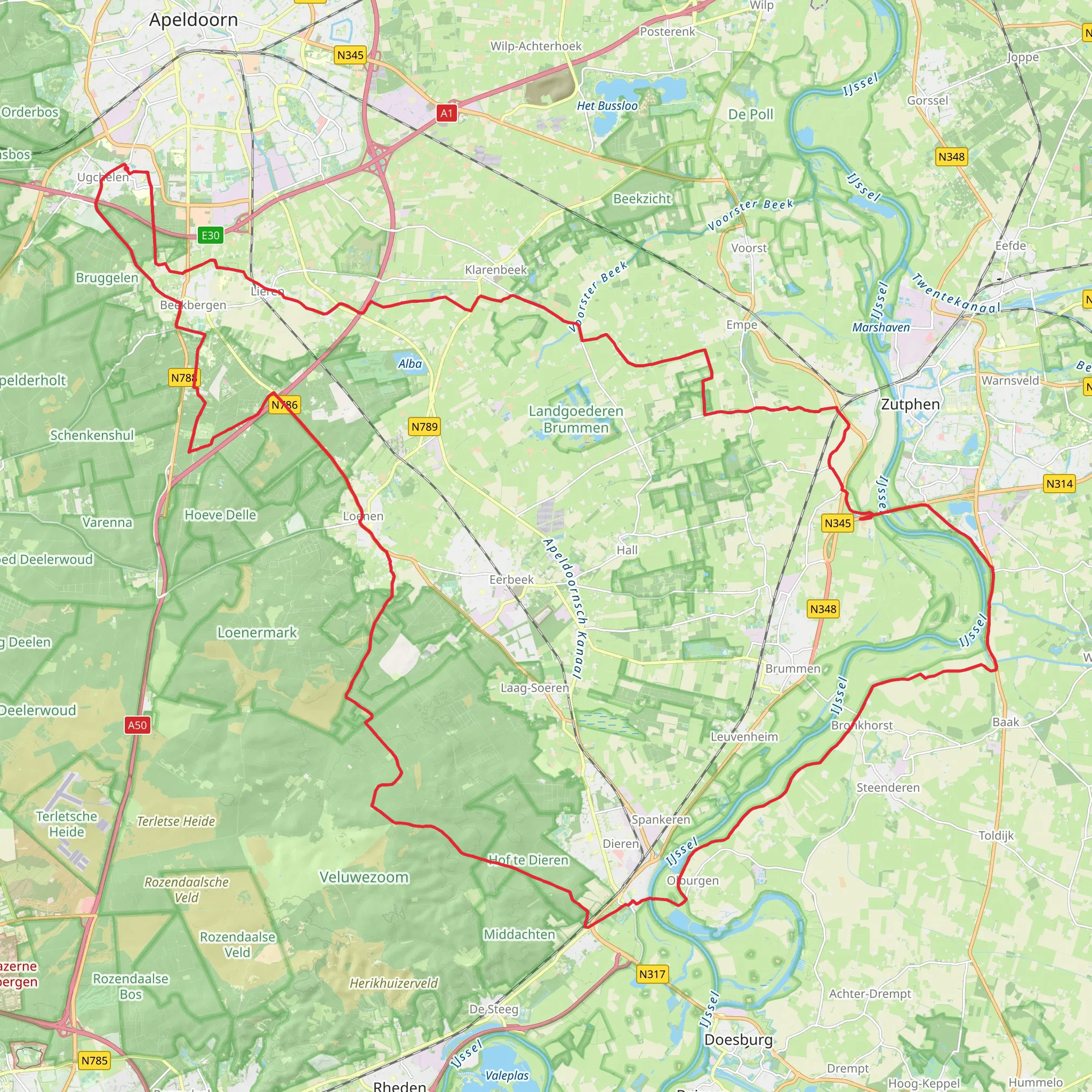
A long, mostly level day (or relaxed two-day) loop of about 72 km / 44.7 mi with only ~200 m / ~656 ft of total climbing, this route is best thought of as an “easy-on-the-legs, big-on-distance” walk: wide farm lanes, quiet country roads, and long straight stretches through woodland edges and open fields. Expect gentle gradients, frequent junctions, and a pace that’s dictated more by distance, wind, and foot comfort than by hills.
Because your start point is listed only as “near,” the most practical trailhead to plan around for this loop is the Beekbergen / Loenen area (municipality of Apeldoorn, Gelderland, Netherlands)—a sensible anchor because the route name references Loenenenseweg, Beekbergerweg, and Lange Juffer (all local road/trail names in that area). If you share the lon/lat (or a GPX), I can pin the start to the nearest exact address/landmark and tailor the directions and key turns precisely.
Getting to the start (car + public transport)
By car - Aim for the village centers of Beekbergen or Loenen (near Apeldoorn) and park at a public lot near shops/cafés so you can stock up before setting off. In this region, parking is typically easiest near village amenities or at signed recreation/forest access points on the edge of town. - If you’re using HiiKER, open the route and use its start-point navigation to choose the closest legal parking to the official start.
By public transport - The nearest major rail hub is typically Apeldoorn. From there, regional buses commonly connect toward Beekbergen and Loenen (service frequency varies by day/time). - Plan for an early start: a 72 km / 44.7 mi day is much more comfortable with maximum daylight. Use HiiKER to confirm the exact start location, then match it to the nearest bus stop.
What the terrain feels like underfoot
Most of the loop’s “difficulty” is simply the time-on-feet. With only ~200 m / ~656 ft of ascent spread across the whole distance, you’ll rarely notice sustained climbing. Underfoot, expect a mix of: - Paved or hard-packed lanes (fast, but repetitive impact—consider cushioned footwear). - Gravel/forestry tracks through managed woodland. - Field-edge paths that can be muddy after rain, especially where farm machinery has churned the margins.
Because the route uses named roads/ways, you’ll likely encounter frequent intersections where multiple straight options look similar. Keep HiiKER handy and confirm direction at every major junction—this is classic “easy walking, easy to drift off-route” country.
Landmarks, landscape, and the feel of the region
This part of Gelderland sits on the transition between settled agricultural land and the Veluwe’s broader mosaic of woodland and heath. Even when you’re not deep in forest, you’ll often be walking with tree lines, shelterbelts, and small copses nearby.
Look out for: - Long, ruler-straight lanes: these are common in managed landscapes and can be deceptively draining mentally—break the day into segments (e.g., 10 km / 6.2 mi blocks). - Woodland edges and mixed forest: you’ll often move between open farmland and shaded tracks, which helps with heat management on sunny days. - Small water features and drainage ditches: not dramatic, but they shape the walking—expect narrow bridges/culverts and occasional slick edges.
Wildlife you’re likely to notice
You’re in a region where wildlife is present but often shy around roads and villages: - Roe deer are common at dawn/dusk along woodland margins. - Foxes and hares are frequently seen in open fields. - Birdlife is a highlight: buzzards, woodpeckers, and a steady mix of farmland birds. Early morning is best for activity. Ticks can be an issue in grassy edges and woodland understory in warmer months—long socks and routine checks help.
Navigation and pacing for a 72 km / 44.7 mi “easy” loop
Even with low elevation gain, this is a serious distance. Typical moving times: - At 4.5 km/h (2.8 mph): ~16 hours moving (too long for most as a single day). - At 5.5 km/h (3.4 mph): ~13 hours moving (still a very big day). Many hikers will prefer splitting it into two days of ~36 km / 22.4 mi each.
Key planning points: - Junction discipline: confirm your line on HiiKER at every major crossing—especially where multiple farm lanes run parallel. - Surface management: if you feel hotspots early, address them immediately; hard surfaces over 72 km punish small issues. - Wind exposure: open farmland can feel harder than the elevation profile suggests. A light shell can matter even on mild days.
Historical context you’ll be walking through
The Apeldoorn–Beekbergen–Loenen area sits within a landscape shaped by centuries of agriculture, forestry, and estate management, with the nearby Veluwe historically used for timber, grazing, and hunting. Many of the straight tracks and orderly woodland blocks reflect managed land use rather than “wild” forest. Villages here often grew along practical routes—roads linking farms, mills, and market towns—so walking these lanes is, in a quiet way,
AI Planner
Days planned around your pace, with somewhere to stay each night.
Surfaces
Asphalt
Concrete
Unknown
Sand
Dirt
Gravel
Comments and Reviews
User comments, reviews and discussions about the Loenenseweg, Beekbergerweg and Lange Juffer Loop, Netherlands.
average rating out of 5
0 rating(s)