
Download
3D Flyover
Add to list
More
33.7 km
2 days
0 m
Multi Day
“A wind-swept, ruler-flat loop through canal-side dikes and “broek” woods—steady, meditative, and sometimes soggy.”
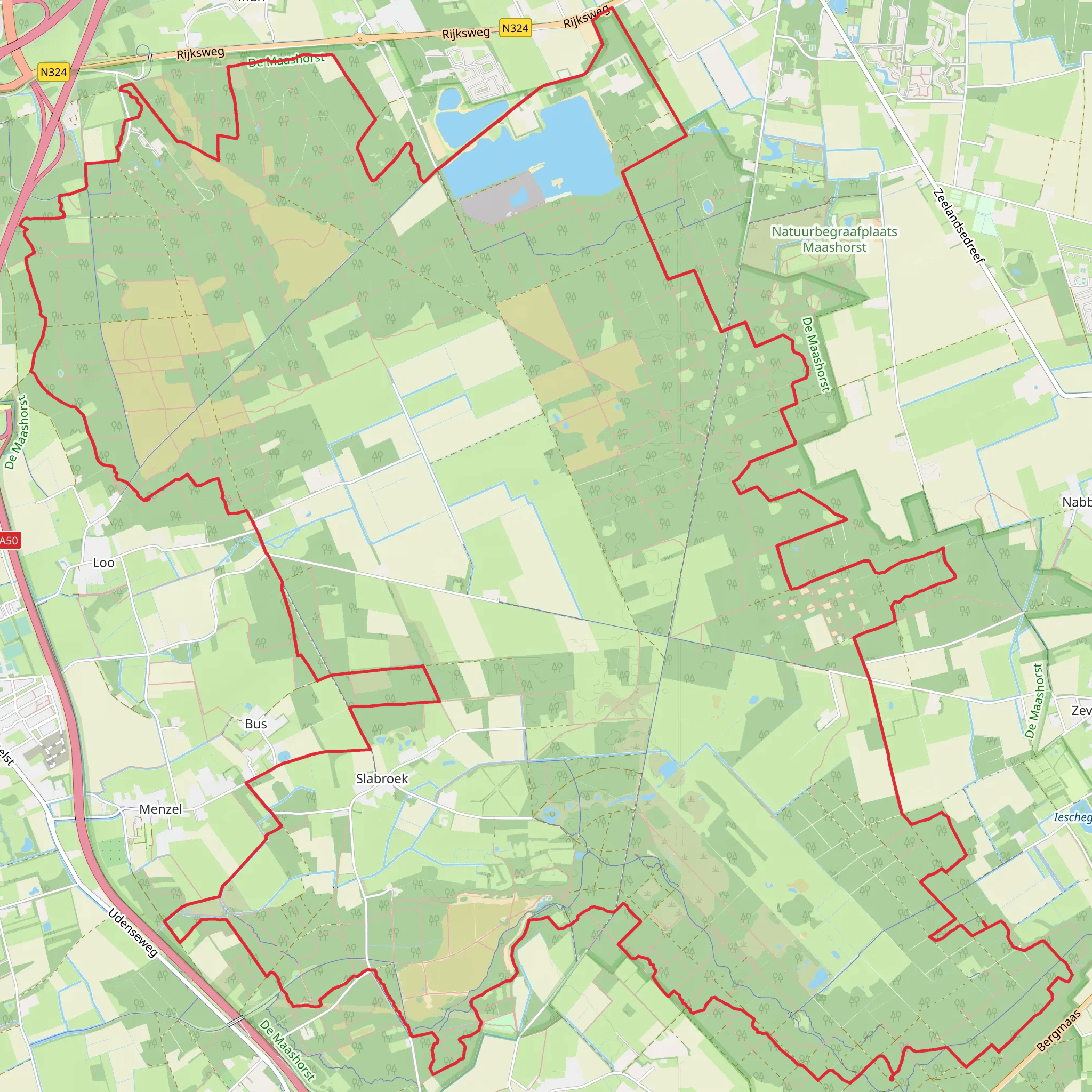
This is a long, low-lying loop of roughly 34 km (21.1 mi) with essentially 0 m (0 ft) of climbing, ideal for steady pacing on flat ground. Expect a mix of quiet farm lanes, dike-top paths, drainage-canal towpaths, and broad forestry tracks threading through the Schaijsche, Steenbergen, and Slabroeksche areas—names you’ll often see tied to local woods (“-broek” commonly refers to wet woodland or marshy ground). Even though the elevation gain is negligible, the day can feel substantial because of distance, wind exposure, and occasionally soft or damp footing.
Getting to the start (car + public transport)
Because the start is only given as “near” (no coordinates provided), the most reliable way to pinpoint the trailhead is to search the route by name in HiiKER, then use the “Directions”/map view to identify the nearest village center, parking pull-off, or trail car park.
- By car: In this part of the Low Countries, starts are commonly near a forest car park (bosparking), a small chapel, a dike access point, or a café at a village edge. Plan for narrow rural roads and limited shoulder space; park only in marked areas or obvious lay-bys so you don’t block farm access.
- By public transport: Typically you’ll take a train to the nearest regional station, then a local bus to a village stop (often near a church square), finishing with a short walk to the loop. When you pull the route up in HiiKER, look for the closest bus stop icon or village label and aim to start from there.
If you share the lon/lat (or a HiiKER link), I can convert the start point to the nearest known address or prominent landmark and tailor the access instructions precisely.
What the terrain feels like over 34 km - Surface: Mostly firm, flat tracks—often compacted gravel, dirt forestry roads, and paved farm lanes. After rain, the “broek” sections can hold water: expect muddy patches, slick leaf litter, and puddled ruts. - Wind: With little topographic shelter, headwinds can be the biggest “difficulty multiplier.” A calm forecast can make this feel easy; a breezy day can make the same loop feel like a workout. - Wayfinding: The landscape can look repetitive—straight canals, parallel tracks, and field edges. Keep HiiKER handy and confirm junctions, especially where multiple farm tracks meet.
A practical way to break down the day
- 0–8 km (0–5 mi): Settling in on open lanes and field edges
Early kilometers are usually the most exposed: long sightlines across pasture or arable fields, with drainage ditches and occasional hedgerows. You’ll likely pass working farms—expect tractors, loose gravel at driveways, and the occasional livestock smell. Keep dogs leashed where stock is present.
8–18 km (5–11 mi): Wet woodland character (“broek”) and quieter tracks
This is where the loop often earns its name: wetter ground, alder/willow-type vegetation, reedier margins, and a cooler, shaded feel. Even with “0 m” of gain, you may step up and down tiny dikelets, culverts, and bridge approaches—nothing that registers as climbing, but enough to watch your footing.
Wildlife to look for: waterfowl along canals and ponds (ducks, geese, coots), herons, and small raptors hunting field margins. In damp woodland edges, you may see amphibians in wetter seasons. Ticks can be present in grassy margins—long socks and a quick check at breaks help.18–27 km (11–16.8 mi): Long straightaways, canals, and dike-top walking
Expect efficient, fast walking on straight tracks. The tradeoff is monotony and exposure. If the route follows a canal or drainage channel, the path can be narrow with a steep drop to water—take care when passing cyclists or other walkers. In warm weather, these open stretches can feel hotter than expected due to reflected sun and limited shade.27–34 km (16.8–21.1 mi): Return through mixed woodland and rural edges
The final segment often alternates between forest blocks and the outskirts of villages or scattered homes. Fatigue tends to show up here because the terrain doesn’t “force” breaks—plan a deliberate last rest stop around 26–28 km (16–17.5 mi) so the finish doesn’t drag.
Landmarks and regional character (and why the place looks so flat)
This landscape is shaped by water management: drainage ditches, canals, and raised embankments are not just scenery—they’re infrastructure. The “broek” naming hints at historically wet ground that was gradually made workable through ditching, embanking, and managed woodland. Many of these areas were used for grazing, peat/wood harvesting, and later organized forestry, with straight tracks reflecting planned management rather than natural footpaths.
You may also encounter: - Small bridges and culverts over drainage channels (often the most slippery spots) - Field chapels, boundary stones, or old farmsteads that mark long-settled agricultural land - Forestry compartments (rectangular blocks of trees) with ruler-straight rides
What to watch out for
- Soft ground and standing water: Especially in shaded “broek” sections; waterproof footwear or at least quick-drying trail shoes help.
AI Planner
Days planned around your pace, with somewhere to stay each night.
Surfaces
Unknown
Ground
Sand
Asphalt
Dirt
Grass
Gravel
Paved
Unpaved
Comments and Reviews
User comments, reviews and discussions about the Schaijsche, Steenbergen and Slabroeksche Loop, Netherlands.
average rating out of 5
0 rating(s)


