
Download
3D Flyover
Add to list
More
51.6 km
3 days
80 m
Multi Day
“A long, sandy Veluwe loop of pine, drifting dunes and open heath—best for seasoned, time-rich walkers.”
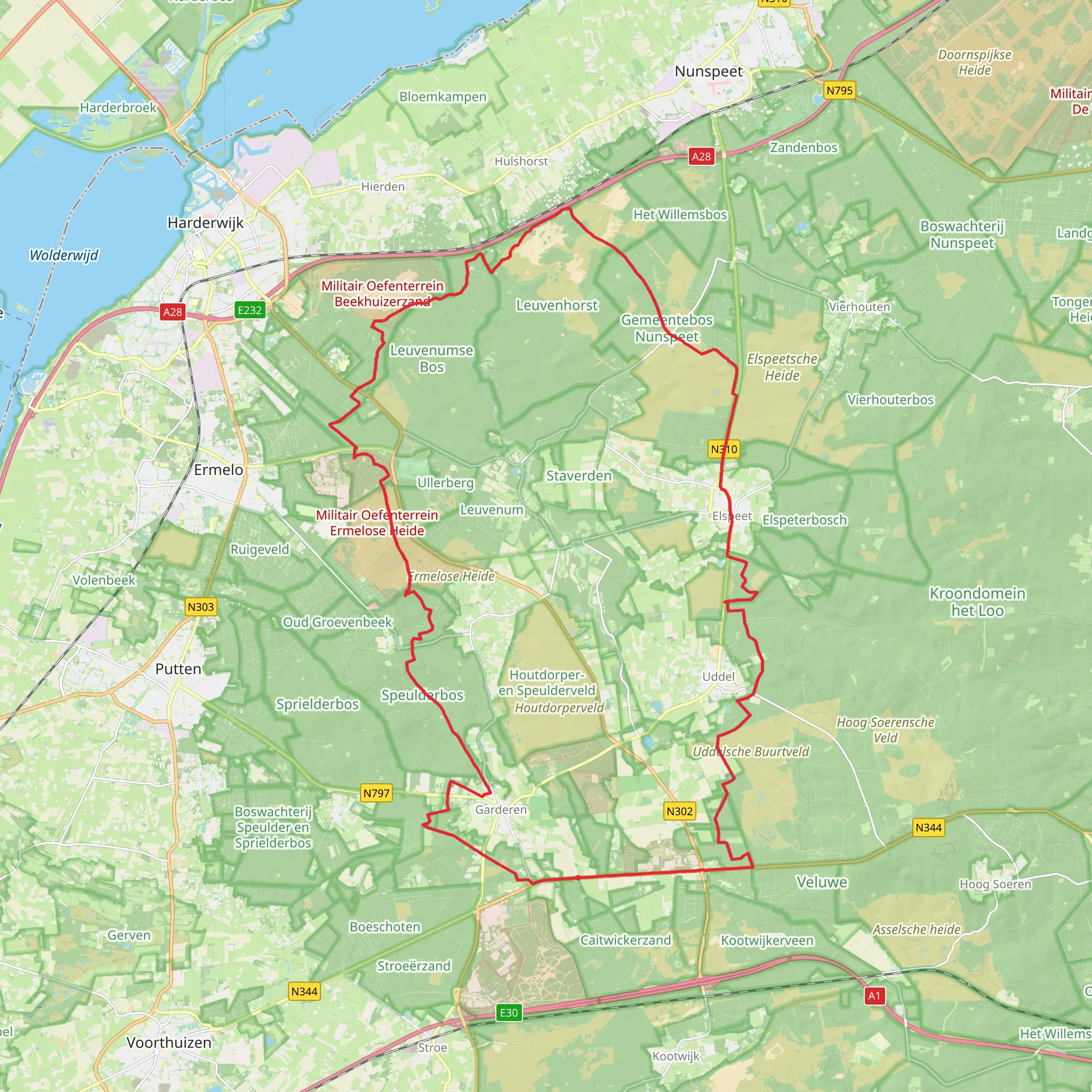
A long, low-relief loop through the Veluwe’s classic mosaic of pine forest, drifting sand, and open heath—ideal for strong walkers who want big distance without big climbing. At roughly 52 km (32.3 mi) with about 100 m (328 ft) of total ascent, the challenge is mostly time-on-feet, sandy footing, and exposure on the heaths, not elevation.
Because your start point is listed only as “near”, the most practical trailheads for this loop are typically around Ermelo / Speuld on the northwest Veluwe. If you share the lon/lat (or a GPX), I can pin it to the nearest specific address or landmark and tailor the transport directions precisely.
Getting to the start (car + public transport)
By car - Aim for the Ermelo area and use a signed Veluwe trailhead car park (P-plaats) near the heath/forest edge. Common access points in this region are near Ermelo and Speuld, where you’ll find multiple marked parking areas serving the heath and sand zones. - Expect limited services at trailhead car parks (usually no water taps). Plan to start with full bottles.
By public transport - The most reliable rail access is via Ermelo Station (Nederlandse Spoorwegen services). From there, you can usually connect by local bus toward the forest/heath edge, then walk a short link to the loop. - If you’re planning a very early start or late finish, check bus frequency in advance and be ready to walk extra from the station if needed. - For on-trail navigation and to confirm the exact start point and connectors from transit stops, use HiiKER.
What the terrain feels like over 52 km / 32 mi
This loop is “easy” in gradient but not effortless: - Footing: frequent soft sand (especially around Hukshorsterzand) and springy heath/forest tracks. Sand can slow pace dramatically. - Exposure: heath sections can be windy and sunny with little shade. - Wayfinding: the Veluwe has many intersecting tracks; it’s straightforward with HiiKER, but easy to drift onto parallel paths without it. - Time planning: most hikers take 10–13+ hours depending on sand, breaks, and daylight. In winter, daylight is the limiting factor.
Route character and key sections
You’ll move through three signature Veluwe landscapes—each with its own hazards and highlights.
Forest corridors (Elspeterweg feel)
Early and late portions often follow long, straight forest lanes typical of managed Veluwe woodland. Expect: - Pine and mixed woodland with occasional deciduous pockets. - Wide tracks that can be fast underfoot compared to sand/heath. - Subtle undulations—this is where most of the modest 100 m / 328 ft of gain accumulates in tiny rises rather than any single climb.
Look out for: - Cyclists on shared forest roads (the Veluwe is popular for biking). - Forestry operations: occasional machinery, temporary diversions, or stacked timber.
Hukshorsterzand: drifting sand and open sky
Hukshorsterzand is one of the loop’s defining features: a sandy, semi-open area where wind and sparse vegetation create a dune-like feel. - Underfoot, sand ranges from firm-packed to ankle-deep, and it’s the most energy-intensive part of the day. - Navigation can feel less “corridor-like” here; tracks may braid and fade. Keep HiiKER handy and don’t rely on a single set of footprints.
What to watch for: - Blowing sand on windy days—eye irritation is common; sunglasses help. - Heat and dehydration in warm weather: sand reflects sun and you’ll feel it. - Tick habitat begins at the sand-heath edges where grasses and low shrubs thicken.
Ermelosche Heide: wide heathland, wildlife, and big horizons
The Ermelosche Heide is classic Veluwe heath: open, gently rolling, and expansive. - In late summer, heather can bloom in purple tones; outside bloom, it’s still striking for its scale and sky. - Tracks are usually sandy-gravelly and can be dry and dusty.
Wildlife you may encounter (often at dawn/dusk): - Red deer and roe deer are emblematic of the Veluwe; you may see them at forest-heath transitions. - Wild boar also occur in the region—generally shy, but give space, especially if you see signs of rooting. - Birdlife can include buzzards and other raptors riding thermals over open heath.
Practical cautions: - Ticks are a real consideration in heath and woodland edges. Long socks, repellent, and a post-hike check are sensible. - Ground-nesting birds may be present seasonally; stay on established paths where required.
Landmarks, culture, and historical context
This part of Gelderland sits within the broader Veluwe, a landscape shaped by: - Ice-age processes that left sandy soils and subtle relief, later reworked by wind into drifting sand areas. - Centuries of heathland management (grazing, sod-cutting, and controlled use) that historically supported local agriculture and kept large heaths open. - Later forestry planting (notably conifers) that created the long straight lanes and production forests you’ll walk through today.
You’ll likely pass: - **
AI Planner
Days planned around your pace, with somewhere to stay each night.
Surfaces
Unknown
Asphalt
Sand
Unpaved
Dirt
Gravel
Concrete
Paved
Grass
Ground
Comments and Reviews
User comments, reviews and discussions about the Elspeterweg, Hukshorsterzand and Ermelosche Heide Loop, Netherlands.
average rating out of 5
0 rating(s)



