
Download
3D Flyover
Add to list
More
114.3 km
7 days
0 m
Multi Day
“A time-rich loop around Tilburg, shifting from canal calm to windy farmland and pine shade.”
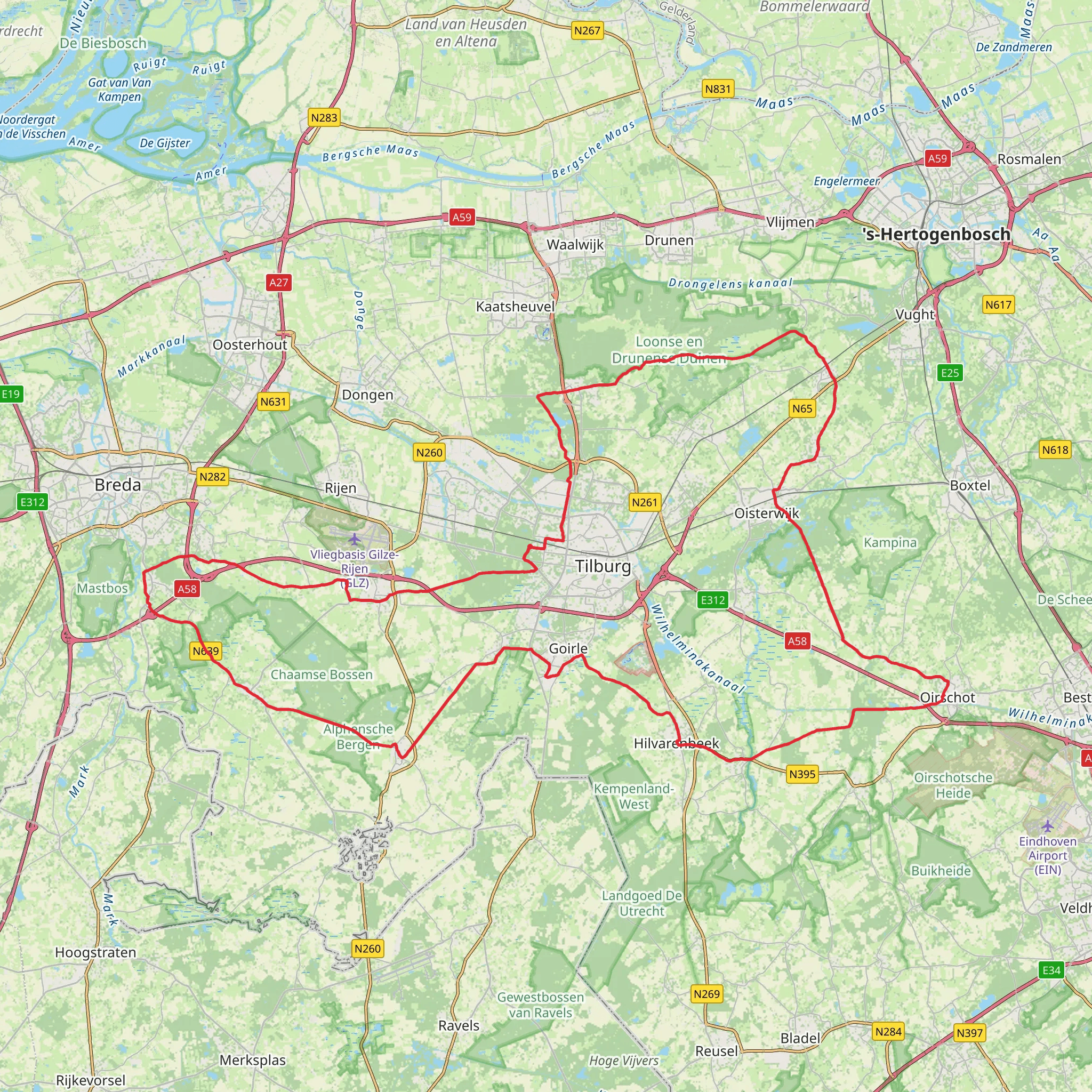
A flat, long-distance circuit around Tilburg and its surrounding villages, this loop is best treated as a 2–4 day walk rather than a single outing. At roughly 114 km / 71 miles with an estimated ~0 m / ~0 ft of climbing, the challenge is less about hills and more about time on feet, surface variety (pavement, cycle paths, towpaths, forest tracks), and staying oriented through suburban edges and farmland.
Getting to the start (public transport + car) and where “near” makes sense
Because the start point is listed only as “near” (no coordinates provided), the most practical and common access point for a Tilburg-area loop is Tilburg Centraal Station, the city’s main rail hub and a clear landmark for meeting, resupply, and bailing out if needed.
- Public transport: Tilburg Centraal is well connected by Dutch rail (NS) with frequent services from major cities in the region. From the station forecourt you can step straight onto city walking/cycle infrastructure to link into the loop.
- By car: Aim for parking near Tilburg Centraal or one of the large city-center garages (Tilburg has multiple signed “P” garages around the center). If you prefer a quieter start, you can also park near major green edges such as Stadsbos013 / Oude Warande (Tilburg’s wooded parkland area) and join the loop from there.
If you share the lon/lat for the intended trailhead, I can convert it to the nearest known address or significant landmark and tailor the access instructions precisely.
What the walking is like (surfaces, pacing, and how to split it)
Expect a mix typical of the Tilburg region: urban greenways, canal-side or drainage corridor paths, farm access lanes, and pine/heath woodland tracks on the sandy soils of North Brabant. Even with negligible elevation gain, the loop can feel demanding because: - Hard surfaces add up over 71 miles (shin/foot fatigue is the most common issue). - Wind exposure across open fields can be more taxing than hills. - Navigation complexity increases around ring roads, industrial edges, and multi-path park networks.
A sensible split for most hikers:
- 3 days: ~38 km / 24 miles per day
- 4 days: ~28–30 km / 17–19 miles per day
If you’re keeping it “Easy,” 4 days is the friendlier plan, leaving time for breaks, cafés, and detours to parks or heritage spots.
Navigation and wayfinding (keep it simple)
Tilburg’s outskirts can have many parallel paths (walking routes, cycleways, service roads). Use HiiKER to: - Confirm you’re on the correct branch when paths braid together near canals/green corridors. - Spot resupply points (supermarkets, bakeries, convenience stores) as you pass through villages. - Identify bail-out options: Tilburg has strong public transport coverage, and nearby towns often have bus links back toward the city.
Landmarks, landscapes, and the “feel” of the region
North Brabant is known for its sandy soils, heath remnants, managed pine woods, and a dense patchwork of villages and farmland. On a loop of this length around Tilburg, the most memorable features tend to be:
- Urban-to-nature transitions: You’ll repeatedly move from residential streets into surprisingly quiet green corridors—parks, wooded estates, and field margins—then back into built-up areas for services.
- Woodland and parkland pockets: Tilburg’s green spaces and nearby forested areas (often pine and mixed woodland) provide shade and softer footing. In these sections, watch for rooty singletrack, occasional muddy patches after rain, and cyclists on shared paths.
- Agricultural landscapes: Long straight lanes between fields and farmsteads can be meditative but exposed. In wet seasons, expect slick brick paths and mud at field edges where tractors cross.
Nature and wildlife to look out for
Wildlife sightings depend on season and time of day, but in this part of the Netherlands you can reasonably expect: - Birdlife: waterfowl and songbirds along canals/ponds; raptors over open fields. - Mammals: rabbits and hares are common; roe deer are possible in quieter woodland edges, especially early morning. - Insects: in warmer months, bring protection for mosquitoes/gnats near still water and shaded woodland.
Stay on established paths around sensitive heath/woodland edges, and be mindful that many “wild” corridors are also working landscapes (farm access, forestry, water management).
Historical context (what you’re walking through)
Tilburg and the wider North Brabant region have a long history shaped by trade routes, agriculture, and later industrial development. Tilburg itself became especially associated with textiles and manufacturing, and the modern landscape reflects that layering: older village cores and churches, planned neighborhoods, industrial estates, and carefully managed green buffers. On a loop like this, the “history” often shows up subtly—canals and drainage works, old road alignments, and estate-style park woods—rather than dramatic ruins.
Practical planning: water, food, and overnight options
- Water: In the Netherlands, towns and villages are frequent, but don’t assume every park has a working tap. Plan to top up whenever you pass supermarkets, cafés, or public facilities. Carry enough capacity for 2–3 hours between reliable stops.
- Food: You’ll have regular access to bakeries and supermarkets if the loop stays near settlements. For multi-day splits
AI Planner
Days planned around your pace, with somewhere to stay each night.
Surfaces
Unknown
Asphalt
Concrete
Paved
Sand
Cobblestone
Gravel
Wood
Comments and Reviews
User comments, reviews and discussions about the Tilburg Loop, Netherlands.
average rating out of 5
0 rating(s)


