
Download
3D Flyover
Add to list
More
126.1 km
6 days
0 m
Multi Day
“A flat-but-epic Brabant loop of canals, woods, wet broeken and windy heaths—easy on climbs, demanding on stamina.”
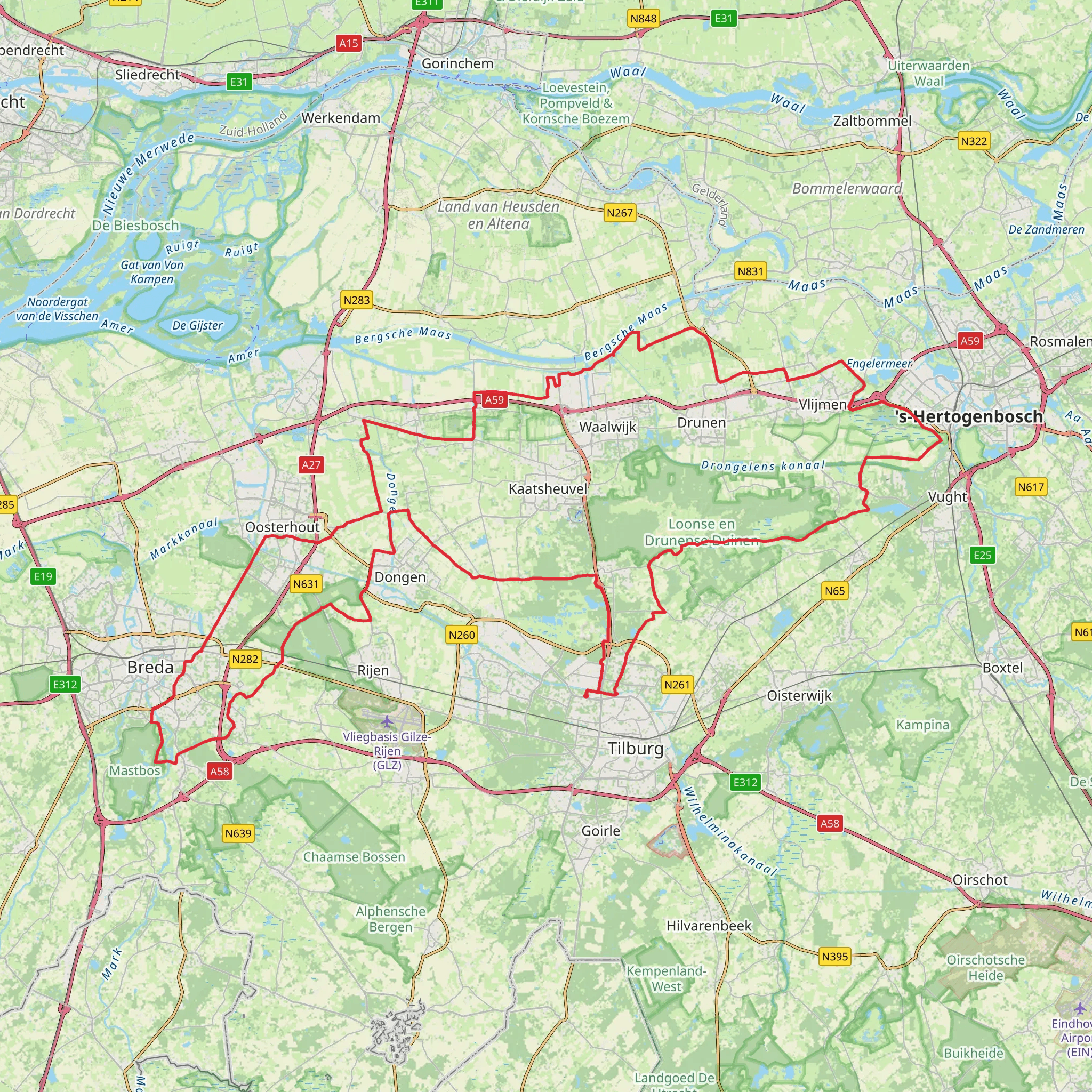
This is a long, low-relief loop of roughly 126 km (78 mi) with essentially 0 m (0 ft) of sustained climbing—expect it to feel “easy” in terms of elevation, but big in terms of time-on-feet. The terrain is typical of the Brabant lowlands: canal paths, forest tracks, sandy heathland lanes, farm roads, and occasional paved connectors. Underfoot is usually forgiving, though you’ll likely encounter short sandy stretches (slower walking) and muddy sections after rain in the wetter broek/lowland areas.
Getting to the start (public transport + car)
Because the start point is listed only as “near,” the most practical way to anchor this route is around the best-known landmark in the name: De IJzeren Man recreation area by Vught, North Brabant (near ’s‑Hertogenbosch/Den Bosch)—a well-known lake and leisure area that commonly serves as a trailhead for local long loops.
- By train + bus: Travel to ’s‑Hertogenbosch (Den Bosch) station or Vught station. From either, local buses and short taxi rides typically get you close to Recreatieplas De IJzeren Man (Vught). From Vught station it’s also feasible to walk to the lake area as a warm-up.
- By car: Aim for parking at/near Recreatieplas De IJzeren Man, Vught (signed recreation area parking). Arrive early on weekends—this is a popular local destination.
If you share the route’s GPX or a lon/lat for the exact trailhead, I can pin it to the nearest specific street address or named access point and describe the first kilometer precisely.
You’ll want HiiKER loaded for this one: the loop is long, and the “easy” profile can lull people into underestimating how many junctions of similar-looking tracks you’ll pass in forests and heaths.
What the route feels like, section by section
0–20 km (0–12 mi): De IJzeren Man and the wooded edges The opening tends to be the most “civilized”: broad paths near the lake, then into mixed woodland. Expect well-surfaced multi-use paths close to recreation zones, then narrower forest tracks. Early on, it’s common to see waterfowl (coots, mallards, geese) around the lake margins and canals, and songbirds in the tree belts. Even with minimal elevation gain, you’ll notice micro-undulations from old sand ridges and track camber—nothing that registers as climbing, but enough to affect ankles over a full day.
20–55 km (12–34 mi): Hooibroeken—wet lowlands and field margins “Broeken” in Dutch place names often signals low-lying, wetter ground—think drainage ditches, reed edges, and soft verges. This is where conditions change most with weather: - After rain, some tracks can become slick clay or puddled farm lanes. - In drier spells, it’s fast walking, but watch for narrow berms beside ditches.
Wildlife here is often subtle but rewarding: herons, egrets, and raptors hunting over open fields. In spring and early summer, insects can be intense near standing water—pack repellent if you’re sensitive.
55–95 km (34–59 mi): Vrachelse Heide—open heath, sand, and big skies Heathland is the psychological midpoint: more exposure, more wind, and often sandy, energy-sapping footing in places. The vegetation shifts to heather, grasses, and scattered pines/birch, with long sightlines that make navigation feel easier—until multiple parallel sandy tracks appear. This is where HiiKER is especially useful to confirm you’re on the correct line when trails braid and rejoin.
What to look out for: - Ground-nesting birds (seasonal): stay on established paths. - Ticks in grassy/heathy edges—do checks, especially if you brush through vegetation. - Sun and wind exposure: even cool days can dehydrate you here.
95–126 km (59–78 mi): Achter de Keten—quiet lanes, forest returns, and the long finish The final third often alternates between forest blocks and rural connectors. Fatigue is the main hazard now: the terrain stays easy, but attention drops, and that’s when people miss turns or roll an ankle on a rooty track edge. Expect more straight forestry lines and occasional paved stretches that can feel harsh on feet late in the day—consider cushioned footwear if you’re prone to sore soles.
Landmarks, nature, and what makes this area distinctive
- De IJzeren Man (Vught) is a prominent recreational water feature and a classic Brabant landmark. The broader region around Vught and Den Bosch has a long relationship with water management—drainage, canals, and controlled lowlands shape the landscape you’ll be walking through.
- Heathland (Vrachelse Heide) represents a traditional Dutch habitat that historically depended on grazing and land use patterns; today it’s valued for biodiversity and open character.
- Broek landscapes (Hooibroeken) highlight the low-country reality: ditches, drainage channels, and wet soils that can change the hike’s difficulty more than any hill ever could.
Practical planning: time, resupply, and gear
- Time estimate: At a steady
AI Planner
Days planned around your pace, with somewhere to stay each night.
Surfaces
Unknown
Asphalt
Concrete
Gravel
Paved
Dirt
Comments and Reviews
User comments, reviews and discussions about the De Ijzeren Man, Hooibroeken, Vrachelse Heide and Achter de Keten Loop, Netherlands.
average rating out of 5
0 rating(s)


