Download
3D Flyover
Add to list
More
18.3 km
~3 hrs 40 min
7 m
Point to Point
“A breezy Betuwe dike ramble: orchards, wide skies, and river horizons shaped by Dutch watercraft.”
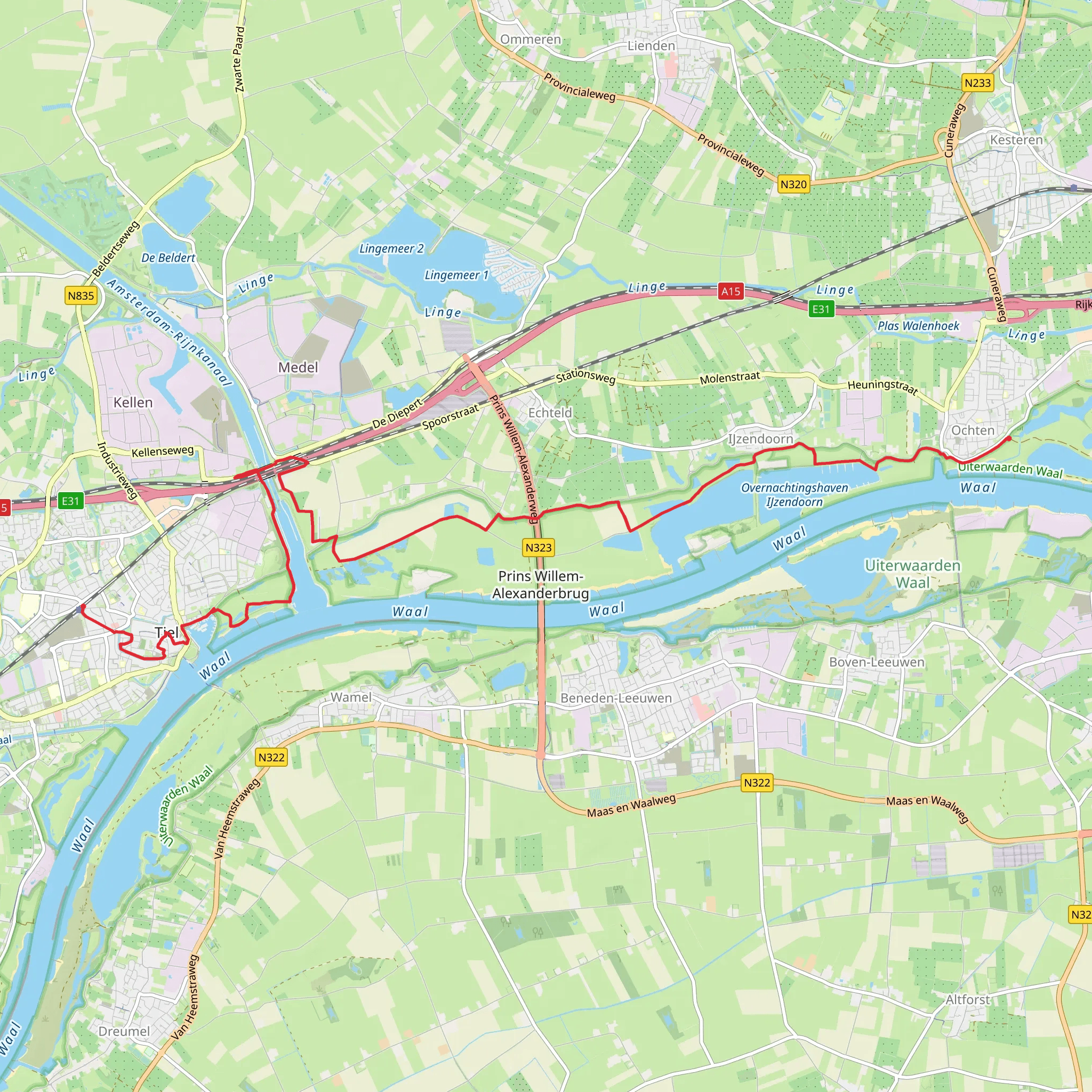
This is a classic, flat river-landscape walk through the Dutch Betuwe: orchards, dikes, wide skies, and long views over the Rhine/Waal system. At around 18 km (11.2 mi) with roughly 0 m (0 ft) of climbing, it’s more about steady pacing, wind management, and staying comfortable on exposed dike tops than about elevation.
Getting to the start (Tiel)
Start area (nearest well-known landmark): the most practical “hike head” for a Tiel-based route is around Tiel railway station (Stationsplein, 4001 Tiel, Netherlands) or the nearby Waal river dike a short walk north of the center. If you’re using HiiKER, match your start point to the closest pin near Tiel Station or Waalbandijk.
By public transport - Train: Tiel has an NS station with regular connections via Utrecht and ’s‑Hertogenbosch (often with a change at Geldermalsen depending on your origin). From the station, you can walk to the river/dike in minutes. - Bus: Regional buses also serve Tiel and surrounding villages; useful if you want to shorten/adjust the route or return from Ochten without backtracking.
By car - Tiel is easily reached via the A15 corridor. Use city parking near the center or near the station (paid parking is common). If you’re doing a point-to-point ending in Ochten, consider staging a second car near Ochten (or plan a return by bus/train).
What the route feels like (surface, exposure, pacing)
Expect a mix of paved dike paths, compacted gravel, farm access lanes, and short village sections. Because the terrain is essentially level, the main “effort spikes” come from: - Headwinds on the dike (common in open river country) - Long straight sections where pace can drift - Hard surfaces (pavement) that can fatigue feet—cushioned footwear helps
Plan on 3.5–5 hours of walking time depending on stops and wind.
Tiel to the river landscapes (0–6 km / 0–3.7 mi)
Leaving the built-up area of Tiel, the route quickly transitions into the Betuwe’s characteristic patchwork: orchards, drainage ditches, and broad fields. In spring you may pass stretches of blossoming fruit trees; later in the year, expect harvest activity and farm traffic.
Wildlife is subtle but constant: - Waterfowl (mallard, coot, grebes) in ditches and side waters - Geese grazing fields in cooler months - Raptors (kestrel, buzzard) hovering over open ground - Along wetter edges, you may spot herons and, with luck, kingfisher flashes near calm water
Because the route is low and open, sun and wind exposure can be significant even on mild days—bring a light shell and sun protection.
Willems Polder and dike walking (6–13 km / 3.7–8.1 mi)
Willems Polder is part of the broader riverine polder system—land shaped by centuries of Dutch water management. The “landmark” here isn’t a single monument so much as the engineered landscape itself: dikes, canals, and regulated floodplains that make settlement and agriculture possible on ground that would otherwise be periodically inundated.
You’ll likely notice: - Wide, open sightlines with very little shade - Seasonal wet areas and reedbeds depending on water levels and management - Dike-top travel that feels easy underfoot but can be deceptively tiring in wind
What to look out for - Cyclists and e-bikes: dike paths can be popular commuter/recreation corridors. Walk predictably and keep right. - Livestock fencing and gates: some sections may pass near grazing areas; respect closures and keep dogs leashed where required. - Soft verges: after rain, the grassy shoulder can be slick—stay on the firm track.
If you’re navigating, keep HiiKER handy here: the polder grid can look repetitive, and small turns at farm tracks are easy to miss.
Approaching Ochten (13–18 km / 8.1–11.2 mi)
As you near Ochten, the landscape often becomes more village-fringed again—houses, small roads, and local traffic—before settling into the quieter edges of town. Ochten sits in the same Betuwe region, historically defined by its relationship to the rivers: trade, agriculture, and the constant need to manage flood risk.
Historical context to carry with you This part of Gelderland has long been shaped by the Rhine–Waal river system and the Dutch tradition of poldering and dike building. The Betuwe is also widely known for fruit cultivation, and many routes here pass through areas that have supported orchards for generations. Even without dramatic ruins, the “history” is visible in the layout of land parcels, the raised dikes, and the way villages cluster on slightly higher, safer ground.
Practical planning: water, food, and comfort
- Water: Bring enough for an exposed, flat walk—1–1.5 L is typical in cool weather; more in warm conditions. Refill options depend on where you pass through villages.
- Food: Pack snacks; services can be intermittent between towns.
- **Footwear
AI Planner
Days planned around your pace, with somewhere to stay each night.
Surfaces
Unknown
Grass
Asphalt
Unpaved
Paved
Ground
Concrete
Sand
Comments and Reviews
User comments, reviews and discussions about the Tiel to Ochten via Willems Polder, Netherlands.
average rating out of 5
0 rating(s)