
Download
3D Flyover
Add to list
More
37.3 km
2 days
0 m
Multi Day
“A wind-shaped coastal loop from engineered sands to dune edges and quiet polder canals—endurance-minded.”
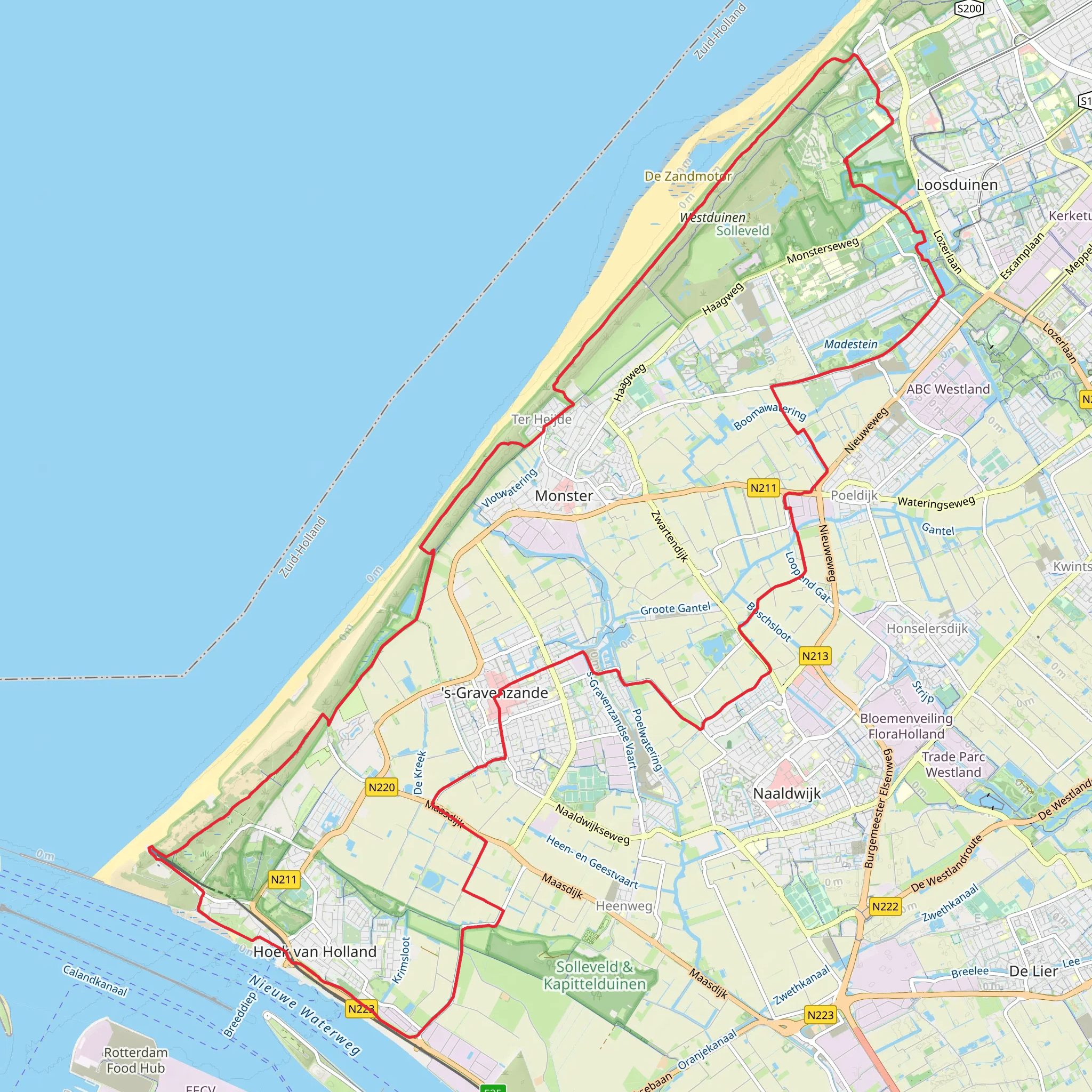
This is a long, flat coastal-and-polder loop of about 37 km / 23.0 mi with essentially 0 m / 0 ft of climbing—more of an endurance walk than a “hike,” best planned around wind, sand, and exposed sections. The route links three distinct landscapes: the engineered shoreline at the Zandmotor (Sand Motor), the dune edge and coastal access near Hoeksebaan, and the open, geometric farmland and waterways along Madepolderweg.
Start location (nearest landmark/address)
- The most practical “pin” for the start is the Zandmotor / Sand Motor viewpoint and beach access near Ter Heijde (South Holland, Netherlands)—commonly reached via the Ter Heijde beach approaches and parking areas by the dune line. If you’re navigating to a recognizable landmark, aim for Zandmotor (Sand Motor), Ter Heijde (signed locally as Zandmotor).
- If you share the exact lon/lat, I can convert it to the closest street address or named access point more precisely.
Getting to the start (car + public transport)
By car - Follow regional routes toward Ter Heijde (near Monster / Westland) and look for signs for Strand / Zandmotor. There are typically designated parking areas near the dune access points; arrive early on fair-weather weekends because beach traffic can fill lots quickly. - Bring coins/cards as needed for Dutch parking meters (varies by lot/season).
By public transport - The nearest major public-transport hubs are generally The Hague (Den Haag) and Delft, with onward connections toward the Westland coast. From there, local buses typically serve Monster and Ter Heijde; expect a short walk from the closest stop to the dune/beach access. - Plan for reduced frequency in evenings and on Sundays/holidays. Use HiiKER for the exact start point and to align it with the nearest stop and footpath approach.
What the route feels like underfoot
- Surface mix: compact sand and beach-adjacent paths near the Zandmotor; firm gravel/asphalt cycle paths and farm roads in the polder; occasional softer sandy stretches where paths meet dunes.
- Gradient: effectively flat—any “ups and downs” are minor dune undulations or small bridge ramps over canals.
- Exposure: very high. There’s little shelter from wind along the coast and across open fields.
A good way to think about pacing: 37 km / 23 mi on flat ground is still a full-day outing for most people. If you average 4.5–5 km/h (2.8–3.1 mph) including short stops, you’re looking at roughly 7.5–9 hours on the move.
Coastal engineering and the Zandmotor (first ~10–14 km / 6–9 mi)
The Zandmotor is one of the most distinctive “landmarks” you’ll encounter: a large, man-made sand peninsula designed to let currents and wind redistribute sand naturally along the coast, reinforcing beaches and dunes over time. Walking here feels wide-open and elemental—big sky, sea, and sand—with constant wind shaping the surface.
What to look out for - Soft sand: If your loop uses beach sections, expect slower progress. Firm sand near the waterline is faster but can be narrower at higher tide. - Tide and storm surge: Even on a “flat” hike, water can dictate your line. Check tide times before committing to long beach stretches. - Wind chill: Coastal wind can make mild temperatures feel much colder; pack a windproof layer year-round.
Nature and wildlife - Coastal birds are the headline: gulls, terns, and waders are common, and you may see birds resting on quieter sandbars. Keep distance from roosting groups, especially during breeding season when disturbance matters most. - Dune-edge vegetation is hardy and salt-tolerant; stay on established paths where possible to protect fragile dune plants.
Hoeksebaan and the dune edge (middle ~10–12 km / 6–7.5 mi)
As you transition away from the most open sand, the route typically threads along the dune margin and access roads around Hoeksebaan. This section often feels “faster” underfoot—more compact surfaces, clearer lines, and easier navigation.
Navigation - The area can have multiple parallel tracks (walking paths, cycle paths, service roads). Use HiiKER to confirm you’re on the intended line, especially where paths braid near dune entrances and road crossings.
Crossings and shared-use paths - Expect frequent cyclists on Dutch coastal routes. Walk predictably, keep right where appropriate, and be extra cautious at junctions where cycle paths cross access roads.
Madepolderweg and the polder landscape (last ~11–15 km / 7–9 mi)
The polder portion is a complete change of mood: straight lines, canals, drainage ditches, and big agricultural skies. It’s historically significant because this landscape reflects centuries of Dutch water management—land reclaimed and maintained through dikes, pumping, and careful drainage. Even when you don’t see a dramatic “dike wall,” the entire area is shaped by the ongoing effort to keep low-lying land usable and protected.
What to expect - Long, straight segments: Mentally easier for some, monotonous for others. Break it into chunks (e.g., canal-to-bridge, bridge-to-farm junction).
- Very limited shade: Sun exposure can be intense in summer; in cooler months, wind remains the main factor.
AI Planner
Days planned around your pace, with somewhere to stay each night.
Surfaces
Unknown
Asphalt
Paved
Comments and Reviews
User comments, reviews and discussions about the Zandmotorpad, Hoeksebaan and Madepolderweg Loop, Netherlands.
average rating out of 5
0 rating(s)



