
Centraal Station to Voorschoten via Haagse Hout, Ksteel De Wittenburg and De Paauw
Download
3D Flyover
Add to list
More
21.4 km
~4 hrs 16 min
0 m
Point to Point
“From Den Haag’s green hush to Wassenaar’s grand estates, a flat, reflective stroll to Voorschoten.”
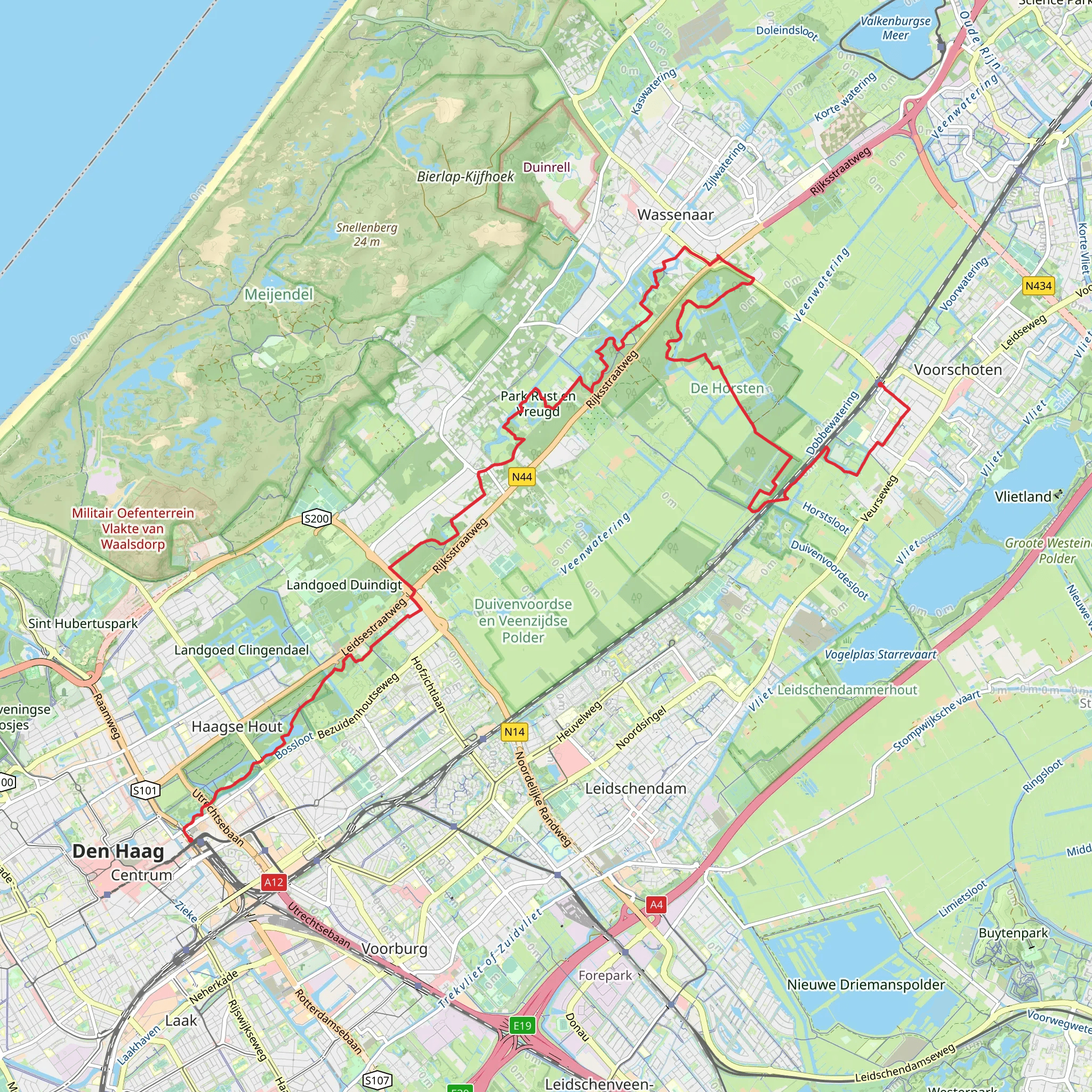
Starting from the area around Den Haag Centraal (The Hague Central Station)—the main rail hub beside Koningin Julianaplein and the Utrechtsebaan (A12) approach roads—this is a flat, city-to-estate-to-village walk of roughly 21 km (13.0 mi) with essentially 0 m (0 ft) of climbing. Expect a mix of paved park paths, wide gravel estate lanes, and quiet residential streets, with frequent opportunities to shorten the day using trains/trams in and around The Hague, Wassenaar, and Voorschoten.
Getting to the start (public transport / car)
- Public transport: The simplest approach is to arrive by train at Den Haag Centraal. It’s served by frequent intercity and regional services from Amsterdam, Rotterdam, Utrecht, Leiden, and beyond. From the station forecourt you can step straight onto pedestrian routes leading toward Haagse Hout.
- By car: If you’re driving, aim for parking near Den Haag Centraal (garages around Koningin Julianaplein / Bezuidenhout). City-centre parking can be expensive and time-limited; if you want a calmer start, consider parking near a tram/rail stop on the edge of The Hague and riding in.
You’ll finish near Voorschoten—typically within easy reach of Voorschoten station (rail connections toward Leiden/The Hague) and local bus routes, making this a straightforward point-to-point hike.
From the station area, the first kilometres are urban but green-edged: broad sidewalks, cycleways, and planted boulevards quickly funnel you into Haagse Hout, one of The Hague’s best-known city woodlands. The transition is quick—within about 1–2 km (0.6–1.2 mi) you’ll be under mature trees and away from traffic noise.
Haagse Hout is a classic Dutch urban woodland: flat terrain, straight and curving paths, and a canopy that can feel surprisingly dense for a city park. Underfoot is usually firm—paving or compacted gravel—so it’s a good choice in wet weather. In calmer corners you may spot common urban wildlife such as moorhens and ducks on ponds and ditches, and small birds (tits, thrushes, woodpeckers) in the trees. Early mornings and quieter weekdays tend to be best for wildlife; weekends bring more runners, dog walkers, and cyclists.
As you continue north-east, the route begins to feel more “estate-like,” with wider lanes and more formal landscaping. Over the next 6–9 km (3.7–5.6 mi), you’ll be moving through a patchwork of green corridors, residential edges, and parkland that reflects how this region developed: The Hague’s growth pressed up against long-established country estates and later commuter towns, leaving a distinctive mix of formal avenues, water features, and wooded parcels.
Estates, avenues, and what to watch for
This middle section—running roughly from km 6 to km 16 (mi 3.7 to 10)—is where the character of the hike really settles in.
- Kasteel De Wittenburg (Wassenaar area): You’ll pass near the grounds associated with De Wittenburg, an estate with a “castle” setting typical of Dutch country houses—ornamental water, long sightlines, and carefully managed woodland. Access can vary by path and property boundaries, so it’s worth checking your exact line in HiiKER and being ready to follow signed public rights-of-way rather than cutting across private drives.
- De Paauw (Wassenaar): This is one of the most notable landscaped parks in the area, known for its ponds, mature trees, and open lawns. It’s a good place for a short break because there are usually benches and clearings. Waterfowl are common here; keep an eye out for herons along the edges of ponds and canals.
- Path surfaces and pace: Expect mostly easy walking on firm surfaces. Even though the elevation gain is effectively nil, the distance adds up; a steady pace with short breaks works well. If you’re used to hillier hikes, the main “effort” here is simply time on feet.
Because you’re moving through a heavily used cycling region, the main hazard isn’t terrain—it’s fast bikes on shared paths. Stay predictable, keep right where appropriate, and be extra cautious at blind corners where hedges and trees limit sightlines.
Historically, this corridor between The Hague and Leiden/Voorschoten has long been shaped by sand ridges, reclaimed lowlands, and water management. The grand estates and parks you’re skirting are part of a broader pattern: wealthy families and institutions established country properties on slightly higher, better-drained ground, then landscaped them with ponds, canals, and tree-lined avenues. Even when you’re walking through what feels like “natural” woodland, much of it is designed landscape—a hallmark of this part of South Holland.
Navigation and logistics on a flat, built-up route
Even on an easy, low-relief hike, navigation can get fiddly where parks, estates, and residential streets interlock. Use HiiKER to: - confirm which estate lanes are public, - avoid dead-ends at gates or private drives, - and choose safer crossings at larger roads.
Plan for frequent road crossings, especially as you transition between green spaces. The most time-consuming delays can come from waiting at signals or detouring to find a legal crossing.
Water and food are usually easy to manage on this route because you’ll pass through or near built-up areas.
AI Planner
Days planned around your pace, with somewhere to stay each night.
Surfaces
Unknown
Asphalt
Ground
Gravel
Dirt
Paved
Wood
Concrete
Comments and Reviews
User comments, reviews and discussions about the Centraal Station to Voorschoten via Haagse Hout, Ksteel De Wittenburg and De Paauw, Netherlands.
average rating out of 5
0 rating(s)

