
Download
3D Flyover
Add to list
More
64.8 km
3 days
0 m
Multi Day
“A borderland ribbon of purple heather, whispering pines, and sandy heath—flat, but a serious all-day challenge.”
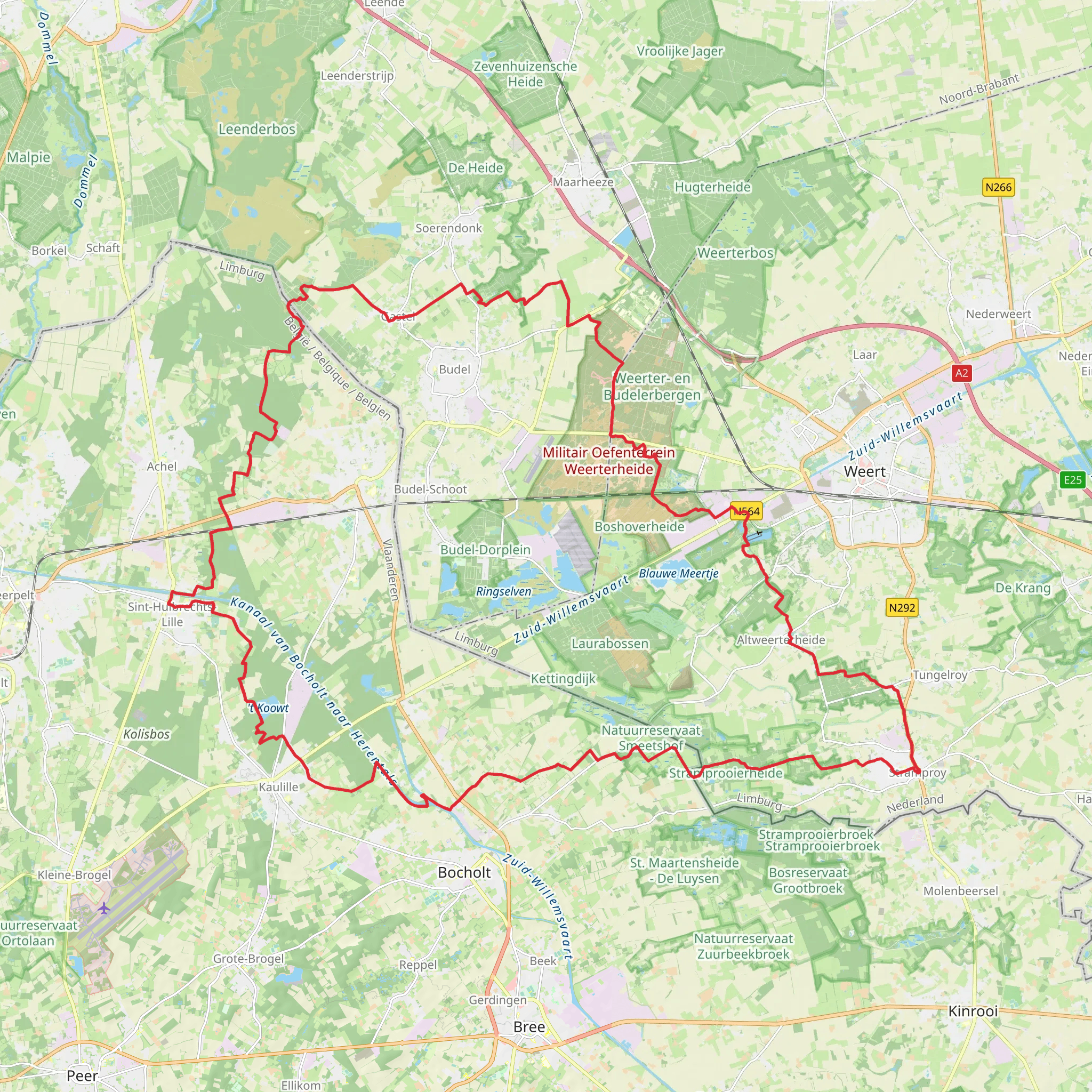
This is a long, low-relief loop of roughly 65 km (40.4 miles) with ~0 m (0 ft) of total climbing, linking a chain of heathlands, inland dunes, and pine forests across the Dutch–Belgian border region. Even with an “Easy” gradient profile, the distance makes it a full-day endurance outing for fast walkers, or a very long two-day hike if you prefer time for nature stops and cafés.
Getting to the start (car + public transport)
Because the start point is listed only as “near” (no town name or coordinates provided), the most practical way to plan is to anchor your start at a well-known access point that sits naturally on this loop’s landscape corridor:
- By car: Aim for the Budel / Budelerbergen recreation area (near Budel, North Brabant, Netherlands)—it’s one of the most recognizable trail-access hubs in this cluster of named areas and typically has clear signage and parking associated with the recreation/forest zone. From there, you can pick up sandy forest tracks and heath paths that stitch toward Gastelsche Heide and the other segments.
- By public transport: The most common rail access for this region is via Weert (NL) (major station) and then local bus/taxi onward toward Budel or nearby villages. If you share the intended start coordinates (lon/lat), I can convert them to the nearest known address/landmark and give a precise bus stop + walking approach.
If you’re navigating on the day, load the full loop into HiiKER and keep an eye on the border-area junction density—many tracks look similar in the pine plantations and dune corridors.
What the terrain feels like (and why it’s “easy” but not “short”)
Expect a predominantly flat profile: forest roads, sandy singletrack, heathland paths, and occasional compacted gravel/cycleway connectors. The “easy” rating comes from the lack of sustained climbs, but the route can still be demanding due to: - Soft sand sections (notably around inland dune areas like Budelerbergen), which can slow pace and increase calf fatigue. - Long, exposed heath stretches where wind and sun can be more noticeable than you’d expect in a “flat” hike. - Navigation repetition in managed forests—straight tracks and frequent intersections can make it easy to drift off-route if you’re not checking HiiKER regularly.
Plan your day around time-on-feet: many hikers average 4–5 km/h (2.5–3.1 mph) on mixed sand/forest terrain, putting this at 13–16+ hours moving time if done in one push. A strong, steady pace with minimal stops can bring it down, but it’s still a big day.
Route character, segment by segment (approximate)
Because loops like this can be walked in either direction, the distances below are best used as planning blocks rather than exact “mile markers.”
0–12 km (0–7.5 mi): Settling into heath-and-forest edges
You’ll likely begin on firm tracks that skirt heathland margins before the route commits to broader natural areas. Early on, it’s common to see heather (Calluna), gorse, and open sandy clearings. In cooler months, these open areas can feel damp underfoot; in summer, they can be dry and dusty.
12–28 km (7.5–17.4 mi): Gastelsche Heide feel—open heath, quiet tracks, big skies
This is where the landscape tends to open up: heath mosaics with scattered pines and birch, plus long sightlines. Wildlife is often subtle but present:
- Roe deer at forest-heath transitions (most likely early/late in the day).
- Heathland birds (listen for calls over the open ground).
- Reptiles such as common lizard in sunny sandy patches (watch where you place hands if you stop on warm banks).
If you’re hiking during late summer, heather bloom can turn sections purple, and the route feels more exposed—carry enough water because shade can be intermittent.
28–42 km (17.4–26.1 mi): Budelerbergen—sandy inland dunes and pine plantations
Budelerbergen is known for its inland dune character: rolling sand, pine forest, and a “dry” feel underfoot. Even without real elevation gain, the micro-undulations and sand can make this the most energy-intensive portion. Footwear with good sand-shedding tread helps; gaiters are optional but can be nice if you hate sand in shoes.
Look out for: - Loose sand on corners where bikes may also pass—step wide and stay alert. - Monoculture pine blocks where every junction looks the same; check HiiKER at intersections rather than “following the most used track.”
42–55 km (26.1–34.2 mi): Tungelerwallen area—linear earthworks and quieter connectors
“Tungelerwallen” refers to a landscape shaped by historic defensive earthworks in the wider region. Even when the “walls” are subtle on the ground, you’ll often notice long, straight embankment-like lines, ditches, and older boundary geometry that contrasts with the more organic heath. This section can feel calmer and more “corridor-like,” with easier walking on firmer paths—use it to regain rhythm after the sand.
**55–65 km (34.2–40.4 mi): Return leg—forest lanes, heath edges, and the final long flat
AI Planner
Days planned around your pace, with somewhere to stay each night.
Surfaces
Unknown
Asphalt
Unpaved
Sand
Gravel
Ground
Concrete
Paved
Dirt
Grass
Wood
Comments and Reviews
User comments, reviews and discussions about the De Boberden, Gastelsche Heide, Budelerbergen and Tungelerwallen Loop, Netherlands.
average rating out of 5
0 rating(s)



