
Download
3D Flyover
Add to list
More
84.7 km
4 days
0 m
Multi Day
“A long, level wander through heath and whispering pines—easy underfoot, demanding in patience.”
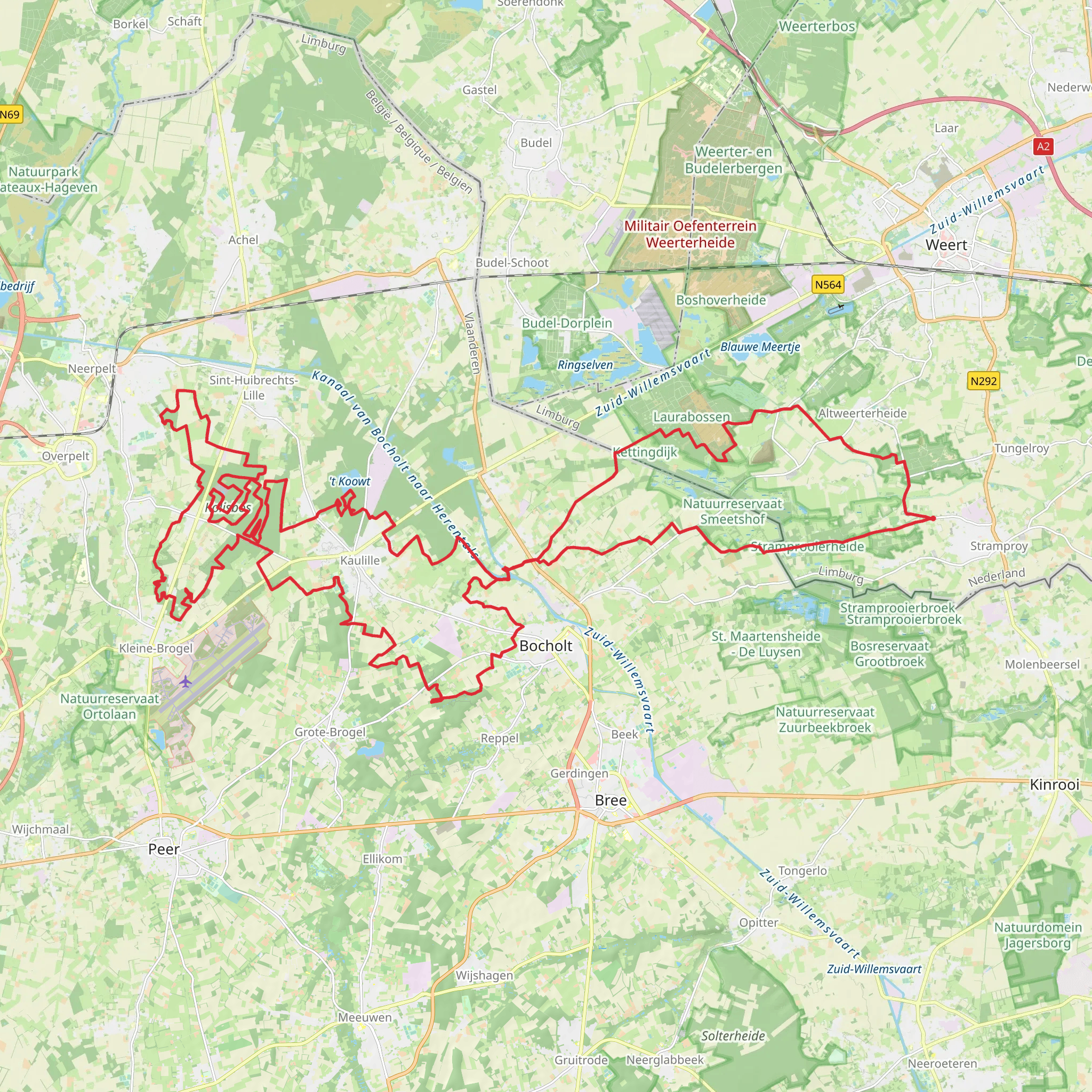
This is a long, very flat loop of roughly 85 km (52.8 mi) with about 0 m (0 ft) of climbing, linking heathland, pine-and-oak production forests, and quiet rural edges. Expect mostly wide forest tracks, sandy paths, and occasional paved connectors—ideal for steady mileage, but the length makes it an all-day (or multi-day) undertaking even though the terrain is easy.
Because your start point is listed only as “near” (no coordinates provided), I can’t reliably convert the lon/lat to a nearby address or landmark yet. If you share the start lon/lat (or a GPX), I’ll pin it to the nearest recognizable place (e.g., a trailhead car park, chapel, visitor center, or village square) and tailor the access directions precisely.
Getting to the start (car + public transport)
Without the exact start landmark, the best planning approach for this region is: - By car: aim for a signed forest/heath parking area (“parking,” “P,” “bosparking,” or “heideparking”) close to the loop’s first segment. In this landscape, parking is often at the edge of the forest blocks where sandy tracks begin. Arrive early—on weekends, popular heath/forest car parks can fill quickly. - By public transport: plan around the nearest rail station in the surrounding towns, then a regional bus to a village stop near the forest edge. From there, it’s commonly a 1–5 km (0.6–3.1 mi) walk to a trail access point. When you provide the start coordinates, I’ll identify the closest station/stop and the most straightforward walk-in.
What the route feels like underfoot
You’re moving through classic lowland terrain: nearly level, with long, runnable straights through forest compartments and more open, airy stretches across heath. The “easy” rating fits the technical difficulty (few steep grades, minimal scrambling), but the distance is the real challenge—feet, hydration, and pacing matter more than climbing fitness.
Typical surfaces you’ll rotate through: - Sandy singletrack and sandy doubletrack: can be energy-sapping; after dry spells it’s looser, and after rain it can turn into soft, churned sections. - Forest roads (hard-packed gravel/dirt): fast, consistent, and good for making time. - Short paved links: usually near farms, small roads, or to connect between forest blocks.
Plan for a steady, efficient cadence rather than “hiking by elevation.”
Landmarks, landscape, and nature to watch for
The names you’ve listed suggest a stitched loop through heath (“heide”) and woods (“bossen”), with color-coded local waymarking themes (e.g., “Rode Driehoek” = red triangle; “Blauwe Ruit” = blue diamond). These kinds of routes often pass through: - Heathland clearings: open views, low shrubs, and seasonal color changes. In late summer, heath can bloom and draw pollinators. - Pine plantations and mixed woodland: straight trunks, uniform stands in places, then pockets of mixed oak/birch where the understory is richer. - Forest edges and rides: long corridors cut through the woods—excellent for navigation but also where wind can funnel and where cyclists may move quickly.
Wildlife you may encounter in this type of lowland heath/forest mosaic: - Deer (often most active at dawn/dusk along forest edges) - Foxes and small mustelids (more likely seen as quick movement across tracks) - Ground-nesting birds in open heath areas (keep to paths to avoid disturbing them) - Ticks in grassy/heathy margins—especially in warmer months; long socks and checks at breaks help.
If the loop crosses wetter pockets (ditches, low boggy hollows), you may also see amphibians and more insect activity—bring repellent in summer.
Navigation and waymarking (and how to avoid wrong turns)
On long, flat forest networks, the main risk is not “getting cliffed out,” it’s drifting onto the wrong parallel track and losing time.
- Use HiiKER to keep a live position check at junctions—especially where multiple sandy tracks meet at odd angles.
- Expect repeating junction patterns in plantation forestry (many intersections look similar).
- Where the route transitions between the “red triangle” and “blue diamond” style segments, pay attention: it’s easy to follow the wrong color if multiple local loops overlap.
A practical rhythm that works well on this kind of terrain: - Confirm direction at every major junction. - If you’ve gone 300–500 m (0.2–0.3 mi) without seeing the next expected turn or landmark, stop and verify on HiiKER rather than “hoping it reconnects.”
Distance planning, pacing, and time-on-feet
At 85 km (52.8 mi), even easy ground becomes a logistics hike.
A realistic moving pace range for many hikers on flat mixed surfaces: - 4–5 km/h (2.5–3.1 mph) moving pace on firm tracks - Slower on sand, faster on gravel roads
That puts moving time roughly 17–21 hours if done in one push, before breaks. Many people will prefer splitting it into two days (for example, ~42–45 km / 26–28 mi per day), depending on daylight and support options.
Food, water, and resupply expectations
Forests and heathland loops can be deceptively “empty” for services: - Carry enough water
AI Planner
Days planned around your pace, with somewhere to stay each night.
Surfaces
Unknown
Unpaved
Asphalt
Gravel
Ground
Sand
Dirt
Concrete
Paved
Wood
Grass
Comments and Reviews
User comments, reviews and discussions about the Alweerterheide Rode Driehoek, Laurabossen Blauwe Ruit and Goolderroute Loop, Netherlands.
average rating out of 5
0 rating(s)


