
Download
3D Flyover
Add to list
More
17.6 km
~3 hrs 30 min
0 m
Loop
“Wander sandy Brabant woods and tea-dark vennen, where quiet WWII echoes linger beside reeds.”
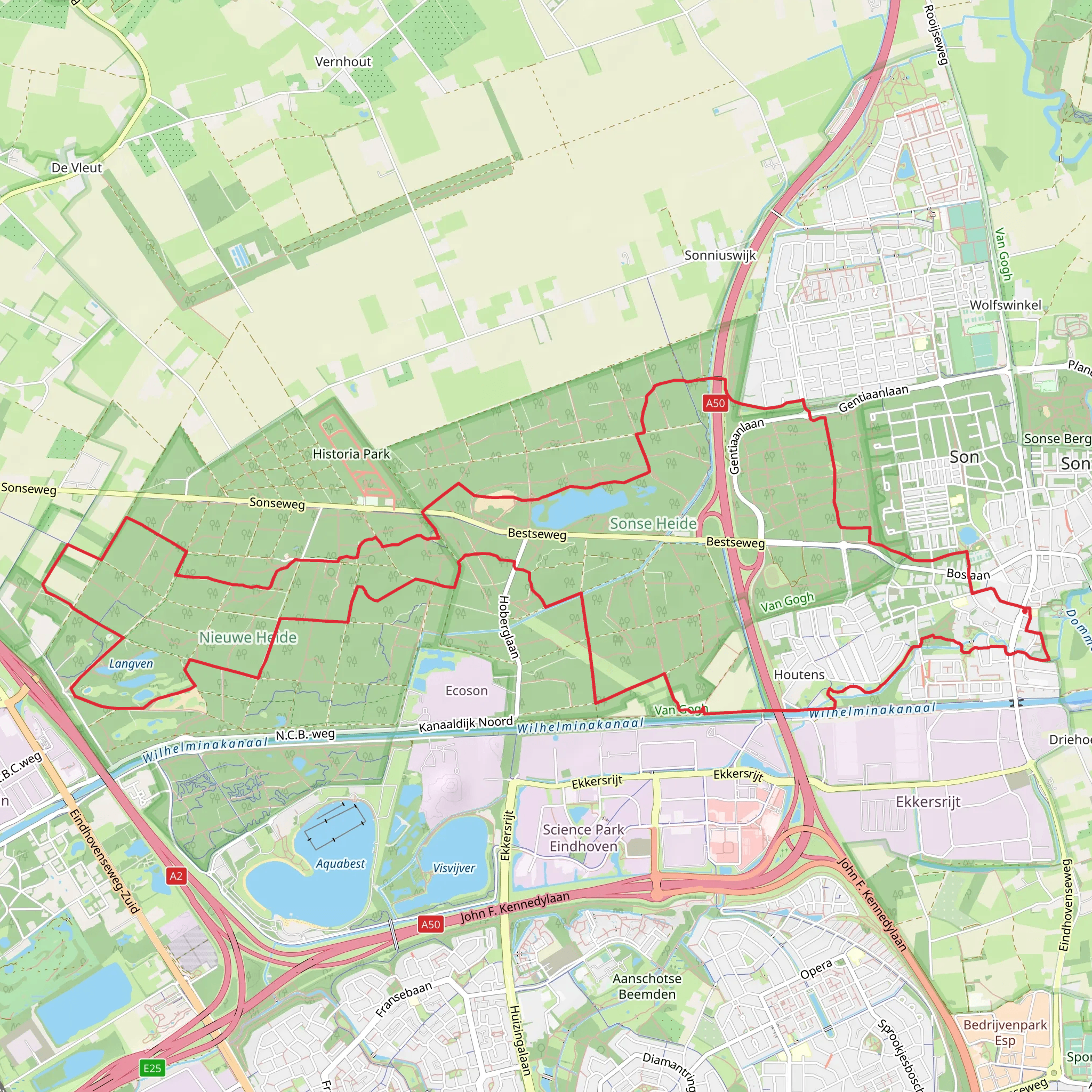
This is a flat, water-and-woodland loop of about 18 km / 11.2 mi with essentially 0 m / 0 ft of climbing, weaving through the Nieuwe Heide area between Best and Son en Breugel (North Brabant). Expect a classic Brabant landscape: sandy forest tracks, remnants of heathland, and a chain of small lakes/ponds (“vennen”)—with Langven and Oude Meer as the headline waters—plus a few places where the region’s WWII history is quietly but powerfully present.
Getting to the start (and what “near” usually means here)
Most versions of this loop are easiest to begin near the Joe Mann Paviljoen area in Best, a well-known trailhead/café/parking hub on the edge of the woods. A commonly referenced start location is:
- Joe Mann Paviljoen, Joe Mannweg, 5681 PT Best, Netherlands (routiq.com)
By car: Navigate to Joe Mannweg in Best and follow signs for the pavilion/parking. This is one of the most straightforward places to park for longer loops in this forest-heath mosaic. (routiq.com)
By public transport: The nearest rail hub is typically Best station (NS). From there, you’ll usually need a bus and/or a short taxi ride, or plan on adding a few extra kilometers of walking to reach Joe Mannweg and the forest edge. If you want, share where you’re coming from (e.g., Eindhoven Centraal) and the time of day, and the most practical bus connection can be narrowed down.
For navigation on the day, load the route in HiiKER so you can stay on the correct forest tracks when multiple sandy paths braid together.
What the terrain feels like underfoot
Because the elevation change is negligible, the “difficulty” here is almost entirely about surface and conditions:
- Unpaved dominates: long stretches of sandy forest road, pine-needle singletrack, and compacted dirt. Many routes in this area are overwhelmingly off-road. (klikprintenwandel.nl)
- Wet patches happen: after rain, low spots near the vennen can turn soft, muddy, or puddled, and some forest parcels can hold water for a while in wetter seasons. (klikprintenwandel.nl)
- Noise comes and goes: you may periodically hear the A50 and the N620, especially when the loop swings closer to the edges of the nature area. (klikprintenwandel.nl)
Plan on 3.5–5 hours of walking time for most hikers, depending on breaks and how boggy the margins of the lakes are.
Langven, Oude Meer, and the “vennen” landscape
The heart of the walk is the contrast between production forest (planted pine blocks that are increasingly being managed into more varied woodland) and the open, waterlogged pockets where the old heathland character still shows through. Historically, this broader heath area was much more continuous; over time, large parts were reclaimed and converted, while some heath and ven complexes remained. (klikprintenwandel.nl)
Oude Meer and Langven are the most recognizable waters on this loop. You’ll often find: - Reedy margins and dark, tea-colored water typical of sandy-soil vennen - Small clearings where the forest opens and you get longer sightlines across the water - Bird activity along the edges—listen for rustling in the reeds and watch for quick, low flights over the surface in calmer weather
A neat geological detail in this area is that some vennen persist even on slightly higher sandy ground because of less-permeable layers in the basin that help hold water. (klikprintenwandel.nl)
Wildlife and what to look out for
You’re in a mix of woodland, heath remnants, and wetland edges, so wildlife tends to be subtle rather than dramatic: - Waterfowl and reed-edge birds around the vennen (best early and late in the day) - Deer are possible in quieter forest sections—often noticed first by movement or tracks in soft sand - Insects and ticks: from spring through autumn, expect mosquitoes near still water and ticks in grassy/heathy edges—long socks and a post-hike tick check are smart.
WWII history you may pass near
This region between Son and Best saw intense fighting in September 1944 during the liberation
AI Planner
Days planned around your pace, with somewhere to stay each night.
Surfaces
Sand
Unknown
Dirt
Asphalt
Unpaved
Ground
Paved
Comments and Reviews
User comments, reviews and discussions about the Langven, Oude Meer and Hoberg Loop, Netherlands.
average rating out of 5
0 rating(s)

