
Download
3D Flyover
Add to list
More
26.1 km
~5 hrs 14 min
19 m
Loop
“A big-sky Dutch loop of peaty pools, whispering reedbeds and moorland hush—flat, long, unhurried.”
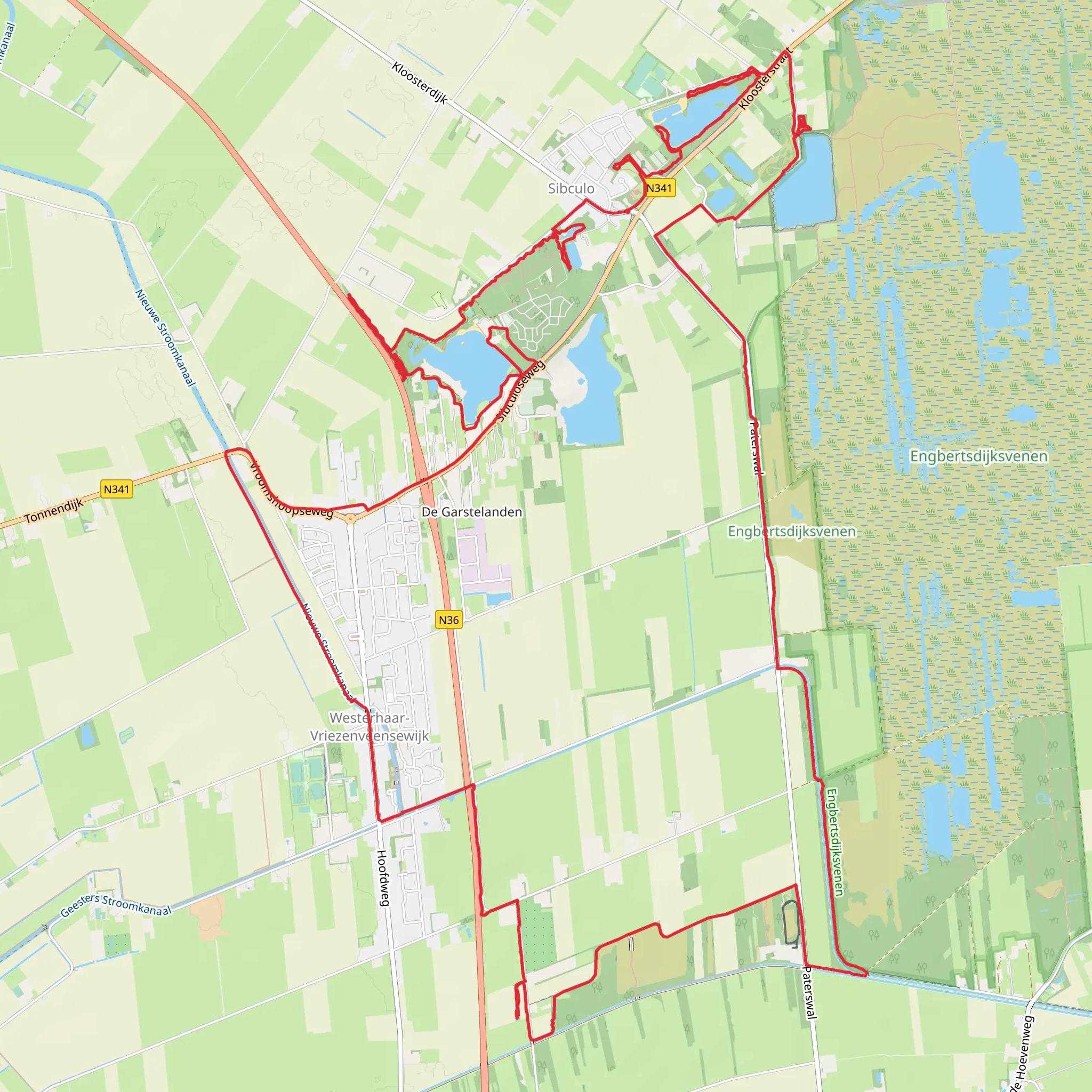
This is a long, low-relief loop through classic Dutch wetland-and-heath scenery—peaty pools, reedbeds, and open moorland edges—where the “effort” comes more from steady distance than climbing. At ~26 km (about 16.2 miles) with roughly 0 m (0 ft) of elevation gain, it suits hikers who want an easy, all-day ramble on mostly flat, well-made paths, with frequent water features and big-sky views.
Getting to the start (car + public transport)
Because the start point is listed only as “near” (no coordinates or town provided), the most reliable way to pin down the nearest address/landmark is to use the route’s start point in HiiKER and read the closest road name/parking area it suggests. If you share the start lon/lat (or a GPX), I can convert it to the nearest known address or a recognizable landmark (e.g., a car park, trailhead, or visitor center) and tailor the directions precisely.
In the meantime, here’s how this typically works for this region and trail style:
- By car: Most loops of this length in Dutch nature reserves begin at a signed parking area (P) near a reserve entrance, often close to a small village edge. Expect a small lot rather than a large visitor complex. Arrive early on weekends—flat, easy loops attract cyclists and walkers.
- By public transport: The usual pattern is train to the nearest larger town, then a regional bus to a village stop near the reserve boundary, followed by a 1–3 km (0.6–1.9 mi) walk to the trailhead. Use HiiKER to confirm the closest bus stop to the start point and to avoid private farm tracks.
What the terrain is like (and why it feels “easy”)
You’ll be on a mix of:
- Compacted gravel and sandy paths through heath and woodland edges
- Boardwalks or raised paths near wetter sections (common around venens/peat pools)
- Short paved connectors when the loop skirts villages, farms, or access roads
Even with negligible elevation gain, plan for variable underfoot conditions: - After rain, peatland margins can be soft, slick, and muddy, especially where foot traffic funnels around puddles. - In drier spells, sandy stretches can feel a bit draggy over 26 km (16.2 mi), even though it’s flat.
Route flow and key landmarks (approximate distances)
Because the exact start point isn’t specified, the distances below are structured as a typical progression for a 26 km (16.2 mi) loop linking the named features. Once you provide the start coordinates, I can align these to the exact sequence and refine the segment lengths.
0–5 km (0–3.1 mi): Settling in along flat reserve paths
The opening usually follows broad, easy paths that let you find a rhythm quickly. Expect open views across heath or meadow edges and the first hints of wetland—ditches, small pools, and reedbeds. This is often where you’ll see the first interpretive signs about habitat restoration and water management.
5–12 km (3.1–7.5 mi): De Vlegge area—wetland character and birdlife
Around De Vlegge, the landscape tends to feel more “watery”: peat pools, reed fringes, and damp hollows. These areas are prime for:
- Waterfowl and marsh birds (listen for calls from reedbeds)
- Dragonflies and damselflies in warmer months
- Amphibians near still water (especially in spring)
Stay on the marked path where boardwalks or roped edges appear—peat margins can be deceptively unstable, and sensitive vegetation is easily damaged.
12–18 km (7.5–11.2 mi): Oude Oostervenen—peatland history written into the ground
“Oude … venen” points to older peatland/wet heath systems. In much of the Netherlands, these landscapes are closely tied to centuries of peat cutting (turf extraction) and later drainage and reclamation, followed by modern conservation efforts to re-wet and protect remaining habitats. Even if you don’t see obvious “ruins,” the straight drainage lines, water level controls, and the patchwork of wet/dry vegetation often reflect that long human history.
This middle section is usually the most atmospheric: open, quiet, and expansive. Wind exposure can be noticeable—bring a light shell even on mild days.
18–24 km (11.2–14.9 mi): De Spartelvijver—pond/lake feature and a natural pause point
A “vijver” is typically a pond or small lake. De Spartelvijver often provides a clear landmark where many hikers stop for a longer break. Expect:
- Open water with reeds and marginal plants
- Good chances of spotting herons and other waterside birds
- Reflections and wide views that make navigation feel intuitive (you can “aim” for the water feature)
If there are benches or viewing points, they’re commonly placed here. Keep snacks secured—some areas have bold birds that will investigate unattended food.
24–26 km (14.9–16.2 mi): Easy return on firm paths
The final stretch is typically straightforward: firmer track, occasional paved connectors, and a gradual return to the start area. Fatigue is more about time-on-feet than terrain, so this is where blister prevention and pacing matter most.
Navigation and wayfinding (keep it simple)
This is
AI Planner
Days planned around your pace, with somewhere to stay each night.
Surfaces
Unknown
Asphalt
Concrete
Ground
Grass
Dirt
Sand
Gravel
Unpaved
Wood
Comments and Reviews
User comments, reviews and discussions about the De Vlegge, Oude Oostervenen and De Spartelvijver Loop, Netherlands.
average rating out of 5
0 rating(s)

