
Download
3D Flyover
Add to list
More
119.4 km
7 days
6 m
Multi Day
“A big-sky Dutch loop of heath, whispering pines, drifting dunes, and quiet fens—demanding in time and sand.”
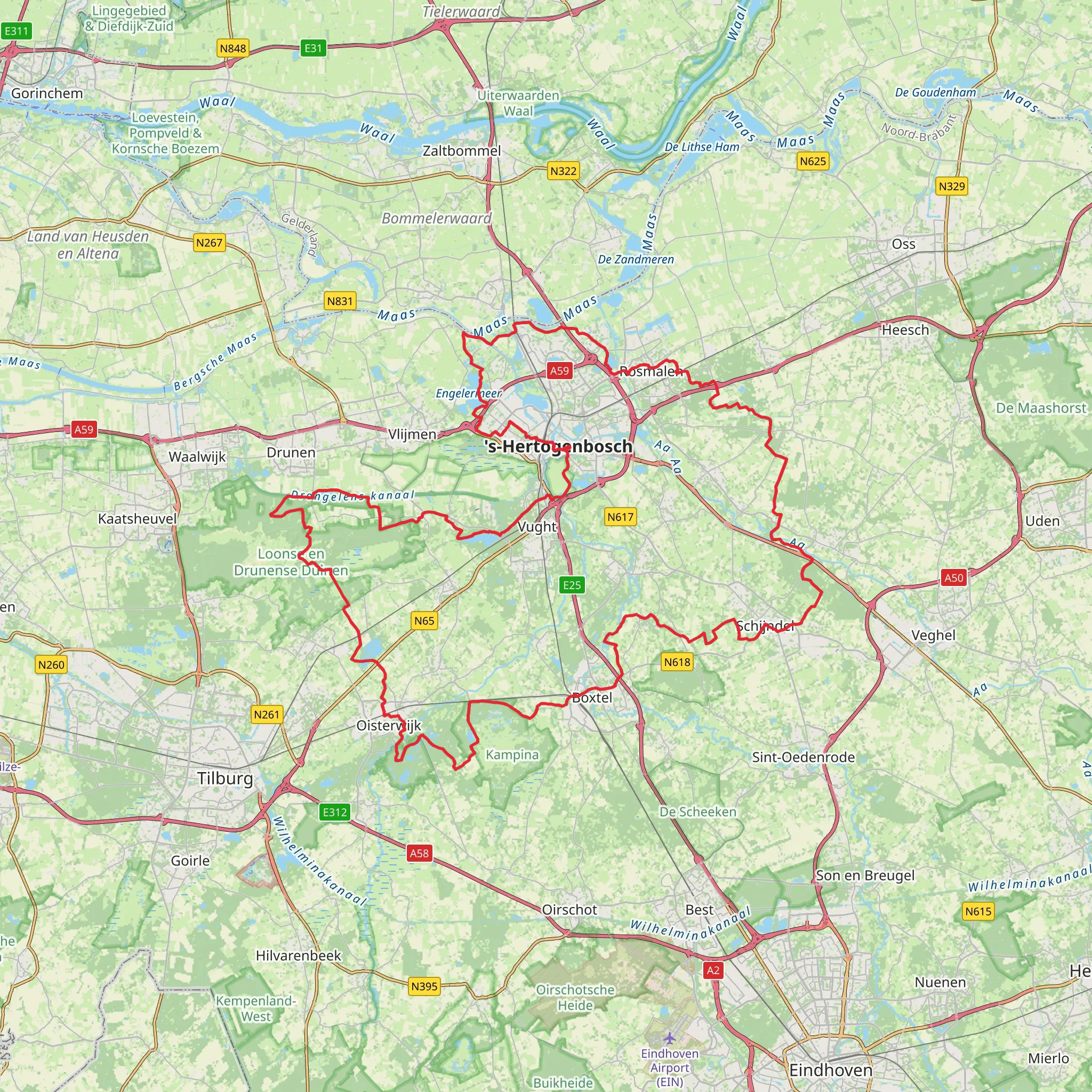
This is a long, mostly flat, big-sky loop through some of the Netherlands’ most distinctive inland landscapes: open heath, drifting sand dunes, pine and oak woodland, and wet heath/peaty pockets. At roughly 119 km (74 mi) with about 0 m (0 ft) of total climbing, the challenge is less about elevation and more about time on feet, sandy footing, wind exposure on open heaths, and staying oriented through large dune fields and forest grids.
Expect a route that feels like three major nature areas stitched together: Vughtse Heide (heath and woodland near Vught), Nationaal Park De Loonse en Drunense Duinen (the “Brabant Sahara” of inland dunes), and Kampina (wet heath, fens, and quiet forest edges near Boxtel/Oisterwijk). Even on an “easy” profile, plan it like an ultra-distance hike: pacing, foot care, and resupply matter.
Getting to the start (public transport + car)
Because your “Hike head” is listed as “near” without a specific point, the most practical start for this loop is near a major access point between Vught and the Vughtse Heide area. A common, easy-to-reach landmark to anchor a start is:
- Vught railway station (Station Vught), Vught, North Brabant — a straightforward rail stop with frequent connections via ’s‑Hertogenbosch (Den Bosch).
By public transport
- Take the train to Station Vught (typically via ’s‑Hertogenbosch). From the station area, you can walk to the heath/woodland edges on the south/southwest side of town to pick up paths that lead toward Vughtse Heide.
- If you prefer starting closer to the dunes, you can also use buses toward Drunen or Tilburg and begin near one of the main dune access points (see below), but that changes where the “loop” naturally closes.
By car - Aim for a large, established trailhead car park at one of the major nature gateways: - Near the dunes: Bosch en Duin / Roestelberg area (near Drunen) is a well-known access zone for De Loonse en Drunense Duinen. - Near Kampina: parking areas around Oisterwijkse Bossen en Vennen or the Kampina access points near Boxtel/Oisterwijk are commonly used. - Wherever you park, confirm overnight parking rules if you’re splitting this into multiple days.
For navigation, load the full loop in HiiKER and download offline maps before you arrive—this terrain has long, similar-looking forest tracks and broad dune expanses where “obvious” lines on the ground can fade.
What the terrain feels like over 119 km / 74 mi
Although the elevation gain is essentially negligible, the underfoot conditions vary a lot:
- Heath and sandy singletrack: springy in places, but can be dry and loose in summer.
- Forest grids: fast walking on compacted paths, but easy to take the wrong junction because many intersections look identical.
- Dune fields: the slowest section—soft sand can cut your pace dramatically and increases calf/Achilles load.
- Wet heath/fen edges (Kampina): can be muddy after rain; some sections may have narrow boardwalks or damp, rooty trail.
A realistic planning pace for a mixed-surface route like this is often 3–4.5 km/h (2–2.8 mph) depending on sand depth and breaks. Many hikers split 119 km into: - 2 days: ~60 km (37 mi) per day (very long days, early starts) - 3 days: ~40 km (25 mi) per day (more comfortable) - 4 days: ~30 km (19 mi) per day (easiest on feet, best for nature stops)
Vughtse Heide: open heath, woodland edges, and military history nearby
Early in the loop, the landscape tends to alternate between heathland clearings and mixed woodland. Heath areas are typically open and wind-exposed, with long sightlines and a big sense of space despite being close to towns.
Wildlife you may notice here and throughout the region: - Heathland birds (skylark-like song in open areas, raptors overhead) - Roe deer at woodland margins, especially early/late - Reptiles in sunny sandy patches (slow down and watch where you place hands/feet if you step off-trail)
This region also carries heavy 20th‑century history. Near Vught is Kamp Vught (Nationaal Monument Kamp Vught), a former WWII concentration camp site and memorial. If your loop passes close enough, it’s a significant and sobering stop that adds context to the landscape you’re walking through—quiet forests here have witnessed events far beyond what the scenery suggests today.
Planning note: heath can be hot and exposed in sunny weather and biting-cold with wind in winter. With little elevation to create shade variation, sun and wind management matter more than “climbing fitness.”
De Loonse en Drunense Duinen: the “Brabant Sahara” and the slow miles
The middle portion through De Loonse en Drunense Duinen National Park is the signature section. You’ll move from forest into a vast inland dune system—one of the largest drifting-sand areas in Western Europe. The dunes can feel almost coastal, but you’re inland
AI Planner
Days planned around your pace, with somewhere to stay each night.
Surfaces
Asphalt
Unknown
Sand
Dirt
Ground
Concrete
Gravel
Unpaved
Paved
Cobblestone
Wood
Grass
Comments and Reviews
User comments, reviews and discussions about the Vughtse Heide, Loonse En Drunense Duinen and Kampina Loop, Netherlands.
average rating out of 5
0 rating(s)



