
Download
3D Flyover
Add to list
More
13.3 km
~2 hrs 40 min
6 m
Loop
“A leg-friendly, level wander from sandy pines to wind-brushed heath and Davidsplassen’s quiet bird hide.”
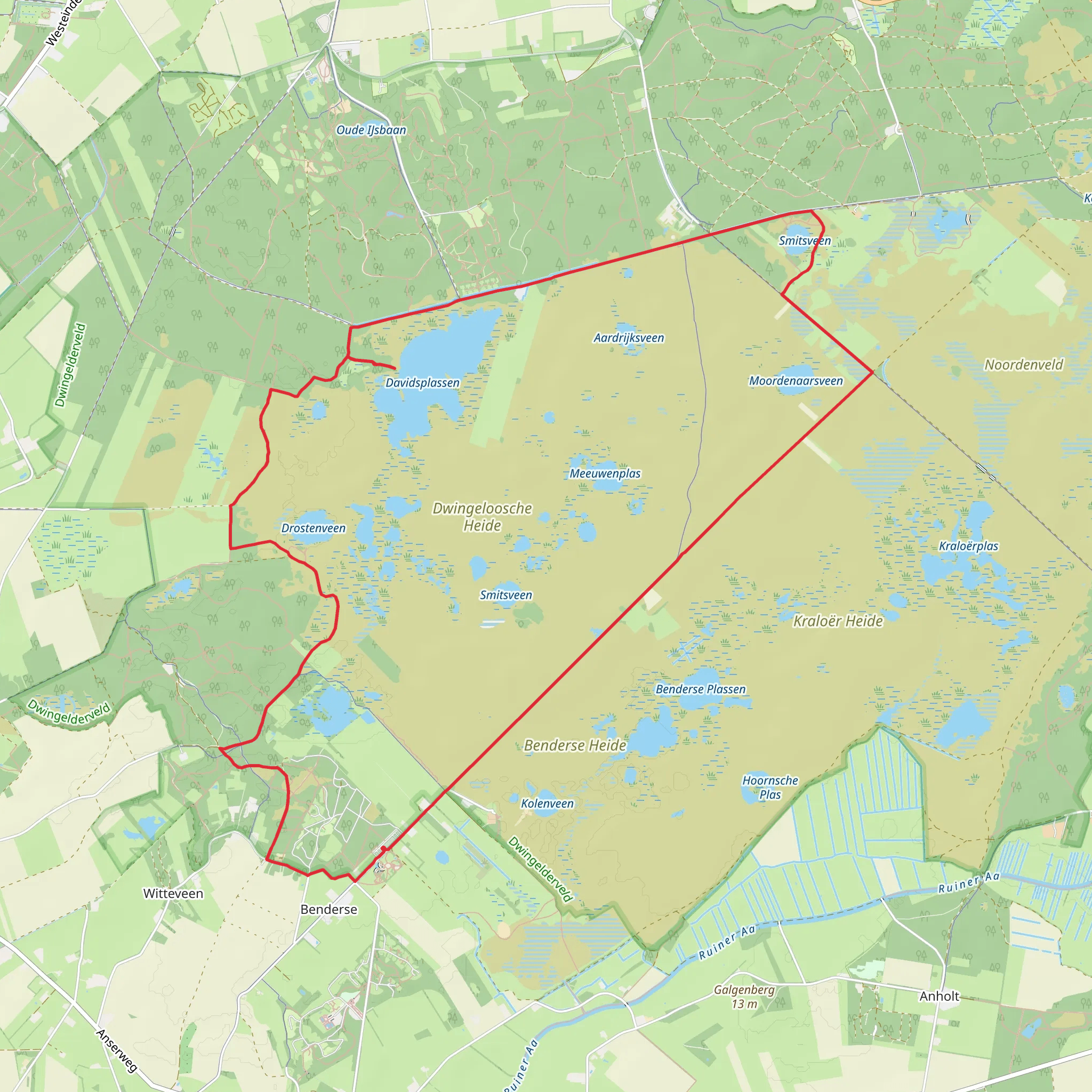
You’re looking at a very flat, low-effort loop of about 13 km / 8.1 mi with essentially 0 m / 0 ft of climbing—classic Drenthe walking: sandy forest tracks, heath-edge paths, and quiet water views. The character of the walk is “easy on the legs, big on atmosphere,” with the main challenges being soft sand, mud after rain, and exposure to wind around open heath and lakes.
Where this hike starts (nearest landmark / address)
This loop is typically approached from the Dwingelderveld area near Dwingeloo, using the main access roads signed for local nature destinations like Planetron / Camping De Noordster, then continuing onto sandy tracks toward the Davidsplassen area. A common practical start for walkers is the large public parking area on/near Anserpad (Dwingelderveld), which is also referenced locally as the main place to leave a car for nearby trails. (dwingeloo.scouting.nl)
If you’re navigating to the Davidsplassen bird hide specifically, the hide is associated with the Davidsplassen lakes in Nationaal Park Dwingelderveld, and the area is signposted from Dwingeloo via those “Planetron / Camping de Noordster” directions. (vogelkijkhut.nl)
Getting to the start (car + public transport)
By car:
- Aim for the Dwingeloo / Dwingelderveld access points and park at the public lot on/near Anserpad (large, commonly used for Dwingelderveld visits). From there you can pick up the loop on foot. (dwingeloo.scouting.nl)
- Expect sandy access roads once you leave the village edge; drive slowly and watch for walkers/cyclists.
By public transport:
- The most straightforward approach is to travel to Dwingeloo (regional buses connect from larger hubs in Drenthe), then continue by walking or a short taxi ride to the Dwingelderveld access/parking area. If you want to keep it fully human-powered, plan extra distance for the approach walk from town.
- For on-trail navigation, load the route in HiiKER before you leave town so you’re not relying on spotty reception in the forest/heath.
What to expect on the loop
From the trailhead area you’ll ease into mixed woodland—pine and deciduous stands—on wide, mostly level tracks. Underfoot is often packed sand that can turn to loose, energy-sapping sand in drier stretches. After wet weather, the low-lying sections can hold water and become muddy, especially where paths funnel toward the lakes and reedbeds.
As you arc toward Davidsplassen, the landscape opens: you’ll transition from forest to wet heath and open water, where the horizon feels bigger and the wind is more noticeable. The Davidsplassen are a well-known birding spot, and the bird hide (vogelkijkhut) is the signature landmark—an ideal place to pause quietly and scan the waterline and reed edges. (drenthe.nl)
The return leg typically threads back through alternating heath-edge and forest corridors, keeping the walking straightforward and the gradients negligible. Because the terrain is so flat, the “difficulty” comes less from elevation and more from surface conditions and distance management (steady pacing, comfortable footwear, and keeping socks dry).
Landmarks, nature, and wildlife to look out for
Davidsplassen & the bird hide:
This is prime habitat for waterbirds and heathland species. The Davidsplassen hide is specifically noted for sightings such as terns, ducks, swallows, and also mammals like roe deer and fox; in winter, large groups of geese use the waters as a roost. (drenthe.nl)
Wet heathland character:
Dwingelderveld is widely recognized as the largest wet heathland area in Western Europe, and that wet-heath mosaic (heather, sedges, boggy pools, and sandy ridges) is exactly what gives this loop its variety despite the
Surfaces
Sand
Unknown
Dirt
Grass
Asphalt
Gravel
Concrete
Comments and Reviews
User comments, reviews and discussions about the Davidsplassen and Spaarbankbosch Loop, Netherlands.
average rating out of 5
0 rating(s)



