Download
3D Flyover
Add to list
More
77.1 km
4 days
0 m
Multi Day
“A wind-swept South Holland loop of dikes, canals and polders, softened by woodland hush.”
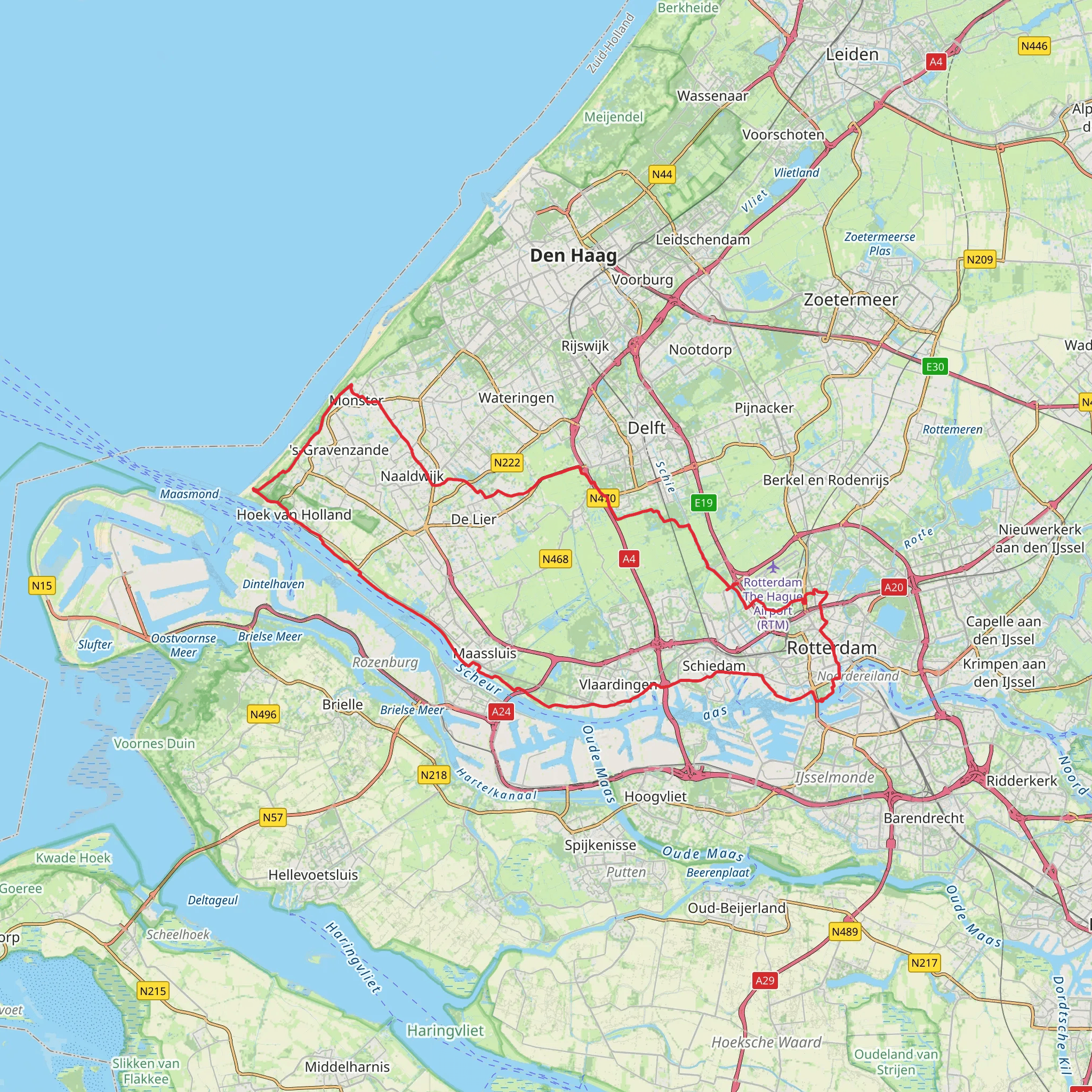
This is a long, low-lying loop through the Rijnmond–Delfland area of South Holland, linking riverfront towns, reclaimed polders, canal paths, and managed woodland and lakes. At roughly 77 km (48 mi) with about 0 m (0 ft) of climbing, the challenge is less about elevation and more about time on feet, wind exposure, and keeping a steady pace on hard, flat surfaces (dikes, cycleways, compacted gravel).
For planning, treat it like an all-day outing: most hikers will want 10–16 hours depending on pace and breaks, and it’s very easy to underestimate how much headwind can slow you down on open dike sections.
Getting to the start (and where “near” typically means)
Because the start point wasn’t fully specified (“near …”), the most practical “hike head” for this loop is Maassluis town center / Maassluis Centrum area, close to the Nieuwe Waterweg riverfront and the Maassluis ferry/harbor zone—a clear, well-known landmark cluster that’s easy to reach and makes sense for a loop of this name.
- By public transport:
- Metro: Rotterdam’s metro network reaches Maassluis Centrum (RET). From Rotterdam city center, you can connect onto the Hoekse Lijn corridor and step off close to the riverfront.
- Train connections: If you’re arriving from farther away, you’ll typically route via Rotterdam Centraal, then transfer to metro toward Maassluis.
- Metro: Rotterdam’s metro network reaches Maassluis Centrum (RET). From Rotterdam city center, you can connect onto the Hoekse Lijn corridor and step off close to the riverfront.
- By car:
- Approach Maassluis via the A20 corridor and local roads into town. Use parking near the riverfront/harbor or near Maassluis Centrum (choose a lot that allows long stays). Start early to avoid commuter pressure and to give yourself daylight buffer.
If you share the exact lon/lat for the intended start, I can pin it to the nearest specific street address or named landmark and align the route description precisely.
What the terrain feels like (and what to watch for)
Expect very flat, very open walking for long stretches:
- Surface: mostly paved multi-use paths and dike-top routes, with some compacted gravel/park paths in wooded sections (Abtswoudse Bos).
- Exposure: little shade in the polders; sun and wind are the main factors.
- Navigation: the path network can be dense with intersecting cycleways and canal-side spurs—use HiiKER to stay on the intended loop and to avoid accidentally following a parallel dike for several kilometers.
- Traffic mix: you’ll share space with cyclists in many places. Stay predictable, keep right where appropriate, and be extra cautious at fast commuter-cycle junctions.
Route flow and key sections (approximate)
Because this is a loop linking multiple named areas, it helps to think of it in four big legs. Distances are approximate and will vary slightly depending on the exact connectors used.
1) Maassluis riverfront and dike country (about 15–22 km / 9–14 mi)
You’ll likely begin near Maassluis’s waterfront, where the landscape is defined by the Nieuwe Waterweg—a major shipping artery engineered as part of the Netherlands’ long relationship with water management and maritime trade. Even when you’re not right on the river, you’ll feel its influence in the dikes, canals, and broad, geometric fields.
What to look for:
- Working waterways: barges, tug traffic, and distant port infrastructure cues.
- Birdlife: open polder edges often hold geese, swans, coots, moorhens, and raptors like kestrels hovering over fields.
- Wind management: if the wind is up, this is where it can bite—plan clothing layers you can adjust without stopping for long.
2) De Wollenbrand and the polder-green corridor (about 12–18 km / 7–11 mi)
De Wollenbrand is part of a broader patchwork of recreation green space and water features that break up the agricultural grid. The walking here tends to alternate between canal-side straightaways and park-like segments.
What to look out for:
- Water edges: after rain, some paths can have slick algae on hard surfaces near canals.
- Bridges and underpasses: these are common “wrong turn” points—confirm each crossing in HiiKER before committing, especially where multiple parallel canals run close together.
Nature notes: - Reeds and wet margins can attract herons, egrets, and in quieter corners you may spot kingfishers (often heard/seen as a quick flash of blue).
3) Abtswoudse Bos: the most sheltered walking (about 10–16 km / 6–10 mi)
Abtswoudse Bos is where the loop feels least like a dike march and most like a traditional park-woodland walk. It’s managed woodland with paths that can be softer underfoot and noticeably calmer in wind.
What changes here:
- Shade and shelter: a welcome break if you’ve had hours of open exposure.
- Path texture: more compacted gravel/soil; after wet weather, expect muddy patches in low spots.
Wildlife: - Woodland birds (tits, finches, woodpeckers), and small mammals are more likely here than out on the open polder lines. Near water pockets, amphibians are possible in warmer months.
4)
AI Planner
Days planned around your pace, with somewhere to stay each night.
Surfaces
Asphalt
Unknown
Concrete
Sand
Unpaved
Grass
Comments and Reviews
User comments, reviews and discussions about the Maassluis, De Wollenbrand, Abtswoudse Bos and Achterplas Loop, Netherlands.
average rating out of 5
0 rating(s)