
Download
3D Flyover
Add to list
More
24.2 km
~4 hrs 50 min
0 m
Point to Point
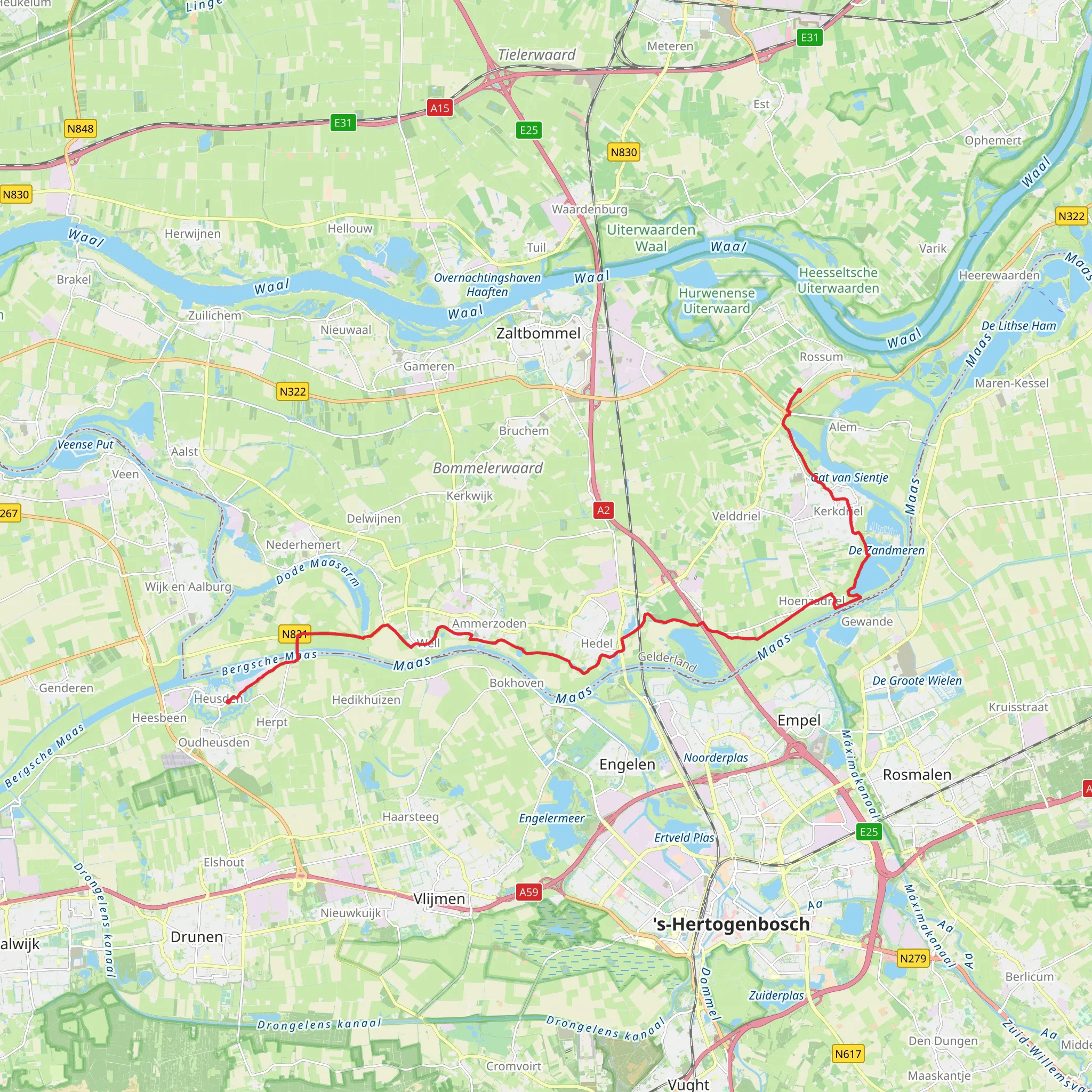
“Beneath vast Dutch skies, a waterside dike ramble—easy-going, unless wind turns it into work.”
This is a flat, waterside walk through the Dutch river landscape where the “effort” is almost entirely about distance rather than climbing: roughly 24 km / 15 miles with essentially 0 m / 0 ft of elevation gain. Expect a mix of paved dikes, compacted gravel paths, and short stretches of quiet lane—excellent in wet weather, but with a few exposed sections where wind and rain can feel more intense than the forecast suggests.
Getting to the start (and what “near” likely means)
You didn’t include a specific start coordinate after “Hike head: near …”. If you share a lon/lat, I can pin it to the nearest recognizable address or landmark. Based on the route name, the start is typically associated with Rome (near the village of Rome, North Brabant, Netherlands)—a small hamlet in the municipality of Dongen, not far from ’s-Hertogenbosch (Den Bosch) and the Maas/Waal river region.
By car - Aim for parking near the dike access points around the Zandmeren recreation area (commonly signed locally) or near village access in/around Rome (Dongen area). In this landscape, trailheads are often informal: a small pull-in by a dike gate, a marina access road, or a recreation-area car park.
By public transport
- The most reliable approach is usually train to a larger hub (often ’s‑Hertogenbosch / Den Bosch or another nearby station depending on your exact start), then bus toward the smaller villages near the river and walk the final 1–3 km (0.6–2 miles) to the dike.
- Because rural bus frequencies can be limited (especially evenings/Sundays), check the last return options before you set out.
If you provide the start lon/lat, I’ll translate it into the nearest named trail access point, marina, bridge, church, or recreation car park and tailor the transport directions precisely.
What the terrain feels like (and why it’s “easy”)
- Gradient: essentially flat—no meaningful climbs or descents.
- Surface: mostly firm and fast (dike-top asphalt or hardpack), with occasional softer edges near water and short muddy connectors after rain.
- Exposure: open dikes mean wind is the main factor. A calm day can turn into a headwind grind on the return leg.
- Navigation: straightforward line-of-travel along water features and dikes, but there can be many junctions with similar-looking farm tracks. Load the route in HiiKER and keep an eye on turns where the path drops off the dike or skirts a marina/recreation inlet.
Route character: Rome → Zandmeren → Nieuwe Wiel → Demer
Plan on the hike unfolding in long, scenic “river-country” segments rather than dramatic single viewpoints.
0–6 km (0–3.7 miles): leaving Rome into the dike-and-polder landscape
You’ll quickly settle into classic lowland scenery: wide skies, straight drainage lines, and fields divided by canals. The walking is efficient here—good for warming up and finding a steady pace. Watch for:
- Cyclists on shared dike paths (often fast, quiet e-bikes).
- Farm access traffic at crossings—tractors can appear suddenly on narrow lanes.
6–14 km (3.7–8.7 miles): Zandmeren—water, marinas, and recreation edges
Zandmeren is known as a recreation/watersports area with inlets, small beaches, and marina infrastructure. Even when it’s quiet, you’ll notice the human-shaped shoreline: jetties, moorings, and managed banks. This section is ideal for breaks because there are usually:
- benches or grassy edges,
- wind-sheltered spots behind marina buildings,
- clearer landmarks for confirming you’re on track.
What to look out for: - Slippery edges on quay stones, boat ramps, and algae-coated concrete near the waterline. - Loose dogs (common around recreation water) and anglers’ lines near popular fishing spots.
14–20 km (8.7–12.4 miles): Nieuwe Wiel—quiet backwaters and birdlife
A “wiel” in the Netherlands often refers to a scour pool/oxbow-like waterbody formed historically by dike breaches and flood dynamics. These waters can feel calmer and more natural than the busier recreation lakes, with reedbeds and willow fringes.
Wildlife you have a good chance of seeing in this kind of habitat: - Waterfowl: mallard, coot, grebes; in migration seasons, mixed flocks can be impressive. - Herons and egrets along shallow margins. - Raptors (buzzards, kestrels) hovering over open fields. - In warmer months, expect insects near still water—bring repellent if you’re sensitive.
This is also where the route can feel most “samey” visually—long straight lines, repeating gates, and multiple parallel tracks. Use HiiKER to avoid accidentally taking a farm-only spur that dead-ends at a gate.
20–24 km (12.4–15 miles): approaching the Demer—river corridors and settlement edges
As you near the Demer, the landscape typically becomes more structured by water management: levees, sluices, and engineered channels. You may pass small bridges, pumping stations, or weirs—subtle but important features in a country where controlling water is central to daily life.
Historical context you’ll feel under
AI Planner
Days planned around your pace, with somewhere to stay each night.
Surfaces
Unknown
Asphalt
Concrete
Grass
Cobblestone
Comments and Reviews
User comments, reviews and discussions about the Rome to Demer via Zandmeren and Nieuwe Wiel, Netherlands.
average rating out of 5
0 rating(s)


