
Download
3D Flyover
Add to list
More
44.7 km
2 days
42 m
Multi Day
“A long, sandy forest-and-heath ramble near Herkenbosch—more about patient footsteps, fuel, and shifting ground.”
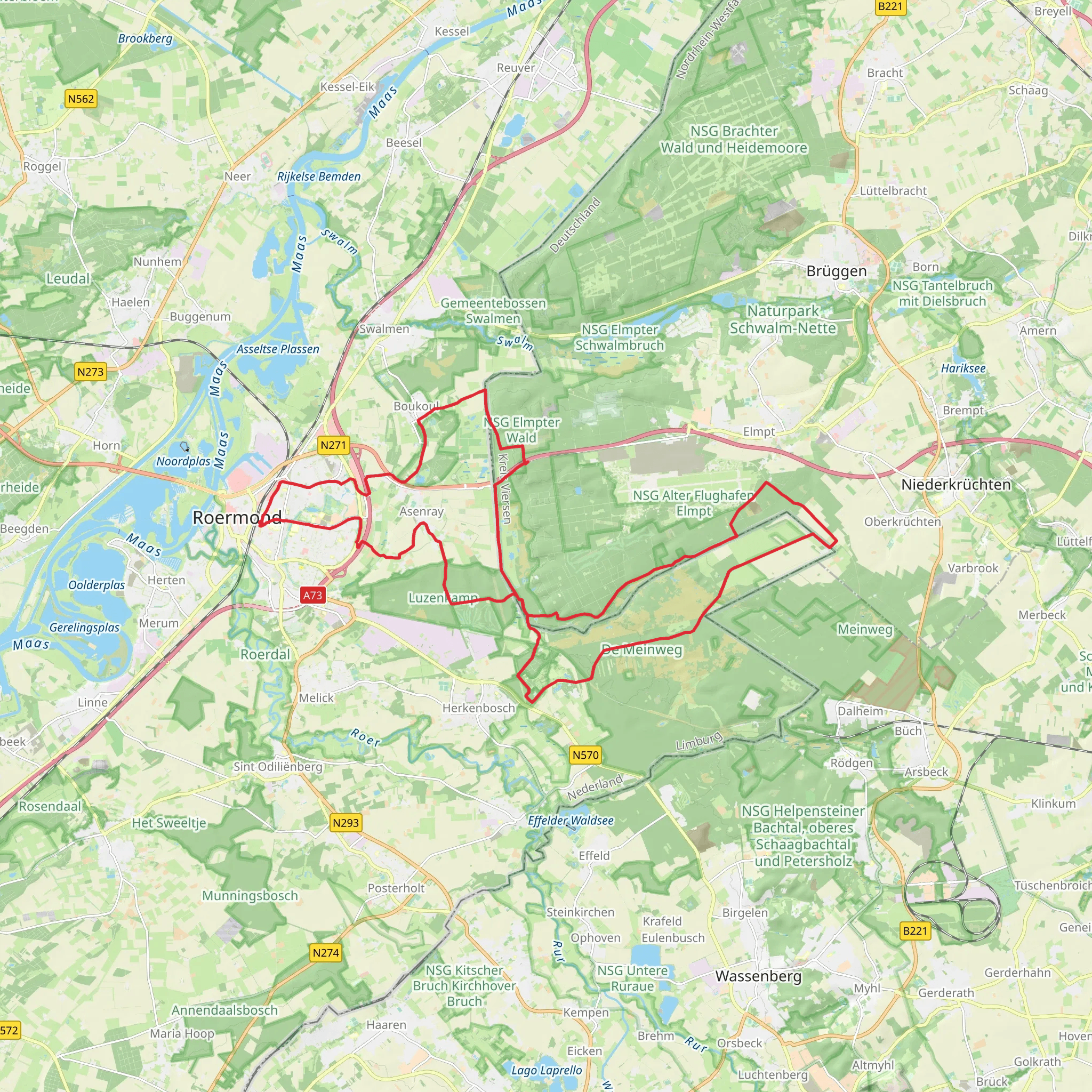
A long, low-effort endurance walk through the sandy pine-and-oak forests and open heath edges around Herkenbosch, linking the quieter “heide” blocks with the cultural waypoint of Aan de Blauwe Steen. At roughly 45 km (28 mi) with about 0 m (0 ft) of total ascent, the challenge is almost entirely about time on feet, surface conditions (sand/mud), and staying fueled rather than climbing.
Likely start / trailhead landmark (nearest clear address): the most practical place to begin is by the main gateway into Nationaal Park De Meinweg at Bezoekerscentrum De Meinweg / Brasserie De Boshut, Meinweg 2, 6075 NA Herkenbosch (Netherlands)—easy parking, facilities, and a straightforward place to meet a shuttle or bail out if needed. (hiiker.app)
Getting to the start (car + public transport)
- By car: Set navigation to Meinweg 2, 6075 NA Herkenbosch. This is the simplest all-day start/finish because it’s a known access point with a large car park and services nearby. (hiiker.app)
- By public transport: From Roermond NS station, buses run toward Herkenbosch; a common approach is to ride to the “Meinweg” stop and walk the short signed approach to the visitor-centre area. Check the day’s timetable before committing to a 45 km day, especially on Sundays/holidays. (hiiker.app)
- Navigation: preload the route in HiiKER before you arrive; forest canopy can make signal unreliable in places. (hiiker.app)
What the walking feels like (surfaces, pacing, and effort)
Expect a steady rotation of: - Firm forest roads and straight forestry tracks (fast, easy cruising) - Sandy stretches (the real energy drain—your pace drops without you noticing at first) - Seasonal mud and puddled hollows in low spots after rain (more common near wet heath/fen edges)
Even with minimal elevation gain, 45 km (28 mi) is a full-day outing for most hikers. A realistic moving pace on mixed sand/track is often 4–5 km/h (2.5–3.1 mph), plus breaks. Plan for 9–12 hours total depending on fitness, daylight, and how soft the sand is.
Footwear and comfort: sand favors shoes with decent underfoot protection; wet periods favor waterproofing. Gaiters can help keep grit out on the longer sandy sectors.
Landmarks, landscape character, and the “heide” sections
The route’s personality comes from the contrast between shaded woodland corridors and open heathland clearings. Around Herkenbosch, the “heide” isn’t a single wide-open moor; it often appears as heath patches and edges where the forest thins and the light changes—especially striking in late summer when heather blooms in purple tones in the broader region.
You’re also walking in and around Nationaal Park De Meinweg, a protected area in Limburg established as a national park in 1995. (en.wikipedia.org) The park is known for a mosaic of habitats—heath, woodland, and wet features—so the scenery can change quickly over short distances.
Aan de Blauwe Steen
“Aan de Blauwe Steen” is typically a named local waypoint/marker rather than a mountain-style summit objective—think of it as a cultural navigation point that helps stitch together longer loops through otherwise similar-looking forest blocks. Treat it as a good place for a time check: if you reach it later than planned, shorten the day using the most direct forest tracks back toward the visitor-centre area.
Nature and wildlife to look out for (and what to do about it)
This area’s biodiversity is driven by the mix of dry sandy ground, heath edges, and wetter pockets. In warm months, the most important “watch your step” wildlife is: - Reptiles on sunny path edges (they like the warmth of open sand and track margins). Give anything you see plenty of space and avoid stepping off-trail into heather or tall grass where visibility drops. - Wild boar signs (rooted ground, tracks). Encounters are uncommon,
AI Planner
Days planned around your pace, with somewhere to stay each night.
Surfaces
Unknown
Asphalt
Sand
Concrete
Gravel
Paved
Ground
Comments and Reviews
User comments, reviews and discussions about the Herkenbosscher Heide and Aan de Blauwe Steen Loop, Netherlands.
average rating out of 5
0 rating(s)


