
Download
3D Flyover
Add to list
More
69.2 km
4 days
0 m
Multi Day
“A big-sky polder loop of straight dykes and canal-laced lanes—wind, distance, and navigation test you.”
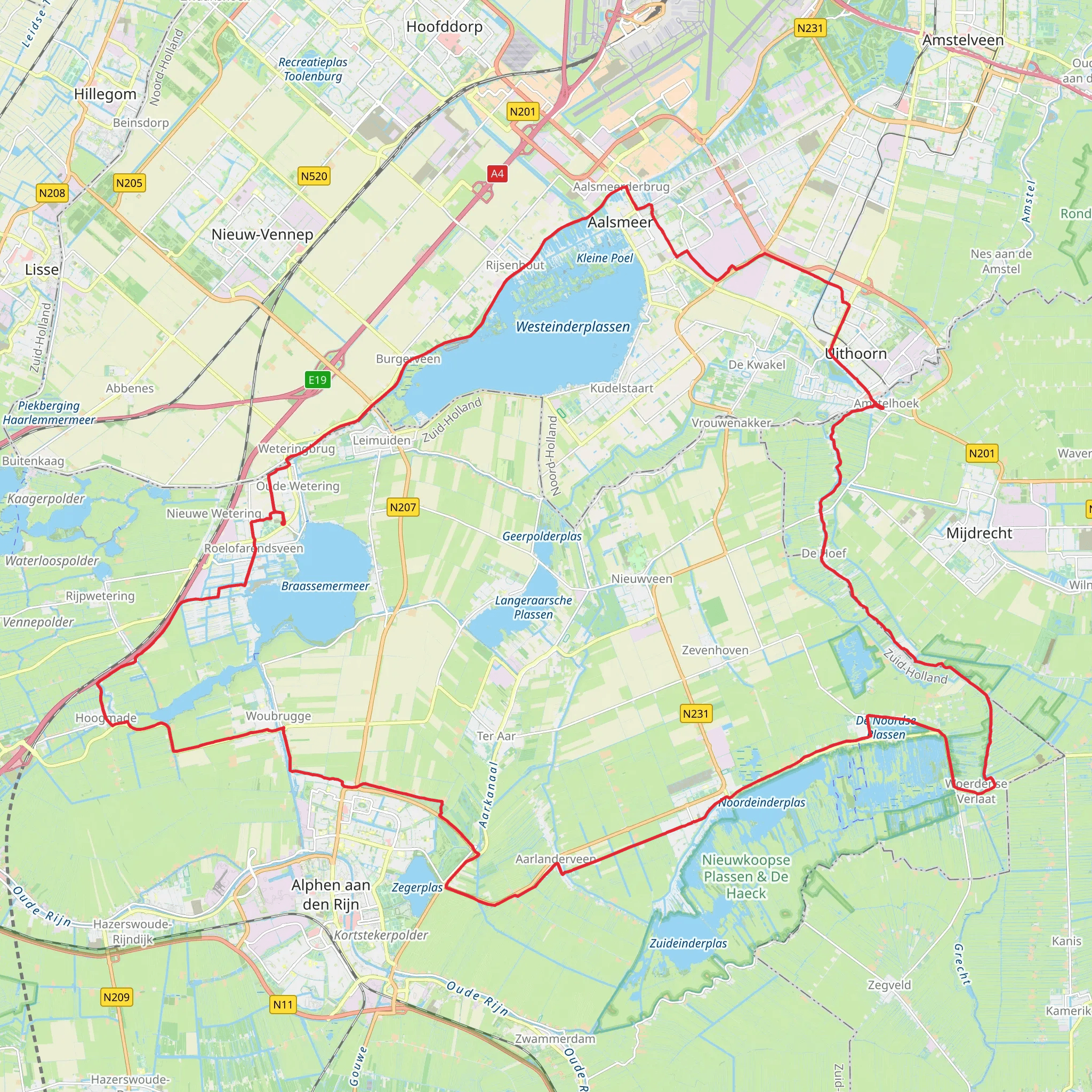
This is a long, flat polder-and-dyke loop of about 69 km / 43 mi with essentially 0 m / 0 ft of climbing, linking quiet lanes and long straight corridors such as Spoorlijnpad (a former rail alignment), Legmeerdijk (a dyke with big-sky views), Noordse Dorpsweg (a ribbon of older settlement along the water), and Kerkweg (a classic village “church road” that tends to thread between farms, canals, and small hamlets). Underfoot you’ll mostly get paved paths, cycle tracks, and firm farm roads; the challenge here is rarely steepness—it's distance, exposure to wind, and staying oriented through a web of ditches and parallel roads.
Because your start point is listed only as “near”, the most practical and recognizable place to begin (and to resupply/finish) is around Uithoorn’s old village center near Amstelplein / Schoolstraat (Uithoorn, North Holland), which is a common parking and access area for local walking routes. (uithoorn.nl)
Getting to the start (car + public transport)
- By car: Aim for Uithoorn centrum, parking around Schoolstraat (behind/near Amstelplein shopping area) is a straightforward landmark-based target and puts you close to services (supermarkets, cafés, water). (uithoorn.nl)
- By public transport: Uithoorn is well connected by regional buses from Amsterdam/Amstelveen and surrounding towns; plan the final approach to Uithoorn Centrum / Amstelplein area and then walk a few minutes to your chosen start. For on-the-day navigation and stop placement, build the route in HiiKER so you can keep the loop intact even if you adjust the exact start point.
What to expect right away: broad, open horizons; long straight lines of water; and a landscape that can feel deceptively “easy” until the wind and the kilometers add up. In wet periods, the edges of farm tracks can be soft, but the main corridors are typically firm.
The landscape you’re walking through (and why it looks like this)
This part of North Holland is shaped by polders, dykes, and drainage, with settlements strung along higher ground and waterways. When you’re on Legmeerdijk and similar raised lines, you’ll notice how the land falls away into flat fields and greenhouse zones—classic reclaimed-land geometry.
A standout historical thread in this area is the old rail infrastructure that once stitched together towns around the Haarlemmermeer region. Spoorlijnpad’s character—straight, efficient, and slightly elevated in places—often reflects that former purpose. Uithoorn’s rail history includes early-20th-century development and structures associated with regional lines and bridges, which helps explain why some “paths” here feel engineered rather than organic. (geschiedenisextra.nl)
Route character by segments (useful for pacing)
Because this is a 69 km / 43 mi day, it helps to think in quarters. Distances below are approximate and will vary with your exact loop geometry:
0–17 km / 0–10.5 mi: Settlements and access corridors
Expect more junctions, crossings, and occasional short urban edges near Uithoorn/Aalsmeer-side development. This is where it’s easiest to drift onto a parallel road—keep HiiKER handy and confirm you’re on the correct side of the canal when the route “looks right” in multiple places.17–35 km / 10.5–21.7 mi: Long dyke and polder lines (Legmeerdijk feel)
This is the most “open” portion: big skies, long sightlines, and often headwinds. Sun exposure can be constant with little shade. If you’re doing this in warmer months, plan water carefully—services can be sparse once you’re away from village centers.35–52 km / 21.7–32.3 mi: Noordse Dorpsweg and older ribbon development
Roads like Noordse Dorpsweg tend to read as historic settlement lines: houses, farms, and small bridges repeating at intervals. You’ll likely pass older-looking structures and feel the shift from “infrastructure corridor” to “lived-in landscape.” Stay alert for faster cyclists and local traffic on narrow sections.52–69 km / 32.3–43 mi: Kerkweg return lines and re-entry to town edges
Kerkweg-type stretches are often straight and efficient—great for steady walking, but mentally tiring late in the day. This is where blisters and foot fatigue show up if footwear is even slightly wrong.
Navigation and safety notes (flat doesn’t mean simple)
- Parallel-road trap: In polder country, you can be one canal over and not realize it for kilometers
AI Planner
Days planned around your pace, with somewhere to stay each night.
Surfaces
Unknown
Asphalt
Comments and Reviews
User comments, reviews and discussions about the Spoorlijnpad, Legmeerdijk, Noordse Dorpsweg and Kerkweg Loop, Netherlands.
average rating out of 5
0 rating(s)



