
Download
3D Flyover
Add to list
More
17.3 km
~3 hrs 28 min
7 m
Point to Point
“Drift from Walik to Schaft through whispering pines, breezy heath and wetland edges—flat yet time-filling.”
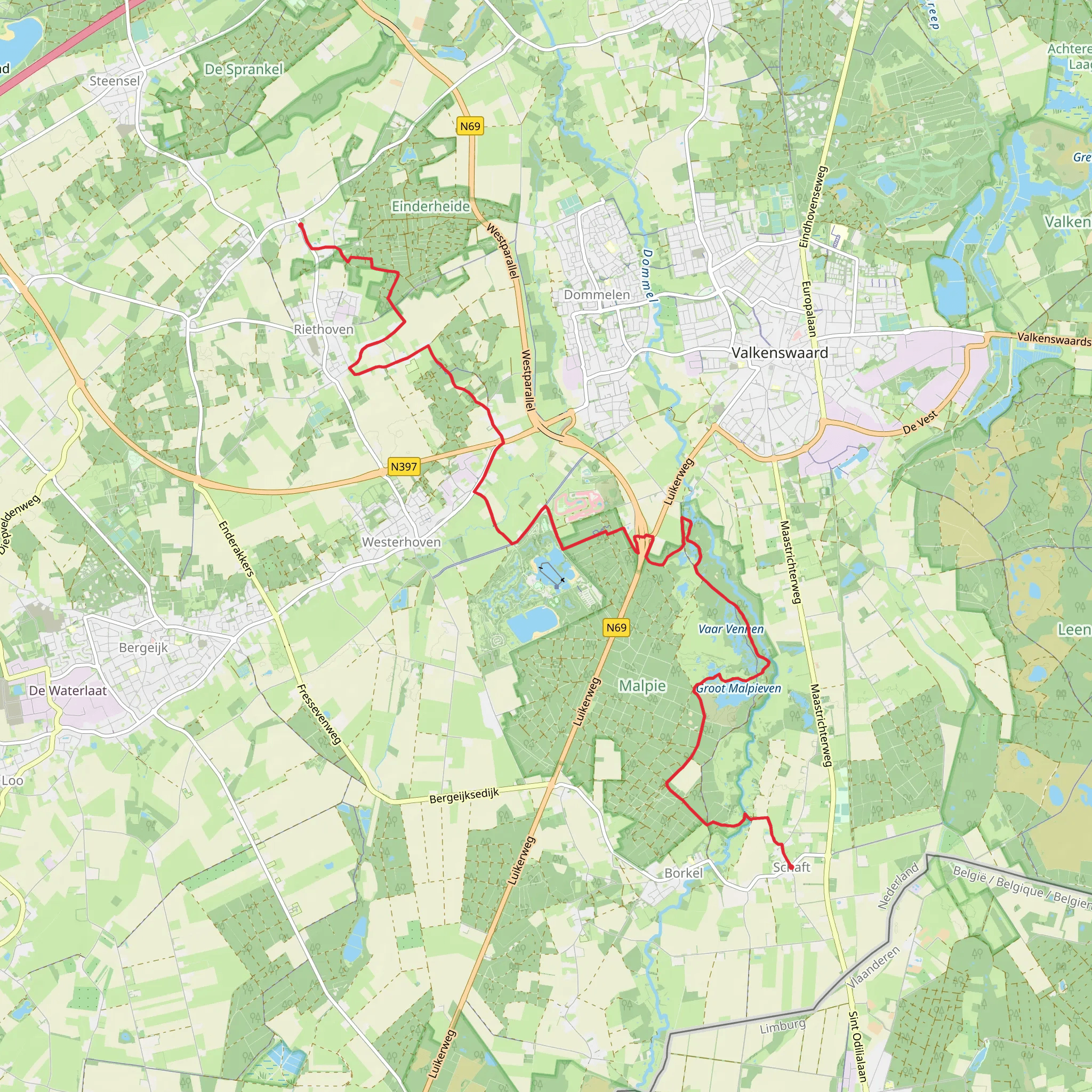
This is a mostly flat, easy-going 17 km (10.6 mi) point-to-point walk from the village of Walik to Schaft, threading together a mix of sandy pine woodland, heathland, and wetland edges around De Kempervennen, De Malpie, and Vossenberg. With roughly 0 m (0 ft) of total climbing, the effort is more about steady time on your feet than elevation—expect about 3.5–5 hours depending on stops and how soft the sand is underfoot.
Getting to the start (Walik) and logistics for a point-to-point day
By car - Aim for parking near Walik (Valkenswaard area, North Brabant, Netherlands)—a practical target is the Walik hamlet / residential edge on the south side of Valkenswaard, close to local lanes that lead toward the Kempervennen recreation area. If you want a simple “meet-up” landmark, use Valkenswaard town center as your rendezvous and drive a few minutes south toward Walik. - Because this is point-to-point, the easiest car plan is a two-car shuttle: leave one car near Schaft village center (near the church / main crossroads), then drive the other to Walik.
By public transport - The most reliable approach is to travel to Valkenswaard (regional buses commonly connect from Eindhoven), then use a local bus/taxi to the Walik side. For the finish, Schaft is a small village just over the Belgian border near Valenciennes? (No—Schaft is near Hamont-Achel / Valkenswaard); local bus coverage can be limited, so check schedules in advance and plan for a short taxi ride if needed. - If you’re coordinating with a group, it’s often simplest to bus to Valkenswaard, then taxi to Walik, and arrange pickup in Schaft.
What the trail feels like underfoot
You’ll be on a patchwork of forest tracks, sandy paths, and compacted multi-use lanes. After rain, low sections can hold water; in dry spells, the sand can feel surprisingly energy-sapping even though the route is flat. Footwear with a bit of tread is helpful; waterproofing is optional but nice in wetter months.
Use HiiKER to keep an eye on junction density—this landscape has many intersecting forestry tracks that can look identical, especially in pine plantations.
Walik to De Kempervennen (approx. 0–5 km / 0–3.1 mi)
The opening kilometers ease you out of the Walik area on quiet paths and tracks, quickly trading houses and small fields for conifer woodland and managed recreation landscapes. You’ll notice the terrain is very level, typical of the sandy lowlands here.
As you approach De Kempervennen, the feel becomes more “open”—expect glimpses of lakes/ponds and the infrastructure of a recreation area (wide paths, occasional signage, and more people on weekends). Even when it’s busy, it’s easy to find quieter edges by staying on the through-route rather than looping around the most popular waterfront spots.
What to look for - Heath and wetland edges: where the trees thin, you may see heather patches and wetter ground with reeds/sedges. - Birdlife: water and heath margins often bring ducks, geese, and small songbirds; raptors can appear over open heath.
De Kempervennen to De Malpie (approx. 5–12 km / 3.1–7.5 mi)
This middle section is the most “nature-forward” part of the day. De Malpie is known for its heathland and wetland character, and the route typically alternates between: - Pine forest corridors (straight, sandy, and quiet) - Open heath (breezier, more expansive views) - Marshy or stream-adjacent stretches (watch for soft verges)
Even without hills, this is where you’ll feel the day’s distance: sand plus exposure can make it feel longer than the profile suggests.
Navigation and safety notes - Track look-alikes: forestry grids can cause accidental “parallel-path” mistakes. Keep HiiKER handy at junctions and confirm you’re taking the correct branch before committing. - Soft shoulders: along wetter edges, the firm-looking margin can be boggy—step on the most compacted line. - Cyclists: some wider tracks are shared; stay predictable and keep right where applicable.
Nature and wildlife - Heathland can host ground-nesting birds seasonally—stay on the main path. - In warmer months, expect insects near water (bring repellent if you’re sensitive). - You may see signs of deer (tracks, droppings) in quieter woodland sections, especially early/late in the day.
De Malpie to Vossenberg and into Schaft (approx. 12–17 km / 7.5–10.6 mi)
The final third trends back into mixed woodland and rural edges, with Vossenberg acting as a gentle transition zone—still flat, still sandy in places, but with a more “between villages” feel as you near Schaft.
As you approach Schaft, paths often become more structured and you’ll start encountering more local foot traffic. Schaft itself is small and calm—plan ahead for food/water because services can be limited depending on the exact finish point and day of week.
Landmarks,
AI Planner
Days planned around your pace, with somewhere to stay each night.
Surfaces
Sand
Unknown
Asphalt
Dirt
Ground
Gravel
Grass
Wood
Comments and Reviews
User comments, reviews and discussions about the Walik to Schaft via De Kempervennen and De Malpie and Vossenberg, Netherlands.
average rating out of 5
0 rating(s)



