
Download
3D Flyover
Add to list
More
26.0 km
~5 hrs 26 min
152 m
Loop
“A long, mostly flat Rhine loop—wind-swept floodplains, a rare Dutch hill, and quiet history.”
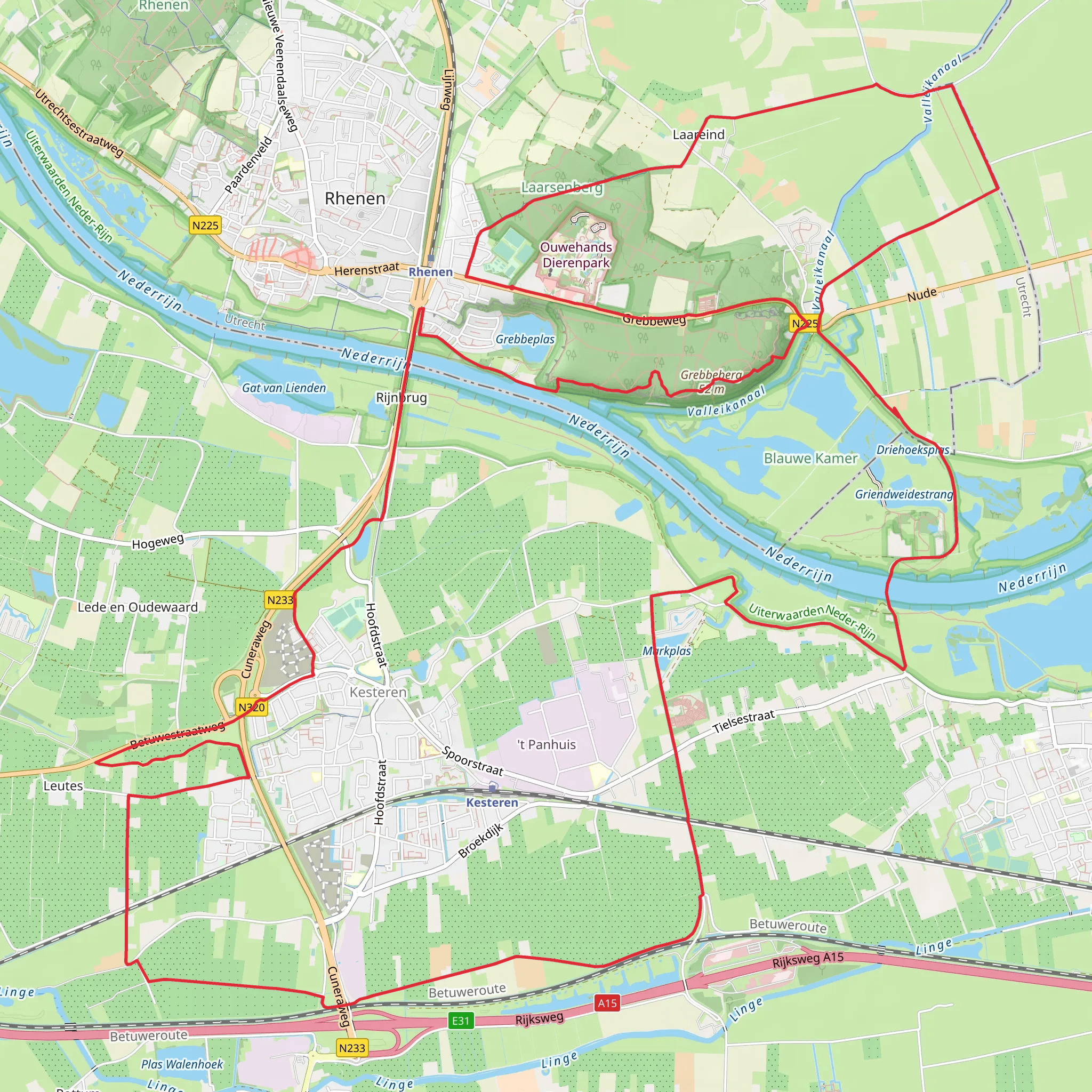
This is a longer, mostly flat river-and-ridge walk that mixes open floodplain scenery with one of the few “proper” hills in the central Netherlands. At around 26 km (16.2 mi) with roughly 200 m (656 ft) of total ascent, it’s very manageable for fit walkers, but the length makes it an all-day outing—plan for 5.5–7.5 hours depending on stops, wind, and how muddy the floodplain sections are.
For the hike start, “near” is missing—if you share a lon/lat (or a GPX), I can pin it to the nearest recognizable place (for example, Rhenen, Wageningen, or Opheusden are common gateways for Grebbeberg/Buitenwaarden loops) and tailor the access directions precisely. In the meantime, the most practical, well-known access point for this loop-style hike is typically around Rhenen Station (Stationsplein, Rhenen, Netherlands) or the Grebbeberg area near the Grebbeweg/Grebbeweg–Utrechtseweg side of Rhenen.
Getting to the start (public transport + car)
By train/bus (public transport): - The easiest hub is usually Rhenen railway station (end of the line from Utrecht via Veenendaal-De Klomp). From the station area you can walk straight into town and toward the Grebbeberg slopes and Rhine floodplains. - If your intended start is closer to Wageningen (across the river), buses connect Ede-Wageningen station with Wageningen and the river area; you can then cross via the nearby Rhine crossings depending on the exact loop.
By car: - Aim for parking in/near Rhenen (often signed for Grebbeberg/Ouwehands Dierenpark area) or at designated trailhead lots near the Grebbeberg approaches. Arrive early on weekends—this is a popular walking area, and parking fills quickly on fair-weather days.
What the route feels like (terrain, surfaces, effort)
Expect a mix of: - Paved cycle paths and village edges (easy footing, faster pace). - Gravel and farm tracks along the river. - Grass and earth paths in the Buitenwaarden (the Rhine’s outer floodplains). These can be wet, rutted, or muddy after rain or high water. - A short but noticeable hill section on/around Grebbeberg, where most of the day’s ascent is concentrated. The “hill” is modest by mountain standards, but in Dutch terms it’s a real climb—often a few short ramps rather than one long grind.
Even with an “Easy” rating, the two things that most often make this feel harder are wind exposure on the open floodplain and soft ground that slows you down.
Landmarks, landscape, and the best bits
0–6 km (0–3.7 mi): Settling in—town edge to ridge approach You’ll likely begin on easy paths leaving the built-up area and trending toward the wooded rise of Grebbeberg. This early section is good for warming up and checking your pacing—26 km is long enough that starting too fast can catch up with you later.
6–11 km (3.7–6.8 mi): Grebbeberg—woodland, viewpoints, and history This is where you’ll pick up most of the elevation gain—roughly 150–200 m (492–656 ft) spread across the Grebbeberg area depending on the exact line you take. Underfoot you’ll often have firmer woodland trails, leaf litter, and occasional sandy patches.
Grebbeberg is strongly associated with World War II history, particularly the Battle of the Grebbeberg (May 1940), when Dutch forces fought to hold defensive lines against the German invasion. In and around the hill you may encounter memorial-related sites and a more solemn atmosphere in places—be respectful, keep noise down near commemorative areas, and stay on paths.
11–20 km (6.8–12.4 mi): Buitenwaarden—big-sky floodplains and river dynamics Dropping off the ridge, the character changes quickly: wide horizons, reedbeds, willow thickets, and open grazing meadows typical of Rhine floodplain restoration areas. This is classic “river country,” shaped by seasonal flooding and managed to give the river room.
What to look for: - Side channels, backwaters, and wet hollows that attract birds. - Grazing animals (often cattle; sometimes horses) used for vegetation management. Give them space, pass calmly, and don’t get between adults and young. - Birdlife: depending on season, expect geese, ducks, herons, and raptors; in migration periods the variety can be excellent. Bring binoculars if you enjoy wildlife.
This is also the most weather-exposed part of the loop. A mild forecast can still feel chilly if the wind is up, especially outside summer.
20–26 km (12.4–16.2 mi): Return leg—paths, fields, and the final push The last third is usually a blend of dikes, tracks, and edges of settlement as you arc back toward your start. Fatigue tends to show here because the terrain is easy and people underestimate the distance—keep eating and drinking even if you feel fine.
Navigation (keep it simple and reliable)
Use HiiKER to follow the loop and to confirm any optional spurs (viewpoints, memorial detours, or floodplain variants). In the Buitenwaarden, paths can be less distinct and occasionally
AI Planner
Days planned around your pace, with somewhere to stay each night.
Surfaces
Asphalt
Unknown
Concrete
Sand
Grass
Dirt
Paved
Unpaved
Comments and Reviews
User comments, reviews and discussions about the Grebbeberg and Buitenwaarden Loop, Netherlands.
average rating out of 5
0 rating(s)

