
Download
3D Flyover
Add to list
More
11.4 km
~2 hrs 17 min
0 m
Loop
“A spacious heath-and-woodland loop of sandy tracks, purple heather horizons, and quiet birdwatching moments.”
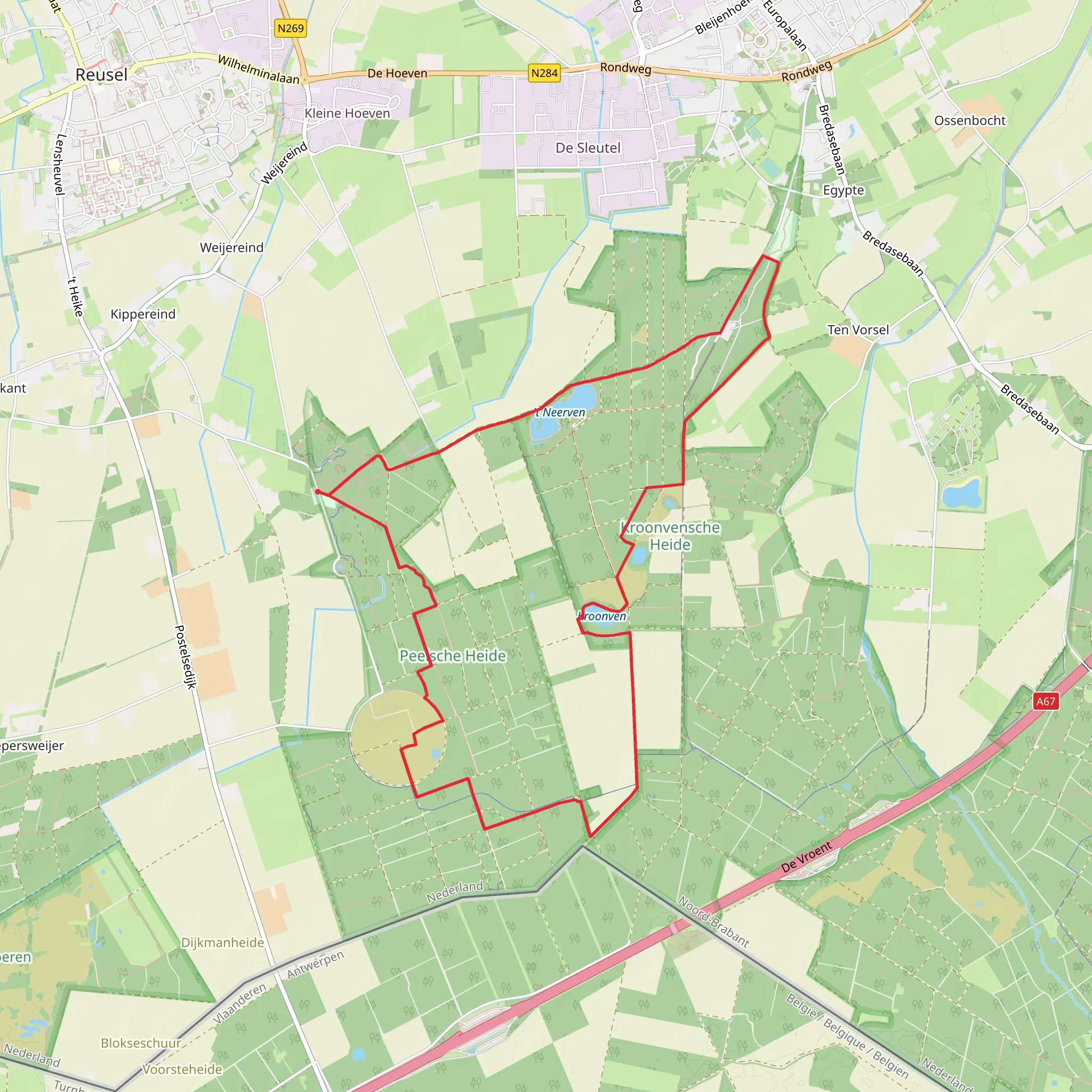
This easy, mostly level loop of about 11 km (6.8 mi) with roughly 0 m (0 ft) of climbing is a classic heath-and-woodland wander: wide sandy tracks, narrow heather paths, and long, open sightlines across Dutch nature reserves. Expect a route that feels spacious and quiet, with frequent chances to spot birds over the heath and along wetter edges.
Getting to the start (car + public transport)
Because the start point is only listed as “near” (no coordinates or town provided), the most reliable way to reach the trailhead is to: - Use HiiKER to open the route and tap the start point to see its exact location, then navigate to the nearest parking area or access gate shown on the map. - If you share the start lon/lat, I can convert it to the nearest known address or landmark (for example, a specific car park, nature reserve entrance, or nearby village street).
General access patterns for this area: - By car: These heath reserves typically have one or more signed nature parking areas (P) on the edge of the heath/forest. Arrive early on weekends—popular loops can fill up quickly. - By public transport: The region is usually served by regional buses linking nearby towns and villages; from the closest stop, it’s commonly a 10–30 minute walk (0.8–2.5 km / 0.5–1.6 mi) to an access point. Use HiiKER to identify which edge of the loop is closest to a bus stop and plan a short approach walk.
What the trail is like underfoot
With essentially no elevation change, the “difficulty” comes from surface and exposure, not hills: - Sandy tracks and compacted forest paths are common—easy walking, but sand can feel a bit draggy in dry spells. - Heathland singletrack can be narrower and slightly uneven, with occasional roots at woodland edges. - After rain, expect soft patches and shallow puddling in low-lying sections, especially where heath transitions to wetter ground.
Plan on 2.5–3.5 hours at a relaxed pace with stops for views and wildlife.
Route flow and key landmarks (approximate)
0–2 km (0–1.2 mi): settling in through woodland edges
The loop typically begins on broad access tracks that ease you into the landscape—often a mix of pine and mixed woodland. You’ll likely pass sandy junctions where multiple tracks meet; keep an eye on HiiKER here because paths can look similar.
2–6 km (1.2–3.7 mi): open heaths—Kroonvensche Heide and Peelsche Heide character
This is the heart of the walk: open heathland with big skies and long views. In late summer, heather can color the landscape in purples and pinks, while other seasons bring muted golds and browns with striking contrast against dark conifers.
Look for:
- Heath “islands” and edges where shrubs and young birch/pine encroach—these transition zones are often the most wildlife-rich.
- Wet hollows (sometimes subtle) that attract insects and birds; they can also be where the ground stays soft longest.
6–9 km (3.7–5.6 mi): quieter interior tracks and nature reserve boundaries
You’ll often re-enter more sheltered sections here—woodland belts that break the wind and feel cooler in summer. This part can include long straight stretches on management tracks. It’s easy walking, but it’s also where people sometimes drift off-route at unmarked intersections—use HiiKER to confirm the correct branch.
9–11 km (5.6–6.8 mi): return leg with alternating heath/forest views
The final portion usually alternates between open and semi-wooded corridors, with a gentle “unwinding” back toward the access point. If there’s a viewpoint-like rise or open sandy clearing near the end, it’s a good spot for a last scan for birds over the heath.
Nature, wildlife, and what to look out for
These heaths are managed landscapes—kept open to preserve biodiversity—so you’ll see a mosaic of habitats: - Birdlife: Expect heath specialists and edge-dwellers—small birds flitting low over heather, and larger birds using open areas for hunting. Early morning and late afternoon are best. - Mammals: Deer are possible at woodland margins; you may also notice tracks in sandy sections. - Reptiles/insects: Heathland can support sun-loving species; on warm days, watch where you place hands/feet on sandy banks or along warm path edges. - Flora: Heather, grasses, and scattered birch/pine define the open sections; wetter pockets can host different plant communities and more insect activity.
Practical cautions: - Ticks can be present in heath/grass—wear long socks, consider repellent, and do a check afterward. - Ground-nesting birds: In breeding season, stay on paths and keep noise low; dogs (if allowed) should be leashed. - Fire risk: In dry periods, heathland can be highly flammable—avoid smoking and follow any posted restrictions.
Historical and cultural context of the heaths
Dutch heathlands are often semi-cultural landscapes shaped over centuries by grazing, turf cutting, and land use that prevented forests from reclaiming the area. Modern conservation continues that work through grazing and vegetation management to maintain open heath habitat. The names in this loop reflect distinct heath parcels and local land history—walking through them is
Surfaces
Dirt
Ground
Unknown
Concrete
Unpaved
Paved
Sand
Asphalt
Comments and Reviews
User comments, reviews and discussions about the t Neerven, Kroonvensche Heide and Peelsche Heide Loop, Netherlands.
average rating out of 5
0 rating(s)
