Download
3D Flyover
Add to list
More
17.4 km
~3 hrs 28 min
0 m
Loop
“Circle Reeuwijk’s peat-carved waters under vast skies—windy dikes, whispering reeds, and birdlife.”
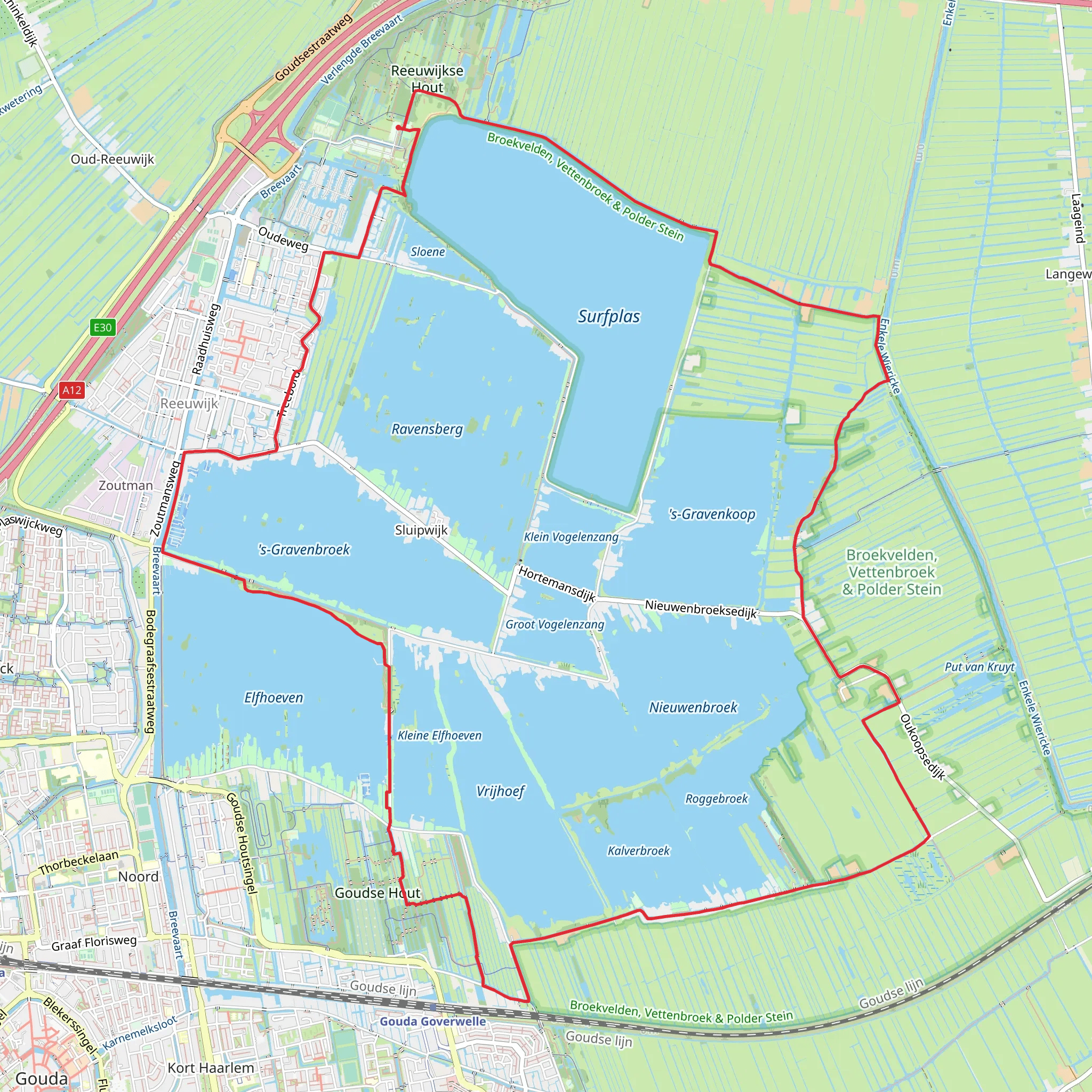
This easy, flat loop of about 17 km (10.6 mi) circles the heart of the Reeuwijkse Plassen lake district just northeast of Gouda in South Holland. Expect near‑zero elevation gain (≈0 m / 0 ft), big skies, long water views, and classic Groene Hart scenery: narrow dikes, reedbeds, drainage canals, and rectangular lakes that look “engineered” because they are—many were created by peat digging.
A practical place to begin is on the southwest side of the lakes near the Gouda/Reeuwijk edge, close to the Reeuwijkse Hout recreation area (a well-known access point with paths, parking, and water views). From there, you can walk clockwise or counterclockwise; clockwise often gives you the broadest open-water views earlier in the day.
Getting to the start (car + public transport)
- By car: Aim for parking around Reeuwijkse Hout (near Gouda), which is one of the most straightforward public access points to the Plassen. From the A12, you’ll be approaching the Gouda/Reeuwijk area quickly; allow extra time on sunny weekends when beach and watersports traffic increases.
- By public transport: The nearest major rail hub is Gouda Station. From there, local buses and a short walk can get you toward the Reeuwijk/Gouda edge of the lakes. For the cleanest door-to-trail planning, use HiiKER to match your chosen start point with the nearest stop and walking approach (bus routes and stop patterns can change).
What the route feels like underfoot
You’ll be on a mix of paved cycle paths, compacted gravel, and narrow dike-top lanes. The walking is uncomplicated and steady, but the terrain is exposed—wind off the water can be surprisingly strong, and shade is limited. After rain, some verge sections can be slick, especially where grass meets the path edge on dikes.
Because this is a lake-and-dike landscape, you’ll frequently pass: - Reed fringes and small inlets - Drainage channels and culverts - Footbridges and narrow crossings - Occasional watersports zones (sailing/surfing) and quieter nature edges
Landmarks and scenery you’ll notice
The loop threads between named plas sections such as Surfplas, Roggebroek, Elfhoeven, and the Broekvelden/Vettenbroek area (names you’ll see on local signage and mapping). The character changes as you go: - Open-water stretches: wide horizons, lots of movement from wind and birds; great visibility but little shelter. - Reedbelt corridors: calmer, more enclosed, with more bird activity and the rustle of reeds. - Dike villages and edges: glimpses of homes, small marinas, and moored boats—then quickly back to quiet water.
If you’re using HiiKER, keep an eye on where the line hugs the water versus where it cuts inland—some lakeside edges are private or have limited access, so the official walkable lines tend to follow public dikes and connecting paths.
Nature and wildlife (what to look out for)
This area is especially rewarding for birdwatching. The larger waters—particularly around Surfplas—are known for large concentrations of waterfowl in winter, with species like Eurasian Wigeon often present in very high numbers, alongside ducks such as Common Pochard, Tufted Duck, and Common Teal; scarcer ducks can sometimes appear among the flocks. (birdingplaces.eu)
Year-round, expect typical Dutch wetland birds: grebes, coots, herons, geese, terns (seasonal), and reed-dwellers. Bring binoculars if you have them, and keep voices low along reed edges—many birds feed close to the shoreline.
Wildlife etiquette matters here: - Stay on the path where reedbeds are close—ground-nesting and reed-nesting birds are sensitive. - Dogs may need to be leashed in certain sections; follow local signs. - Give cyclists space: these paths are heavily used by bikes, especially on weekends.
Historical context (why the landscape looks like this)
The Reeuwijkse Plassen are closely tied to peat extraction. From the Middle Ages onward, this region was valued for peat harvesting, and by the 18th century peat was being dug and transported to nearby Gouda as fuel for industry. Over time, excavations and water intrusion left behind the ponds/lakes you’re walking around today. (en.wikipedia.org)
You’ll also notice that many waters have straight edges and rectangular geometry—a visible imprint of former parcel boundaries and systematic digging. One part of the system, Broekvelden/Vettenbroek, is notably more recent,
AI Planner
Days planned around your pace, with somewhere to stay each night.
Surfaces
Unknown
Asphalt
Gravel
Grass
Wood
Paved
Comments and Reviews
User comments, reviews and discussions about the Reeuwijkse Plassen Loop, Netherlands.
average rating out of 5
0 rating(s)