
Download
3D Flyover
Add to list
More
17.4 km
~3 hrs 29 min
0 m
Point to Point
“A breezy canal-and-village ramble—flat horizons, herons in reeds, and a photogenic bridge finish.”
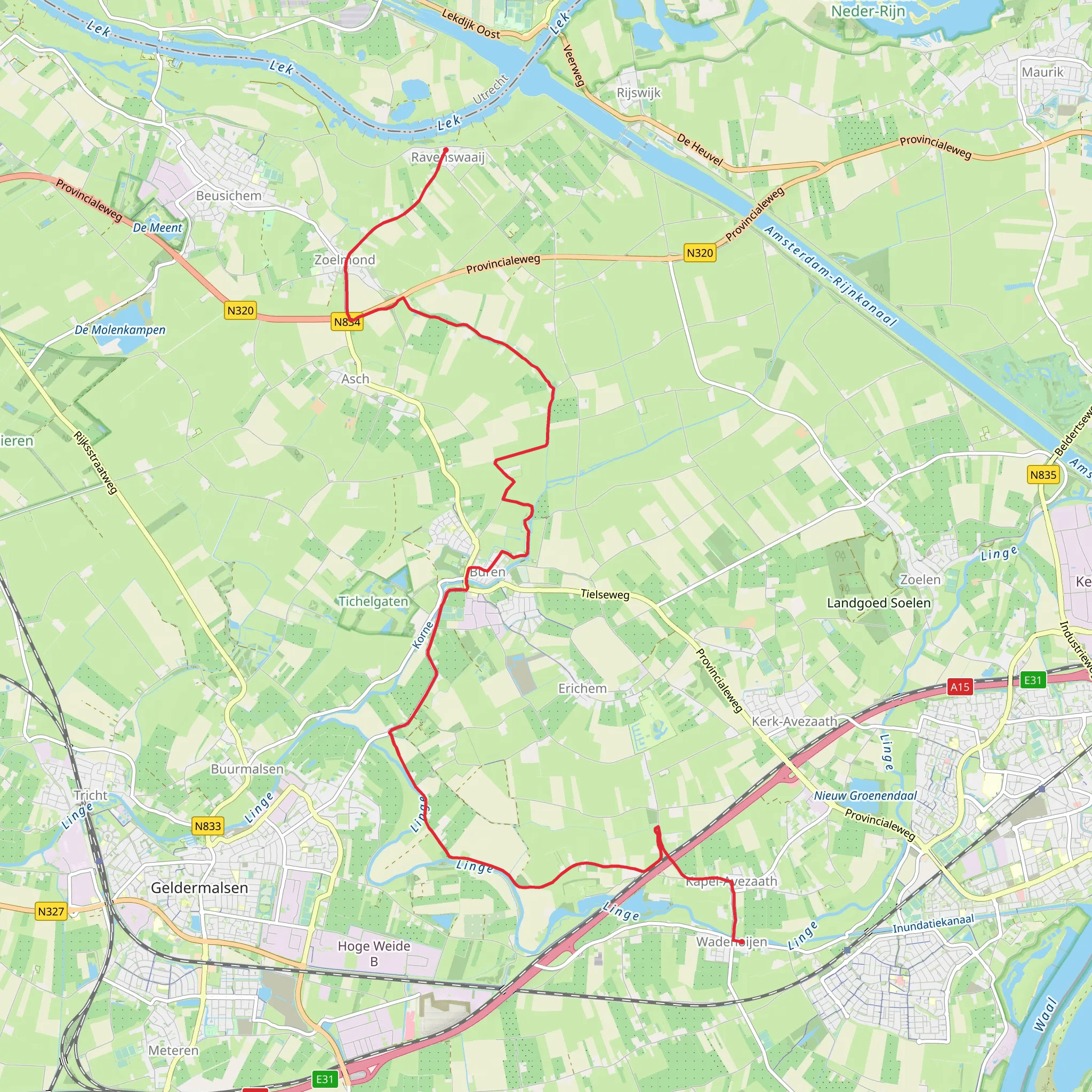
This is a mostly level, canal-and-village walk of about 17 km (10.6 mi) with roughly 0 m (0 ft) of climbing—ideal for an easy day where the main challenges are wind exposure, muddy towpaths after rain, and sharing space with cyclists on paved sections. Expect a mix of quiet residential streets (starting on/near Donkerstraat), open agricultural edges, and long, straight canal corridors leading toward a kanaalbrug (canal bridge).
Getting to the start (Donkerstraat area)
Because “Donkerstraat” exists in multiple towns across the Low Countries, the most reliable way to pinpoint the correct start is to use the route’s exact coordinates in HiiKER and then navigate to the nearest mapped street access point. Once you’ve confirmed the correct Donkerstraat on HiiKER, these approaches usually work well:
- By car: Aim for street parking near Donkerstraat close to the first waypoint/track line. In many canal-side towns, parking is easiest a block or two off the main road rather than right on the towpath access.
- By public transport: Use the nearest rail station or regional bus stop to the Donkerstraat you’ve confirmed in HiiKER, then walk the last 0.5–2 km (0.3–1.2 mi) to the start. In canal regions, stops are often on the main road through town, with smaller streets like Donkerstraat branching off.
If you share the lon/lat for the start (or a HiiKER link), I can translate it to the nearest known address/landmark precisely.
You’ll want comfortable walking shoes (road-to-trail hybrid works well), a light wind layer, and—if it has rained recently—footwear with decent grip for slick towpath edges.
What the route feels like, kilometre by kilometre
0–3 km (0–1.9 mi): Settling in through town edges
The opening kilometres typically thread along local streets and quieter lanes near Donkerstraat. This is where you’ll pass everyday landmarks—brick homes, small gardens, and possibly a local church spire or village green depending on the exact municipality. Surfaces are usually firm (pavement or compacted gravel). Keep an eye out at intersections: canal networks often create “same-looking” junctions, and it’s easy to take the wrong parallel street without noticing. Use HiiKER to confirm you’re staying aligned with the intended corridor.
3–8 km (1.9–5.0 mi): Canal towpath rhythm
Once you reach the canal, the walk becomes wonderfully straightforward: long sightlines, flat grades, and a steady pace. The towpath may alternate between:
- Paved cycleway (fast cyclists—hold a predictable line and listen for bells), and
- Compacted dirt/grass (can be muddy, rutted, or narrow with a sloped edge down to the water).
Wildlife is often most active here, especially in the quieter morning and late afternoon:
- Waterfowl (mallards, coots, moorhens, geese) along reed margins
- Herons/egrets standing motionless in shallows
- Small fish activity near locks/culverts, and occasional raptors scanning fields
If the canal is a working navigation route, you may see barges—give them space at bridge approaches and any lock infrastructure.
8–12 km (5.0–7.5 mi): Via De prins van Oranje—heritage and place-name clues
The “De prins van Oranje” reference is a strong historical place-name signal in Dutch-speaking regions, tied to the House of Orange and the broader political history of the Low Countries. Even when the route itself is peaceful and rural, these names often mark:
- Older roads or inns that served canal traffic and farm trade
- Areas shaped by centuries of water management—ditches, dikes, and engineered banks
- Settlements that grew around transport corridors (canal + road)
In this middle section, expect more open exposure: fields, hedgerows, and fewer buildings. Wind can be the biggest factor on a flat 17 km (10.6 mi) day—plan your layers so you don’t chill when you stop.
Surfaces, hazards, and comfort notes
- Towpath edges: Some stretches have a subtle sideways tilt toward the canal; after rain, the top layer can shear and feel slippery.
- Cyclists: On shared paths, step aside early and predictably; avoid sudden lateral moves.
- Farm access points: Watch for occasional vehicle crossings and muddy tractor tracks.
- Sun/wind exposure: With little elevation and few trees, you can feel weather more intensely than the distance suggests.
12–17 km (7.5–10.6 mi): Approaching the kanaalbrug (canal bridge)
The final leg typically funnels you toward more built-up infrastructure: a bridge approach, busier road crossings, and clearer signage. Bridges are natural pinch points—expect:
- Narrower walkable margins
- Faster traffic noise (if it’s a road bridge)
- Stronger gusts as wind accelerates through the open span
The kanaalbrug itself is the standout landmark: a practical piece of waterway engineering and a classic photo stop, especially if there’s boat traffic or a view down a long straight canal reach. If the route ends near the bridge rather than looping back, plan your return logistics (pickup point, bus stop, or a short walk to a station) before you set out—flat canal
AI Planner
Days planned around your pace, with somewhere to stay each night.
Surfaces
Asphalt
Gravel
Unknown
Cobblestone
Wood
Comments and Reviews
User comments, reviews and discussions about the Donkerstraat to Kanaalbrug via De prins van Oranje, Netherlands.
average rating out of 5
0 rating(s)

