Download
3D Flyover
Add to list
More
23.2 km
~4 hrs 39 min
12 m
Loop
“A gentle Veluwe loop through pine avenues and wilder oak edges, with estate viewpoints to linger over.”
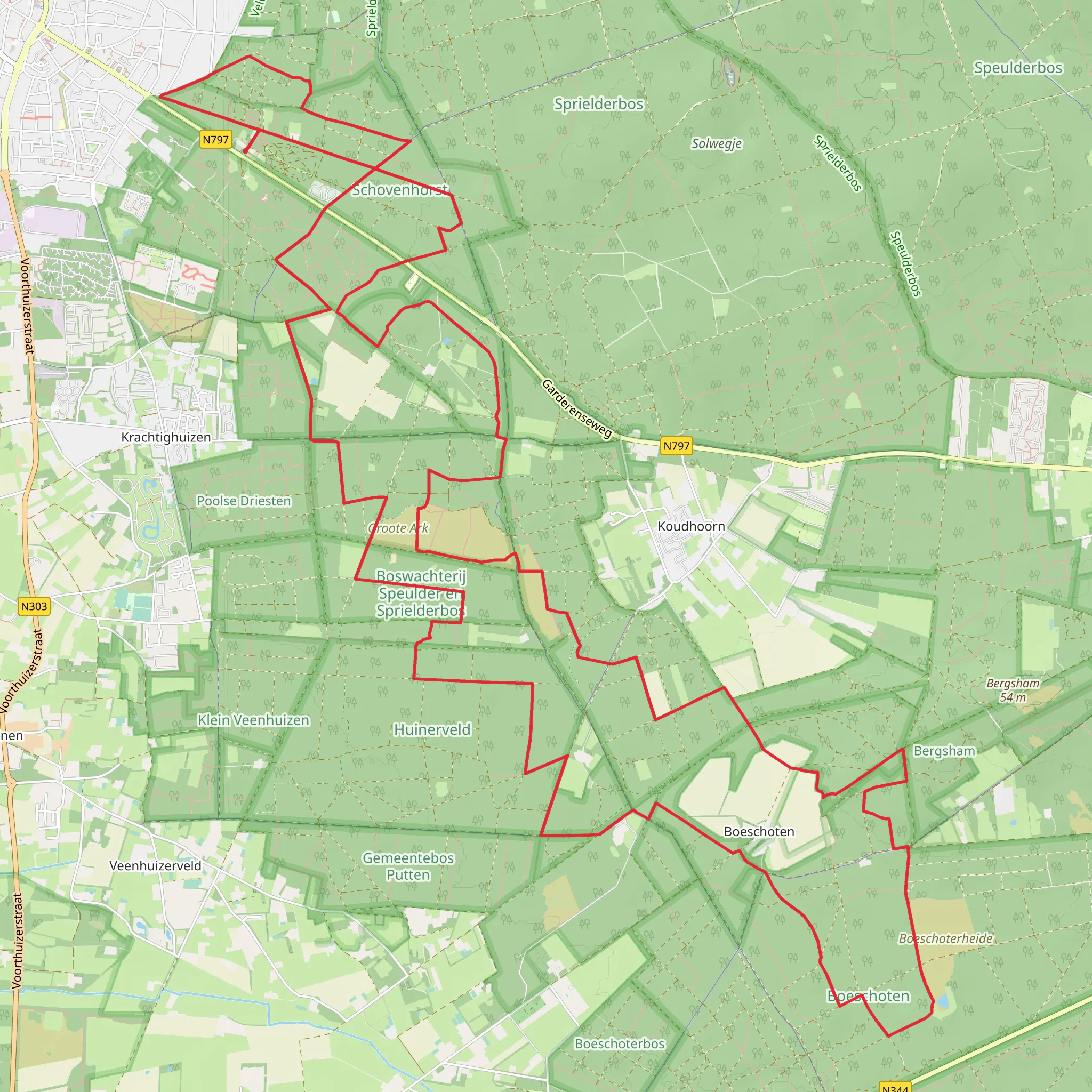
This easy, mostly level loop is a classic “Veluwe woodland-and-estate” day: long stretches of pine and mixed forest, sandy tracks, quiet lanes, and a rewarding mix of cultivated arboretum plantings and older, wilder oak woods. At around 23 km / 14.3 mi with roughly 0 m / 0 ft of climbing, it’s more about steady pacing than physical difficulty—ideal for a relaxed full-day walk with time to pause at viewpoints and estate landmarks.
Nearest start landmark / address (for planning): the most practical start is by the main access for Landgoed Schovenhorst, Garderenseweg 93, 3881 GK Putten, Netherlands (near the estate parking area and Brasserie). (schovenhorst.nl)
Getting to the start (car + public transport)
- By car: Navigate to Garderenseweg 93, 3881 GK Putten. Note that the estate indicates the parking area and some locations are about 500 m further toward Garderen from the address point, so expect a short walk-in before you’re properly “on the estate.” (schovenhorst.nl)
- By public transport: The nearest rail hub is Putten railway station (Putten sits on the Utrecht–Zwolle line). From there, you’ll typically continue by local bus/taxi and then walk the final approach to the estate entrance. (en.wikipedia.org)
For on-the-ground route-finding between stops and trailheads, load the loop in HiiKER before you arrive so you can adapt if you meet temporary forestry works or diversions.
You’ll be walking through the Veluwe landscape—one of the Netherlands’ best-known forest regions—so surfaces are often sand, compacted forest road, and occasional short paved connectors. After rain, sandy sections can feel slower and softer underfoot; in dry spells, they can be dusty.
What the walk feels like, section by section
0–5 km / 0–3.1 mi: Schovenhorst estate woods and arboretum character
Early on, you’re in the managed estate setting of Landgoed Schovenhorst, where the forest has a “collection” feel in places: conifers and specimen trees appear in deliberate groupings, and paths are generally well-used. Schovenhorst is known for its bomentuinen/arboretum and pinetum plantings, with historical development beginning in the mid-19th century and later expansions into multiple themed tree gardens. (upload.wikimedia.org)
If you choose to detour, the estate’s Bostoren (forest tower) is a standout landmark—an optional add-on that can break up the first hour with a panoramic look over the Veluwe canopy. (schovenhorst.nl)
5–13 km / 3.1–8.1 mi: Transition into broader Veluwe forest—long, quiet tracks
The middle miles are typically the most “cruisy”: long straight forest lanes, gentle curves through pine stands, and occasional openings where heather edges or younger woodland regeneration changes the texture of the walk. Because the elevation change is minimal, it’s easy to underestimate distance—plan a steady rhythm and short breaks rather than waiting for a “big climb” that never comes.
Wildlife is often most active at the forest margins and quieter tracks. In the wider Veluwe region, the commonly encountered large mammals include red deer, roe deer, and wild boar (often more visible early/late in the day). (hogeveluwe.nl)
Practical watch-outs here:
- Wild boar: give them space, especially if you see striped piglets; step off the track calmly and let them pass.
- Ticks: sandy forest with deer presence can mean ticks—use repellent, wear long socks, and do a check after.
AI Planner
Days planned around your pace, with somewhere to stay each night.
Surfaces
Unknown
Sand
Unpaved
Concrete
Grass
Gravel
Asphalt
Dirt
Cobblestone
Comments and Reviews
User comments, reviews and discussions about the Schovenhorst and Klein Boeschoten Loop, Netherlands.
average rating out of 5
0 rating(s)