
Download
3D Flyover
Add to list
More
45.8 km
2 days
0 m
Multi Day
“Follow ruler-flat dikes from UNESCO Beemster geometry into Eilandspolder’s watery bird-song under vast skies.”
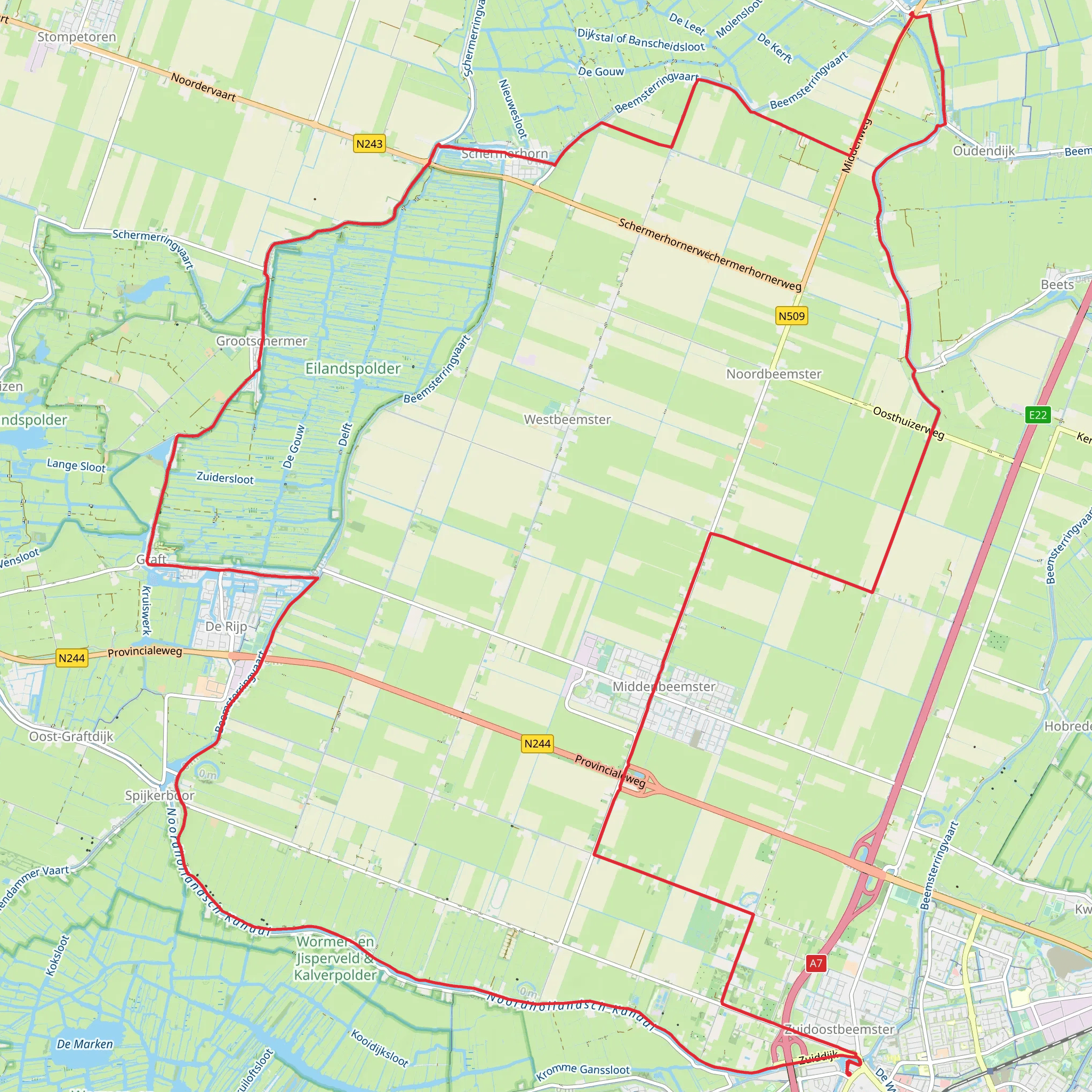
This is a long, flat polder circuit of about 46 km / 28.6 mi with essentially 0 m / 0 ft of climbing, linking two classic North Holland landscapes: the razor-straight, geometric fields and canals of Droogmakerij de Beemster (UNESCO World Heritage) and the open, wet meadow mosaic of the Eilandspolder. Expect big skies, long sightlines, constant water nearby, and a steady rhythm of dikes, farm roads, and quiet lanes rather than “trail” in the mountain sense.
A practical start point that matches the usual access for this area is by Fort bij Spijkerboor, Westdijk 46, 1464 PC Westbeemster (near the hamlet of Spijkerboor). (whc.unesco.org)
Getting to the start (car + public transport)
By car
- Navigate to Fort bij Spijkerboor, Westdijk 46, 1464 PC Westbeemster. This puts you right on the Beemster ring dike with immediate access to the dike-top walking lines and the transition toward the Eilandspolder. (whc.unesco.org)
- Parking is typically along designated areas near the fort/approach roads; keep access lanes clear for farm traffic and emergency vehicles (common in dike landscapes).
By public transport - The region sits north of Amsterdam in North Holland, with the nearest larger hubs typically being Purmerend and the villages in/around Beemster. From there, you’ll usually finish with a bus + a walk or a short taxi ride to the fort area. (For exact stop names and the cleanest foot-legal approach lines, build the route in HiiKER so you can see which dike segments and connectors are walkable end-to-end.)
What the walking is like underfoot
- Surface: mostly firm dike-top paths, paved or compacted farm roads, and grassy verges. After rain, grassy edges and field-side tracks can be slick.
- Exposure: there’s very little shelter. Wind is the main “difficulty multiplier” here—plan layers even on mild days.
- Navigation: the landscape is a grid of canals and straight roads; it’s easy to drift onto a parallel lane and not notice for a while. Load the loop in HiiKER and use it to confirm each canal crossing and dike turn, especially where multiple bridges sit close together.
The route flow and key landmarks (approximate)
0–8 km / 0–5 mi: Fort and ring-dike walking
Starting near Fort bij Spijkerboor, you’re immediately in the Beemster’s defining feature: the ring dike and ring canal that hold the reclaimed land in place. The fort itself is part of the wider defensive system that protected Amsterdam’s approaches; several forts in Beemster were built between the late 19th and early 20th century as part of the Defence Line of Amsterdam context. (whc.unesco.org)
You’ll notice how “engineered” everything feels: straight lines, measured spacing, and long, ruler-flat horizons.
8–24 km / 5–15 mi: Into the Eilandspolder—wet meadows and bird country
As you transition toward the Eilandspolder, the feel changes from strict geometry to a softer, wetter patchwork of ditches, reed edges, and meadow parcels. This area is widely known for meadow birds—depending on season you may see or hear species such as lapwing, redshank, curlew, oystercatcher, and black-tailed godwit. (birdingplaces.eu)
Bring binoculars if you enjoy wildlife: the openness makes distant birds easy to spot, but details are far away without optics.
What to look out for here - Ground-nesting birds (spring/early summer): stay strictly on paths and dikes; dogs should be leashed if allowed where you are walking. - Narrow bridges and dike edges: many crossings are single-file with steep drop-offs into water. - Livestock: cattle and sheep are common; give them space and don’t block gates.
**24–38 km
AI Planner
Days planned around your pace, with somewhere to stay each night.
Surfaces
Unknown
Asphalt
Wood
Comments and Reviews
User comments, reviews and discussions about the Beemster and Eilandspolder Loop, Netherlands.
average rating out of 5
0 rating(s)


